
Jumping into special missions

For some aviators, the path into a career in special missions can come later in life, after working in the military or commercial flying. Oliver Cuenca speaks to four such people about their experiences
While some professionals in the aviation sector may be happy to work in more traditional fields such as commercial operations or the military, others feel the need to find a more offbeat use of their skills. For those people, the special missions sector may offer the change of pace they are looking for.
Why make the jump?
For Tarryn Ryan, Human Performance Manager and Pilot at LifeFlight Australia, transitioning to helicopter emergency medical services (HEMS) felt like a “natural next step”, after serving for 11 years in the South African military.
“My experience in search and rescue (SAR) operations had given me a strong interest in that type of flying,” she explained, “so moving to a HEMS operation made sense. And I felt like I was giving back to my community.”
Jill Pritchard, Chief Flight Nurse at Flight Medic UK, told AirMed&Rescue about her own journey, having started out as a registered flight nurse, before joining the Royal Air Force (RAF) Reserve in 1993.

“I decided I wanted to do something different with my nursing,” she explained, adding that she was placed with 4626 Aeromedical Evacuation Squadron, based at RAF Lyneham.
“I trained as a flight nurse, and for 18 years, I flew hundreds of missions within that role,” she explained. After almost two decades serving with the RAF Reserve, she felt ready to move back into civilian life. “I decided that I would try and take my RAF qualifications and experience, and put them into a civilian equivalent role,” she said.
I decided that I would try and take my RAF qualifications and experience, and put them into a civilian equivalent role
For Constable Kevin Heidt, a Pilot with the Edmonton Police Service (EPS) Flight Operations Unit, leaving the military was a chance to settle down, but going into special missions flying was never guaranteed.
“I didn’t join Edmonton Police to be a helicopter pilot; I joined Edmonton Police to be a police officer with a helicopter background and a chance to fly the helicopter at some point potentially in my career,” he explained. “Nothing’s ever guaranteed for sure. So making that jump was more so about making the jump to be an Edmonton police officer – and the flying aspect was a nice bonus on top of that.
“I loved military aviation,” he continued. “It was fantastic. I think anybody who’s in military aviation would agree that the flying is by far the best flying you’ll ever do. It was exciting, dynamic. You had to fly low level, especially in army aviation. You fly at night. Yeah, it was awesome.
“And I tapped off my career in Iraq, which was, again, fantastic. But the overarching thing with military aviation, especially army aviation in Canada, is you’re always away. So in the end, as nice as the flying was and as fun as it was, and the crews and the people were outstanding and the missions were some of the best times in my life, I couldn’t be away from home anymore. I was done with that part of my life, and the last two years flying, I was gone for nine months and I think 10 months in back-to-back years.”

Captain Iain Davidson, Senior Pilot for Fixed-Wing at the UK’s National Police Air Service (NPAS), said that while the “element of excitement” was a factor in making the jump to law enforcement flying, the most significant reason was a desire to do something he felt was more “worthwhile or societally beneficial”.
The decision was inspired in part by his time “doing maritime rescue coordination work,” he explained. “That had always stuck out as one of the most gratifying jobs I’d had. Because, you know, when you have a good day, you have an exceptionally good day. You get to go home feeling that you’ve really made a tangible difference in some small way.”
When you have a good day, you have an exceptionally good day. You get to go home feeling that you’ve really made a tangible difference in some small way
However, beyond this, he said that the style of flying carried out by NPAS appealed as a “really interesting technical challenge – the survey and the special operations side of it”.
How is it different from what you were doing before?
Ryan explained that one of the biggest differences between flying as part of a HEMS team and being in the military is the smaller scale of operations – meaning that pilots will usually take on more responsibilities beyond just flying.
“For example,” she said, “you might assist with loading a patient, refueling, and other admin roles. As the pilot in command, you assume control of the entire mission.”
Despite this, Ryan noted that there are some similarities between military and civilian special missions operations – in particular, “the dynamic nature of the job, which requires quick decision-making and the ability to be flexible”.
Pritchard added that many of the experiences she had had in the RAF Reserve – such as using aircraft to transport sick and injured personnel and their dependents – is “exactly” what she does in her current role.
“The process of repatriation is very similar between the military and civilian roles – really the only difference is the paperwork,” she said.
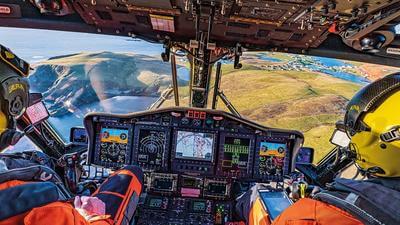
“I really had a 360-degree journey, taking my nursing skills to the RAF, then acquiring my aeromedical nursing skills and then taking those skills back into the civilian sector.”
Heidt explained that, for him, the biggest difference between army and police aviation is the frequency of deployment. “In Edmonton, I could be called to go help at any moment,” he explained, “whereas in army aviation, your main job, you only do on rare occasions. You do a lot of training – your life is training, until you get the opportunity to do your job.”
Despite this, Heidt added, the “actual flying is very similar” in both military and police aviation, with the focus on assisting personnel on the ground. “I’m just the guy flying … to help the guys on the ground do their job.”
Davidson said that one thing that makes his current role different from previous work he has done is “how dynamic it is”.
In other forms of aviation, he said, “you’re flying a scheduled route, and it’s planned well in advance. And you fly to the brief, and that’s the way you make it as safe as possible.”
With NPAS, by contrast, the “majority” of flying is responsive. “So you complete the shift brief, and then you go on readiness, and then the phone goes and you have to get airborne as quickly as possible, to a location that you don’t know yet,” he explained. “Whereas if you do that in most operations, it’s a chat with the chief pilot without tea and biscuits because it’s called going off half-cocked!”

What advice would you give to people looking to make the jump into special missions aviation?
For those looking to transition into special missions aviation, Ryan offered three key pieces of advice.
“Connect with experienced pilots in the field, seek mentorship, and learn about different career paths,” she said. “Be adaptable and open to learning. Whilst there are a lot of similarities, be sure to understand what the differences are and how to adapt to the new environment.”
Be adaptable and open to learning
And finally: “Military training provides a solid foundation. Leverage the skill set gained from military flying and adapt it to the new operating environment.”
Pritchard said: “I would say to anyone in military aviation, whatever their trade or branch, wishing to transfer their skill set to the civilian world, definitely go for it, don’t give up. There is a place waiting for you.”
She noted that, for her, the transition was initially challenging, “as most civilian air medical repatriation companies focus on certain qualifications”. However, she explained that there are companies, such as Flight Medic UK, that “appreciate and embrace” military experience and qualifications.
Heidt added: “My biggest advice … is that if you’re joining [the police] to be a helicopter pilot, you’re joining to be a police officer, and you have to be willing to say, are you willing to be a police officer first?”
Davidson offered this advice to those seeking to move into special missions: “Keep an open mind, and a sense of humor, and explore things!
Keep an open mind, and a sense of humor, and explore things
“Before I got put on to it, I had no idea that the police had planes anymore. And it is by far and away the best job I’ve ever had,” he said. Davidson added that those looking to make a change in their career should “explore new ideas, follow paths of interest, and … gain lots of experience. Then when you stumble across something that’s a bit off the beaten path, you’re going to be better equipped to actually do it.
“All of that will mean you’re more likely to find the interesting special missions side of it, but also be better set up to be the correct sort of person to do it, I think,” he concluded.
June 2025
Issue
Our June edition covers a range of articles with a wealth of experiential information in the features, such as search and rescue as a career route, the latest night vision technology, the increasing popularity of drones for firefighting, the importance of helmets in special missions, why diversity matters in aviation, and why switching to special missions as a job is more fulfilling; plus we have more of our regular content.
Oliver Cuenca
Oliver Cuenca was a Junior Editor at the Voyageur Group. He was previously a News and Features Journalist for the rail magazine IRJ until 2021, and studied MA Magazine Journalism at Cardiff University. His favourite helicopter is the AW169 – the workhorse of the UK air ambulance sector! He also led the creation of Waypoint: The AirMed&Rescue podcast, serving as its Production Editor and co-host.