

Leading the fight against wildfires

With decades of experience fighting fires, Avincis is supporting, leading, and innovating the industry to make sure that Europe is sufficiently adept to face the challenges ahead. Jon Adams explores how this special missions operator is effecting change
In light of a new 2026 report by the European Scientific Advisory Board on Climate Change, ‘Strengthening resilience to climate change – Recommendations for an effective EU adaptation policy framework’, the outlook is clear: climate change is increasing global temperatures and Europe specifically should prepare for higher levels of warming than the rest of the world. The prediction is that, in the next 75 years, there will be a rise in climate risks resulting from a 2.8–3.3°C increase in global temperature compared with the pre-industrial period, and Europe will be heating up roughly twice as quickly. Global average temperatures have already risen to around 1.4°C above pre-industrial levels. The effect of this on Europe has meant that two-thirds of the approximately 24,000 premature deaths from extreme heat in summer 2025 alone have been attributed to climate change. These deaths are not in isolation; rising temperatures are creating the conditions for more flooding, storms, droughts, coastal erosion, rising sea levels, and wildfires.
The consequences of this are obvious, and the report summarizes five recommendations: climate risk assessments should be integrated into relevant European Union (EU) policies and decision-making processes; there should be a common reference for adaptation planning; there should be a clear vision for a climateresilient Europe by 2050, based on science, commitment, and participation; climate resilience should be embedded by design into all EU policies and measures; and climate risk management should be embedded into economic governance and fiscal planning, leading to strengthening the crisis response and recovery instruments in the face of more frequent and severe climate-related disasters.
HELPING IN A CRISIS
Working with governments and key stakeholders for over 60 years in airborne special missions, such as helicopter emergency medical services, air ambulance, search and rescue, and firefighting, as well as offshore services and maintenance, repair and overhaul, Avincis is an expert organization designed to help attend to populations experiencing almost any emergency. Avincis has almost 200 bases across Europe, in addition to two bases in Chile and another in Mozambique. The bases are served by 210 aircraft (of which there are 170 helicopters and 40 fixed-wing craft) composed of aircraft from the original equipment manufacturers (OEMs) Leonardo, Airbus, Bell, Textron, and De Havilland.
One of the key and most immediately evident results from climate change is the increase in the length of the fire season, the number of wildfires within the season, and the size and unpredictability of the fires themselves. Battling wildfires means engaging better firefighters, more of them, and more frequently. The experience and services that Avincis has in the firefighting sector cannot be overlooked when the forecast for rising temperatures and increasing wildfires is so dire. The company has 2,500 staff across the world, and completes approximately 55,000 lifesaving missions every year. With over 50 customers worldwide, the commitment and dedication to public service is evident. Key customers for firefighting alone include the wildfire prevention and response agency of the Andalusian government in Spain (INFOCA), the Spanish Ministry for Ecological Transition and the Demographic Challenge (MITECO), the Vigili del Fuoco, Italy’s national fire and rescue service, and the Chilean National Disaster Prevention and Response Service (Servicio Nacional de Prevención y Respuesta ante Desastres; SENAPRED), not to mention engagement with rescEU, the program that is part of the EU Civil Protection Mechanism, whereby firefighting assets are relocated to partner countries in the instance of a wildfire outbreak that they are unable to fully attend to on their own.
Avincis has almost 200 bases across Europe, in addition to two bases in Chile and another in Mozambique. The bases are served by 210 aircraft, of which there are 170 helicopters and 40 fixed wing craft
A STRONG CORE
Avincis’ headquarters in Lisbon, Portugal, provide it with a strong base to coordinate its operations across Europe, as well as affording it with the local knowledge and connections to ensure that its operations and missions serve local populations to the best of its abilities. Avincis is proud to be on call 24 hours a day, 365 days a year, recognizing that emergencies occur regardless of the time of day or day of the week. The breadth of the geographical locations of its bases means that it is able to efficiently deploy assets to local disasters, but also to quickly and effectively meet the needs of neighboring countries in distress.
Working across Europe is more than simply doing a job on site; the missions, connections and history in the regions to which the company belongs lead to collaboration with customers and also with the other operators and agencies. The sharing of the special missions environments, especially during large-scale events and catastrophes, is an opportunity for relationship building, and learning and teaching, so that future emergency responses can be performed and coordinated by all stakeholders better and more effectively, helping to, for example, continuously strengthen Europe’s resilience to the ever-growing threat of wildfires.
As well as the operational crew that address the lifesaving missions on a day-to-day basis, Avincis also employs an expert research and development team to evolve innovative technologies to enhance operations and services, as well as improve the training capabilities for pilots, crew, and engineers.
A STRONG FIREFIGHTING FORCE
Avincis is not happy to simply be a reactive company; rather, its attitude to fighting wildfires is to take the lead and get ahead of the problem. An example of this is its recent joint initiatives with De Havilland Aircraft of Canada, and the support of the Canadair CL-215, CL-215T and CL-415 water-scooping aircraft platforms. Avincis is the largest private operator of Canadairs globally, operating 18 CL-415s and five CL-215s. The initiatives involve Avincis transferring ownership of its Automatic Dependent Surveillance-Broadcast (ADS-B) system and flight management system (FMS) supplemental type certificates (STCs) for the CL aircraft to De Havilland for inclusion in its spare parts catalogue, thereby providing access to critical system solutions for all CL aircraft operators, helping to strengthen the wildfire response for everyone, and proving that Avincis cares about the mission first regardless of who performs it. Avincis and De Havilland will also work together on developing Avincis-led modification opportunities with the CL platforms.
Brian Chafe, De Havilland Canada’s Chief Executive Officer, said: “We welcome the opportunity to better serve our customers with Avincis, one of the largest operators of our aerial firefighting aircraft. This agreement also recognizes the power of collaboration when new modifications are being considered.”
“Avincis is looking forward to working collaboratively with De Havilland Canada on delivering high-quality solutions for our customers,” said John Boag, Avincis’ Group Chief Executive Officer. “We are very proud to have operated and maintained the biggest fleet of CL-415s in the world for more than 20 years. As a result of this experience, we have built a robust maintenance, design and engineering capability and infrastructure that will serve worldwide CL operators well as part of this new agreement.”
Reflecting the tragic statistics from the European Scientific Advisory Board on Climate Change report, during the 2025 European summer, Avincis completed 10,100 flying hours and 52,600 drops, equivalent to 176.5 million liters of water across Spain, Portugal, and Italy with both fixed-wing and rotor-wing aircraft. The close ties with De Havilland were evident as Italian Canadair CL-415 crews flew 4,800 hours, the second busiest season in five, averaging 12 planes a day being called out to support firefighting operations, reaching a peak of 17 aircraft tasked at the same time. 2025 was the busiest year for five years regarding activations with rescEU, with a total of five missions sent to four different countries – Albania, Montenegro, Spain, and Greece – as well as one mission to Israel.
Last year also saw Avincis being awarded the Portuguese government contract to continue operating three Canadair CL215 aircraft, two primary and one backup, valid for three years until 2027. The aircraft are integrated into the national firefighting response system (DECIR) and mobilized whenever necessary. Avincis has been flying CL aircraft in Portugal for more than 20 years. Over the past three years, the Avincis firefighting fleet has flown nearly 900 hours on missions across the country.
The three Canadair CL-215 aircraft are operated on behalf of the National Emergency and Civil Protection Authority (ANEPC), strengthening the aerial firefighting capabilities at the service of the Portuguese state to fight rural fires.
Aerial firefighting craft that are in use at the moment exist in a replacement rather than a growth phase
A HOTTER EUROPE
Avincis has a strategy and is leading the call for action to ensure that Europe is prepared for the increase in wildfires as a function of climate change. In the report ‘Up in flames: The challenges of fighting wildfires from the air in a hotter Europe’, Avincis identifies some of the same issues brought to fore by the European Scientific Advisory Board on Climate Change. The report outlines the challenges faced by Europe, such as beginning the structural reform needed to secure a robust continent-wide emergency response system, as well as the need for better organization and harmonization to help reduce delays in procurement and reliance on the public sector while at the same time focusing on prevention strategies rather than fire suppression. The report points out the problem of a relatively small available firefighting fleet – not just the platforms themselves, but also the pilots, crew and mechanics. Furthermore, the report shows that due to the slow delivery times of new aircraft into active fleets, the aerial firefighting craft that are in use at the moment exist in a replacement rather than a growth phase.
Avincis wouldn’t be who they are if they just identified problems; instead, the report also details the key structures that need to be in place to improve and enhance aerial firefighting provision in Europe. The report states that governments are a central figure in ensuring that supply chains are functioning to supply firefighters with the parts and tools they need to be adequately equipped. Avincis also points to the Australian model whereby early detection of fires and thoughtful pre-positioning of standby craft can mean the difference between fighting and containing a small fire and being unable to control a raging inferno. Highlighted is also the interoperability and the connectivity between air and ground assets. Air support can only effectively support ground efforts if strong communication and coordination allows the complementary resources to work together. Lastly, the report brings the point forward that this isn’t just a European problem; there needs to be an intercontinental approach to efficient coordination, cooperation, and resource sharing to help with surges in demand.
A PATH FOR THE FUTURE
There can be no denying that aerial firefighting in Europe and around the world is going to be in greater demand as the climate changes to hotter seasons. There are established companies with assets ready to combat the fires that are due, but as wildfires get bigger and less predictable, organizations like Avincis with its decades of experience and the European Scientific Advisory Board on Climate Change call upon governments to permit regulatory reform and increase forward planning to bolster resilience, preparedness, and cooperation between nations to enhance the capabilities of the global firefighting community.
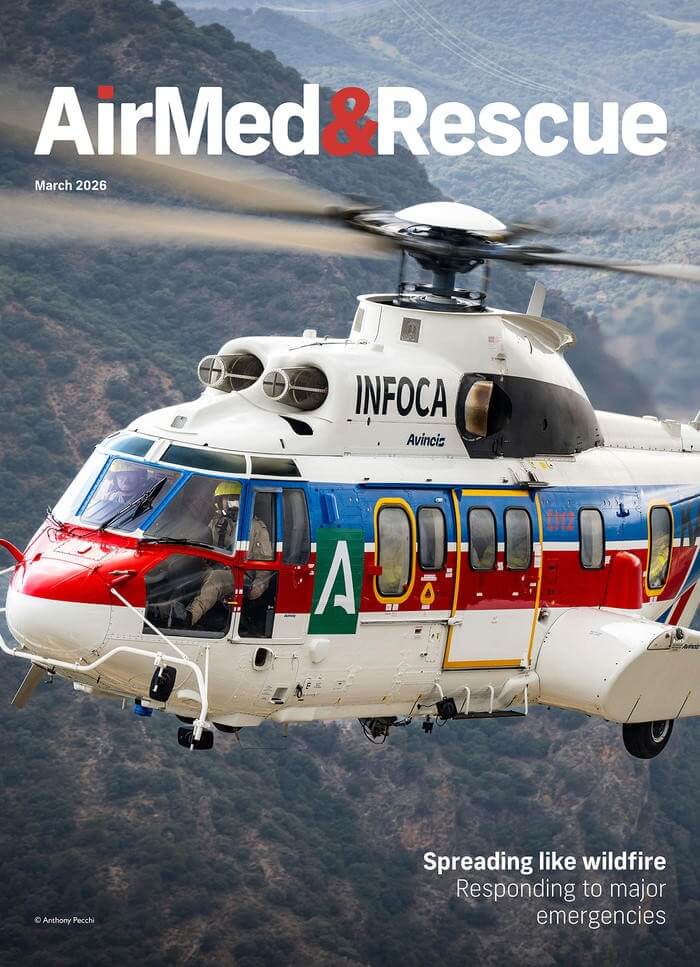
March 2026
Issue
This edition is bursting at the seams with articles from all corners of the special missions sector. We have features on the California wildfires that ravaged the state last year, what the cost–benefit analysis looks like for single-engine rotorcraft and autorotations, how the mission dictates the modification needed to the platform, and what can be done to further prevent the problems associated with inadvertent entry into instrument meteorological conditions.
Editorial Team
The AirMed&Rescue Editorial Team works on the website to ensure timely and relevant news is online every day. With extensive experience and in-depth knowledge of the air medical and air rescue industries, the team is ready to respond to breaking industry news and investigate topics of interest to our readers.