
Lessons learned from qualification testing

Nathan Herbert, Director of Hardware Development at Smith Myers, explains why the failures that never reach the aircraft are often the most valuable lessons of all
Qualification testing is sometimes viewed as a hurdle. A box to tick. An expense that delays deployment. But after decades of developing equipment, I see it very differently. No one likes sharing their failures, but I view every failure as an important lesson learned, and qualification testing is where aviation engineering learns the truth.
Aircraft do not care about good intentions. They do not care that something ‘worked fine on the bench’. They only respond to what survives the real airborne environment.
Some of the most important lessons I have learned in my career have come not from successful flights or lifesaving missions, but from failures uncovered during DO-160 environmental qualification.
In engineering, progress is often built on discovering what does not work. Failure, when it happens in a controlled test environment, is not a setback, it is knowledge. It is an opportunity to correct problems before they ever reach an aircraft, a crew, or a mission.
Failures that never made it onto an aircraft. That is the point.
ALTITUDE IS A DIFFERENT ENVIRONMENT
The first lesson is simple: airborne changes everything.
Altitude, temperature cycling, vibration, shock, moisture, electromagnetic complexity, these conditions expose weaknesses that are invisible in ground testing. Equipment can appear robust in a laboratory and still fail once subjected to combined stresses.
A memorable personal example involved a simple sealed radio frequency (RF) relay. At ground level it behaved perfectly. Every functional test passed. There was no indication of a problem.
But during qualification testing, at altitude in the chamber, the relay began to stick. Back to sea level and everything was fine. We learned that at low atmospheric pressure, the relay subtly mechanically deformed and couldn't actuate reliably.
That is not a fault you would ever discover in a workshop. Yet in service, it would have resulted in a mission critical failure and weeks, if not months of expensive, time-consuming debugging. Testing caught it early, and the design was corrected before it ever reached an operational aircraft.
That is the value of qualification.
BEWARE OF PERSISTENT VIBRATION
Another lesson is that vibration is relentless.
Rotorcraft environments in particular are unforgiving. A connector that feels secure on the bench may loosen under sustained vibration. A mounting arrangement that looks perfectly adequate may allow fatigue to develop over time. Harmonics are an insidious enemy.
Vibration does not always cause dramatic failure. More often it causes intermittent faults, the most difficult kind to diagnose once equipment is deployed.
Qualification testing forces those issues into the open.
CONSIDER ELECTROMAGNETIC COMPATIBILITY
A third lesson is that electromagnetic effects are often underestimated.
Modern mission aircraft are crowded with radios, avionics, navigation systems, sensors, and specialist equipment. Introducing a new device into that ecosystem is never neutral.
Unexpected RF coupling, susceptibility, or emissions can sometimes appear only when everything is operating together. These are subtle interactions, and they are exactly why DO-160 includes rigorous electromagnetic compatibility (EMC) and RF testing.
I have also seen what can happen when unqualified equipment is installed because it appeared acceptable in ground conditions. In one case, competitor ground-based equipment that ‘worked fine’ introduced damaging, unexpected interactions with flight control hardware when installed on an aircraft, contributing to unwanted maneuvering and oscillation.
The aircraft was landed safely, but it was a costly lesson for the operators, and the potential consequences were serious.
Aircraft do not tolerate surprises.
DON’T TAKE SHORTCUTS
Another lesson is that cost and speed pressures are not and should not be engineering justifications.
It is increasingly common to hear arguments like ‘we can qualify it later’, ‘it works fine on the ground’ or ‘it’s close enough to something already flown’. Often the driver is budget. Sometimes it is schedule. Usually it is both.
But in aviation, cheaper is not always better. Shortcuts taken early tend to become far more expensive later.
At Smith Myers, developing airborne communication and location systems such as Artemis has reinforced this discipline. Search and rescue aviation is unforgiving. Reliability cannot be a hope. It must be proven.
Ultimately, the greatest lesson qualification testing teaches is this: the failures you find on the ground are gifts.
They are problems uncovered in a controlled environment, where they can be understood, corrected, and designed out. They are lessons learned without putting crews, operators, or patients in harm’s way.
In aviation, we do not have the luxury of learning through failure in the air. We must learn through failure in testing, where the consequences are manageable and the outcome is improvement.
That is why DO-160 qualification matters so much. Because once equipment is airborne, there are no second chances, only consequences.
Nathan Herbert
Nathan joined Smith Myers in 1998 as an apprentice and has since held key technical and customer focused roles. He now leads the company’s hardware design, development, and testing, playing a vital role in their transition into aerospace. Nathan was appointed to the board in January 2023, marking a new chapter in his longstanding dedication to the company and its vision.
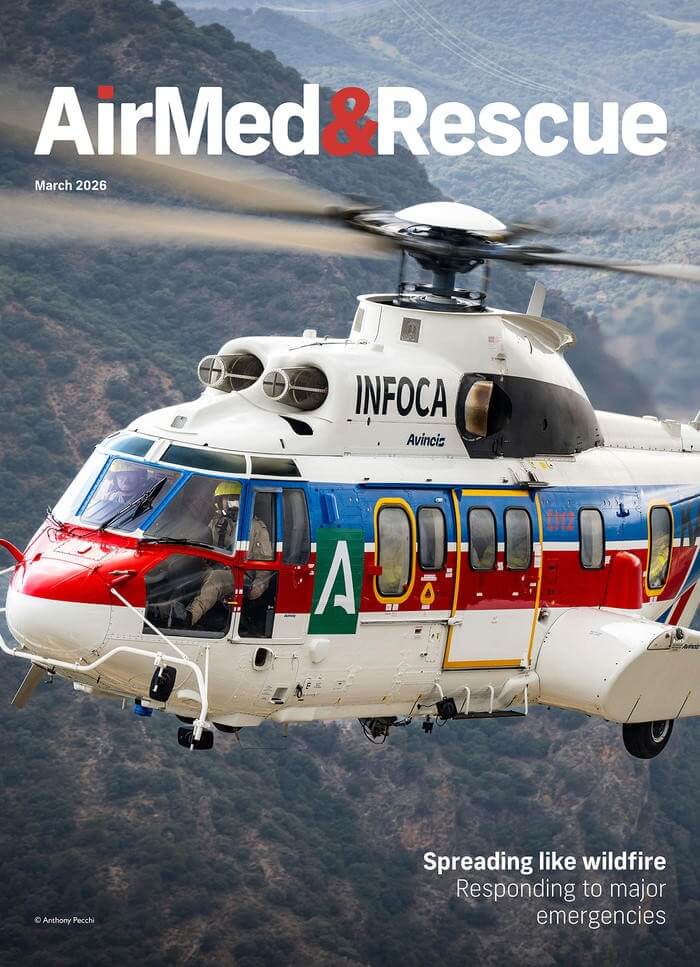
March 2026
Issue
This edition is bursting at the seams with articles from all corners of the special missions sector. We have features on the California wildfires that ravaged the state last year, what the cost–benefit analysis looks like for single-engine rotorcraft and autorotations, how the mission dictates the modification needed to the platform, and what can be done to further prevent the problems associated with inadvertent entry into instrument meteorological conditions.
Editorial Team
The AirMed&Rescue Editorial Team works on the website to ensure timely and relevant news is online every day. With extensive experience and in-depth knowledge of the air medical and air rescue industries, the team is ready to respond to breaking industry news and investigate topics of interest to our readers.