

Lifeseeker: supporting search and rescue operations

CENTUM’s airborne mobile phone location system helps search and rescue crews locate missing people, even in areas without cellular coverage
In many search and rescue (SAR) operations, finding the person is one of the hardest parts of the response. A helicopter can cover a large area, but dense vegetation, snow, mountainous terrain, or poor visibility can prevent crews from seeing someone on the ground. Lifeseeker provides another source of information by detecting and geolocating the missing person’s mobile phone from the air.
Developed by CENTUM, a Spanish technology company with more than 15 years of experience in airborne mission systems, Lifeseeker is designed to help SAR teams locate missing people using their mobile phones. CENTUM develops technology for emergency, security, and defense operations, with systems deployed in more than 30 countries.
How it works
Lifeseeker operates with or without cellular network coverage and supports technologies from 2G to 5G. The phone needs to be switched on, but the missing person does not have to make a call, know their coordinates, or install an app. This is particularly useful when someone is injured, unable to communicate, or outside the range of conventional mobile networks.
Lifeseeker can locate a mobile phone with an accuracy of up to 5m in less than 30min, and in many cases in under 15min. Crews can then focus the search on a much smaller area and coordinate with teams on the ground. Depending on the mission, the system can also support contact with the missing person by SMS or phone call, allowing rescuers to assess their condition and identify any immediate medical needs before reaching them.
Configurations for different missions
Lifeseeker is available in different configurations to meet operational requirements. Lifeseeker Mini is a lightweight solution suitable for uncrewed aerial vehicles (UAVs) and rapid deployment. The Lifeseeker SAR S10 is designed for short- to mid-range missions of up to 30km, while the SAR XL S10 supports longer-range operations of up to 50km, including maritime searches.
Integration into SAR aircraft
Lifeseeker is already used on a wide range of helicopters, including the Airbus H125, H135, and H145; Bell 412 and 429; and Leonardo AW139 and AW109. The system can operate independently or be integrated directly into an aircraft’s mission management system.
Line-fit integration is available on the Airbus H145, with additional integrations underway. This allows operators to incorporate Lifeseeker into new aircraft or existing fleets, depending on their operational requirements.
The system is designed for ease of use, with a web-based interface that guides operators through each step of the mission and supports remote operation.
“We work closely with the teams using Lifeseeker. Their experience in real SAR missions helps us improve the system and adapt it to their operational needs,” said Héctor Estévez, CEO of CENTUM.
To date, Lifeseeker has supported more than 1,000 successful missions and is used by over 50 civilian and military operators worldwide.
CENTUM will be exhibiting at EUROPEAN ROTORS 2026, where visitors can learn more about Lifeseeker and meet the team at stand 556.
Centum
CENTUM is a product-driven company specializing in airborne systems based on cellular technologies. Its solutions support search and rescue, intelligence, surveillance, and critical communications for emergency, security, and defense operations. Working closely with original equipment manufacturers (OEMs), operators, and partners, CENTUM develops reliable, easy-to-integrate systems for crewed and uncrewed aircraft.
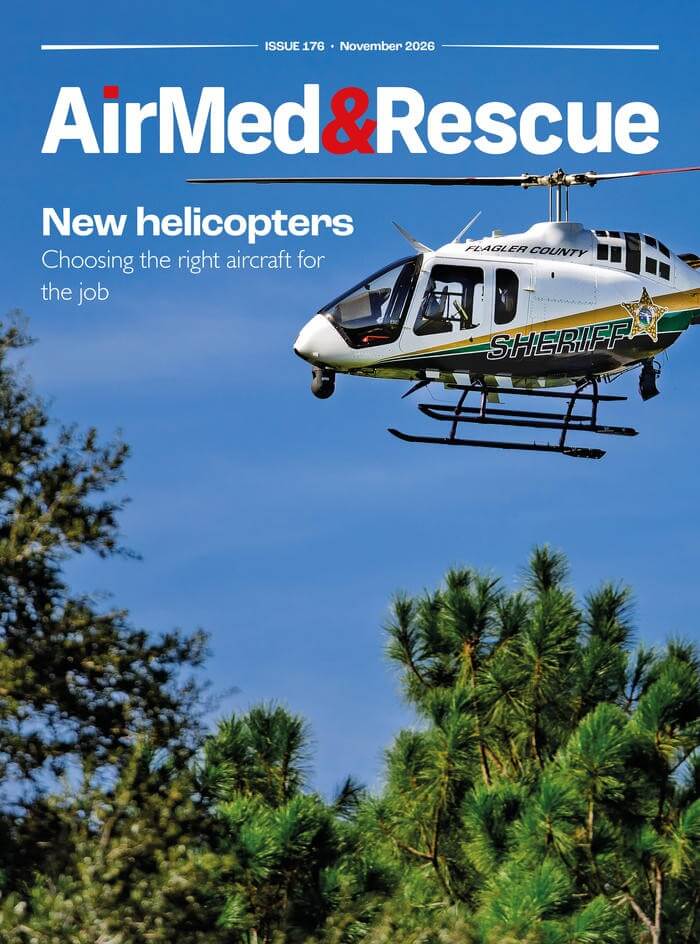
November 2026
Issue
The November edition of AirMed&Rescue has a wealth of articles to keep you informed and engaged. We have features that explore the challenges associated with cable snag and entanglement; determine how and why special missions operators choose a new helicopter; look at the risks, regulation, and requirements of temporary helicopter landing sites; and examine the inroads that are being made by the drone industry into the medical sector.
Editorial Team
The AirMed&Rescue Editorial Team works on the website to ensure timely and relevant news is online every day. With extensive experience and in-depth knowledge of the air medical and air rescue industries, the team is ready to respond to breaking industry news and investigate topics of interest to our readers.
