Make every training moment count

Bluedrop’s Hoist Mission Training System brings demanding rescue scenarios into a controlled training environment
A rescuer descends toward a moving vessel. The cable begins to swing. Above, the crew must coordinate every movement while someone below waits for help. In hoist operations, technical skills, clear communication, and sound judgment must come together under pressure.
The risks are real: cable entanglement, uncontrolled swing or spin, equipment malfunctions, and loss of communication can complicate an already demanding mission. The European Safety Promotion Network Rotorcraft’s hoist training guidance, published by the European Union Aviation Safety Agency (EASA), emphasizes preparation for these threats alongside situational awareness, decision-making, and crew coordination. Building proficiency requires practice beyond routine lifts.
Train for the moments that test your crew
Live aircraft training remains essential, but some emergencies are too dangerous, impractical, or costly to recreate in flight. EASA’s simulator training guidance highlights the value of simulation in preparing crews for these situations, allowing them to rehearse their responses before an unfamiliar event becomes a real emergency.
Bluedrop’s Hoist Mission Training System (HMTS) brings preparation to hoist operators through immersive virtual and mixed reality, hands-on cable interaction, and realistic mission environments. Crews can practice demanding rescue and hoisting operations without exposure to the risks associated with airborne training.
Realism you can see – and feel
Effective hoist training requires more than convincing visuals. HMTS combines a live cable with responsive haptic feedback and realistic cable dynamics that respond to flight dynamics and operator inputs. Trainees practice managing swinging loads while developing the physical skills and situational awareness that their missions demand.
Training can progress from foundational skills to advanced mission rehearsal, incorporating varied environmental conditions, night vision scenarios, and mission changes introduced during an exercise. HMTS can operate independently or integrate with flight training devices, enabling pilots and hoist operators to practice communication and crew coordination together. For training organizations, this means:
• Purposeful repetition: revisit challenging tasks and reinforce procedures in a controlled environment
• Stronger crew coordination: practice the communication essential to aircraft positioning and hoist operations
• Broader preparation: rehearse demanding scenarios that are difficult to reproduce safely in flight
• Better use of resources: Develop skills with less reliance on aircraft availability and lower operating costs than live flying.
Turn practice into measurable progress
Bluedrop’s IMPACTS performance analytics tools support instructor assessment with recorded performance data. By capturing actions and responses within the simulated mission, IMPACTS supports focused debriefings, helps identify skill gaps, and gives trainees a clearer understanding of where improvement is needed. Instructors can use those insights to guide subsequent training.
When the next rescue call comes, crews draw on what they have practiced. HMTS helps make that preparation more realistic, repeatable, and relevant to the demands ahead.
Your next rescue starts with how you train
Meet the Bluedrop team at I/ITSEC, booth 663, or European Rotors, stand 763, to discuss your crew’s training requirements. Contact [email protected].
November 2026
Issue
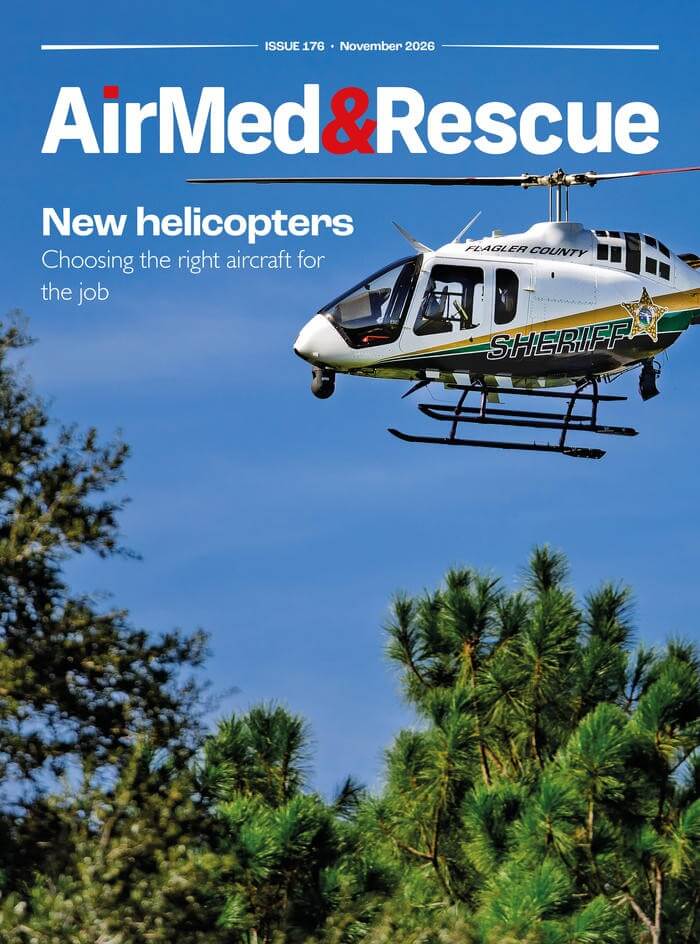
The November edition of AirMed&Rescue has a wealth of articles to keep you informed and engaged. We have features that explore the challenges associated with cable snag and entanglement; determine how and why special missions operators choose a new helicopter; look at the risks, regulation, and requirements of temporary helicopter landing sites; and examine the inroads that are being made by the drone industry into the medical sector.
Editorial Team
The AirMed&Rescue Editorial Team works on the website to ensure timely and relevant news is online every day. With extensive experience and in-depth knowledge of the air medical and air rescue industries, the team is ready to respond to breaking industry news and investigate topics of interest to our readers.