
Maximizing helicopter readiness: integrated simulation for mission and maintenance training

Slyvain Rid highlights the latest training solutions from REISER Simulation and Training and shows how integrated simulation environments can enhance mission capability, reduce reliance on live aircraft, and improve training efficiency across pilot, crew, and maintenance domains
Military aviation is under growing pressure to maintain high levels of operational readiness despite limited aircraft availability, rising costs, and stringent safety requirements. Live training remains indispensable, but it is resource-intensive, constrained by operational limitations, and often impractical for the repeated practice of high-risk or lowfrequency scenarios.
NH90 simulation programs provide a strong example of how simulation-based training devices contribute to aircraft readiness across different training domains. Within this broader landscape, maintenance training is one area in which REISER supports readiness with its fullscale NH90 Maintenance Training Rig (MTR).
The NH90 MTR enables maintenance crews to practice a wide range of procedures without relying on operational helicopters and supports qualification training up to category B1 and B2 standards. It replicates the aircraft to a high level of detail and covers more than 1,500 maintenance training tasks, including complex procedures that are difficult to rehearse under real-world conditions.
The practical benefit is immediate. By shifting hands-on maintenance training away from live aircraft, operators can significantly increase training throughput while preserving fleet availability. Maintenance personnel can repeat critical tasks in a controlled environment, including procedures that would be too risky and too costly to carry out on operational platforms. This directly improves safety and supports the more efficient use of high-value assets.
Aircraft readiness extends far beyond maintenance alone. Modern operations require effective coordination between pilots and rear crew, which in turn calls for training environments that accurately reflect both aircraft behavior and mission context. Integrated simulation enables multi-crew training in realistic, repeatable scenarios, independent of airspace restrictions and other operational constraints.
Extended reality technologies add a further layer of flexibility to selected applications. REISER focuses on solutions that combine physical interaction with virtual elements to deliver clear operational value. The helicopter hoist simulator hoistAR® is one example, providing realistic procedural training with tactile feedback while benefiting from the adaptability of synthetic environments. By interacting with full-flight simulators, hoistAR® also enables crew coordination training, placing hoist operator and pilot in the same training scenario. This approach demonstrates how immersive technologies can complement established training systems.
REISER’s recently qualified H145 D3 XR Simulator reflects this development. Combining XR goggles-driven immersive visualization with a fully haptic cockpit, it supports realistic mission and multi-crew training. Following successful qualification by the German Federal Aviation Authority (LBA) to European Union Aviation Safety Agency (EASA) flight training device (FTD) Level 3 standard, the device demonstrates how XR-based simulators can provide a high-quality training environment with clear operational value.
This broader training architecture is increasingly supported by digital tools designed to improve efficiency and transparency. REISER’s learning management system, simplAIR®, enables training organizations to structure, monitor, and optimize training processes across roles and locations. Capturing interaction data and identifying individual weaknesses enables more precise tailoring of training, improving learning outcomes while enabling instructors to focus on individual trainees’ needs.
Taken together, these elements form a connected training ecosystem that directly enhances safety and aircraft readiness. By reducing dependence on live aircraft, increasing training availability, and supporting targeted, data-driven learning, integrated simulation helps maintain high levels of mission capability under increasingly constrained conditions.
Sylvain Rid
Sylvain is Business Line Manager at REISER, where he has held a range of leadership roles over the past 16 years, including Project Manager and Head of Projects and Systems Engineering. With a background in mechanical engineering, he combines technical expertise with broad experience in simulation and training solutions.
May 2026
Issue
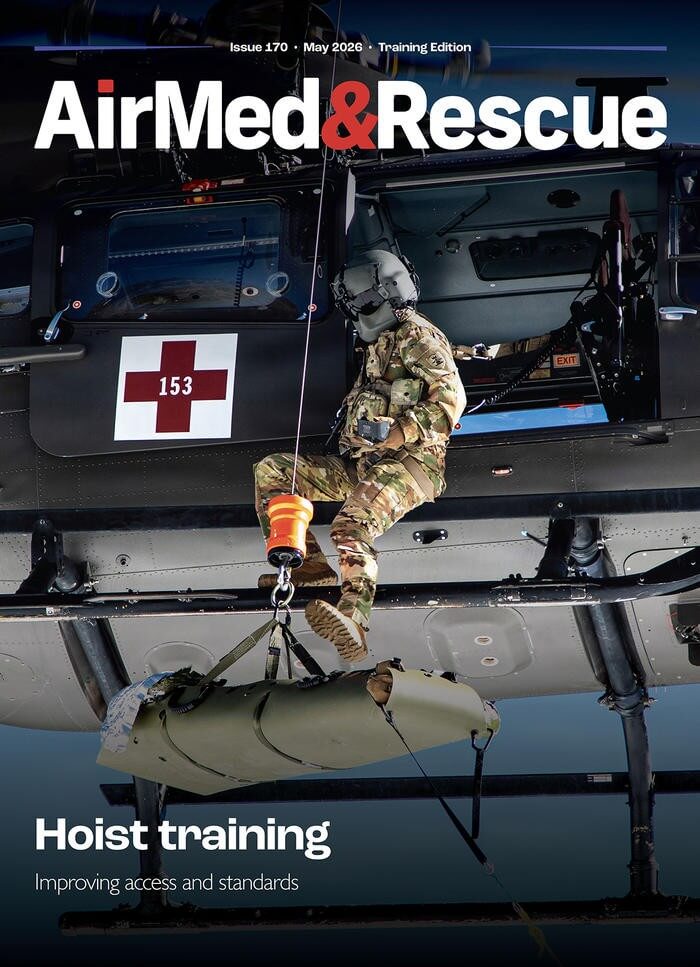
Training for special missions is on another level, so it’s a great pleasure to bring you the training edition of AirMed&Rescue for May. We have features on night flights for police aviators; the simulators for military special missions training; the systems and scenarios for hoist operations; and engineering training for airframe and powerplant mechanics.
Editorial Team
The AirMed&Rescue Editorial Team works on the website to ensure timely and relevant news is online every day. With extensive experience and in-depth knowledge of the air medical and air rescue industries, the team is ready to respond to breaking industry news and investigate topics of interest to our readers.