Meeting the demand for more and safer training

Matt Presnal, Chief Theoretical Knowledge Instructor at Coptersafety, who oversees all its theoretical training programs, shares his experience of the development of training modalities and why this has affected Coptersafety’s decision to expand its service provision
You are moderating a session at EUROPEAN ROTORS on simulation and training. How are current and future flight training devices influencing the direction of flight training?
The discussion of simulation and training is an important one as new technology and capabilities are developed and introduced. As these come into use, we are seeing many questions from operators on how to utilize these new tools in training programs to increase safety in their operations. This is evident by the European Union Aviation Safety Agency (EASA) introducing new regulations including the task-to-tool methodology combined with new Flight Simulation Training Device (FSTD) Capability Signature (FCS) definitions to help answer these questions about training with new and emerging technologies.
It isn’t a question of why we should use simulation – it’s clear that simulation training is safer, cost-effective, and can even be more realistic. The more important question we, as an industry, should be asking is how do we use these devices to safely and effectively train?
The panel discussion at EUROPEAN ROTORS will bring together training device manufacturers (TDMs), original equipment manufacturers (OEMs), and training centers, and we encourage anyone considering, or who already uses simulation in training, to join our session on 2 December 2026.
What are the challenges facing the aviation industry and how is the training sector helping address those problems?
Up until rather recently, most commercial flight simulation training devices were limited to type-rated aircraft or military aircraft applications. We are now starting to see light and medium twin-engine helicopter pilots train in flight simulators and receive the type of training that used to be reserved only for larger helicopter types.
It’s important to recognize that FSTD training does not replace but rather complements live flight training. Simulation devices like full flight simulators (FFSs) are used as tools to safely train muscle memory, proficiency, and aeronautical wisdom. Ultimately, the number one goal of training is to learn and practice operating safely so everyone can make it back home, and simulation provides a safe environment to do that practice. So, we can be prepared for situations we hope never happen.
Is Coptersafety investing in new technology and how will this enhance the training for conditions and situations that are found while performing special missions?
We continue to see the benefits of training with Level D FFSs, and do not see that changing. Here in Helsinki, we are preparing for the arrival of three new simulators within the next 18 months – additional capacity with an AW139, a H145 D3, and, a new type for us, the H175.
All of our FFSs include all relevant supplements and features that allow configuration to support different operations, for example, our H145 D3 FFS will support typical helicopter emergency medical services (HEMS) operations and others such as hoisting missions.
In addition to the enhanced experience through motion, vibration, and smoke generation, we provide operators with custom visuals for their training. The addition of custom visuals, for example a helipad on top of a hospital or an accident scenario, provides an extra level of realism to the training experience that is invaluable when training for special missions such as HEMS or search and rescue (SAR).
We are always monitoring the development of new devices, and technology for training, as we understand that different FSTDs can benefit at different points in the training journey.
Coptersafety is setting up a new training center in Oslo, Norway. What was the impetus for this expansion and what facilities will be available for students?
The demand for simulator training is not slowing down, we hear that from our customers and see it across the industry. And as fleets across Europe, and globally, grow in operations such as HEMS, SAR, and offshore, the need for additional training capacity is vital to the safety of these operations.
Oslo is the first step in expanding our global footprint to continue providing training opportunities and solutions for pilots worldwide. We are also currently expanding our Helsinki headquarters and facility to add an additional three simulators and reach our maximum simulator capacity there.
The first device in Oslo will be a Level D H135/H145 FFS, with the remaining fleet of FFSs and training devices to be announced later. The new training center will follow the same training approach as here in Helsinki, from ground to flight training, to continue providing the high-quality training that Coptersafety is known for.
We look forward to welcoming pilots to Oslo in 2028.
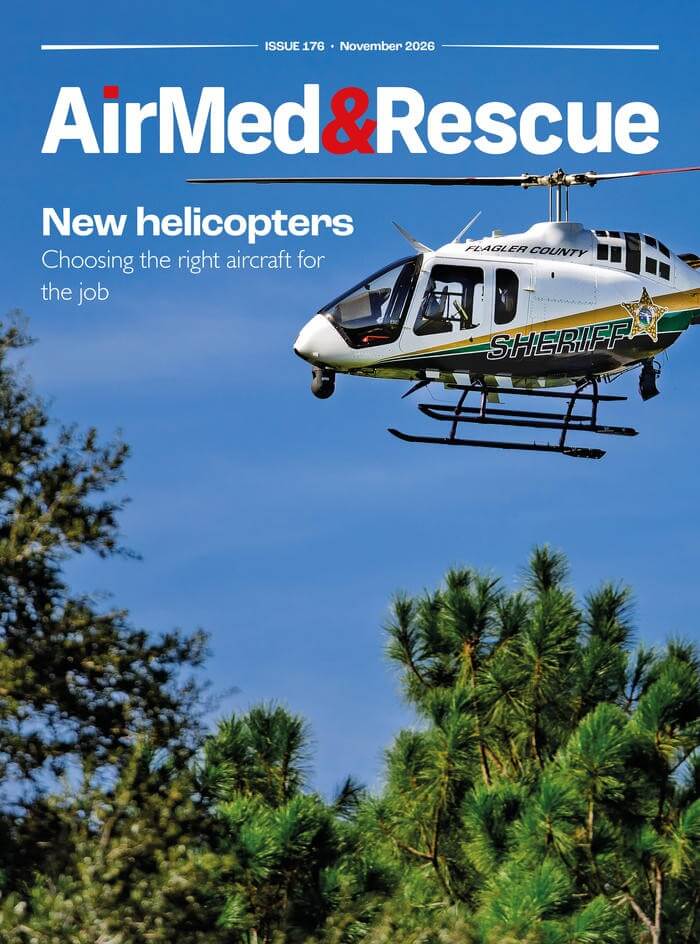
November 2026
Issue
The November edition of AirMed&Rescue has a wealth of articles to keep you informed and engaged. We have features that explore the challenges associated with cable snag and entanglement; determine how and why special missions operators choose a new helicopter; look at the risks, regulation, and requirements of temporary helicopter landing sites; and examine the inroads that are being made by the drone industry into the medical sector.
Editorial Team
The AirMed&Rescue Editorial Team works on the website to ensure timely and relevant news is online every day. With extensive experience and in-depth knowledge of the air medical and air rescue industries, the team is ready to respond to breaking industry news and investigate topics of interest to our readers.