
Open letter: Survivability is not safety

An open letter to the air medical community: Michael Benton, Aviation Safety and Operations Professional, presents a personal reflection on how survivable helicopter accidents are discussed within the air medical community. It is not intended to assign blame, but to encourage thoughtful examination of language, accountability, and learning following serious events
Over the years, our industry has experienced numerous helicopter accidents where everyone survived. I am grateful for those outcomes, but the way these survivable accidents are publicly interpreted should give all of us pause. As we begin 2026, I am writing this as both a reflection on where we have been and a call to action for the industry as we move forward.
The narrative
Following an accident without serious injuries or fatalities, the narrative often shifts to celebration, praising the crew and the program. These outcomes are sometimes framed as indicators of overall safety rather than luck. People outside aviation, and even some within it, may declare victory without a clear understanding of who bears responsibility, how decisions were made, what the risk environment looked like, or what systemic issues the event revealed. The fact that there are no fatalities should not change our approach to preventing the next event.
One recent non-fatal accident involved a hospital-branded helicopter that many assumed was operated, governed, and overseen by the hospital. That assumption was incorrect, as the actual Part 135 certificate holder, legally responsible for pilot training, operational control, maintenance oversight, and safety management, went largely unmentioned in accident coverage and commentary. In some cases, an aircraft operator is obscured even deeper through parent companies with different names, complex ownership structures, or simple silence. I am not accusing these operators of actively trying to hide their identities, but it is possible for them to remain passive while the public draws incorrect conclusions about where responsibility resides.
Another more recent helicopter accident involved a nighttime hard landing in mountainous terrain. The crew survived, thankfully, with only minor injuries, yet the public conversation treated the event as little more than a close call, focusing on the outcome rather than the significant risk factors that contributed to the accident.
In another case, predating the two above, a non-fatal accident that resulted in a totaled helicopter with a small post-crash fire was publicly and repeatedly referred to as a “hard landing”. That terminology persisted beyond the initial response and became the dominant lens through which the event was understood. Survivability and language combined to frame the outcome as a near miss rather than what it represented operationally: a system failure that warranted deeper scrutiny.
Survivability as a headline
In each of these cases, survivability became the headline rather than the breakdowns that preceded it, and when accidents are linguistically downgraded, the urgency to examine contributing factors fades. These are not isolated misunderstandings, and they point to something deeper and more concerning. Survivability is being mistaken for safety, even if indirectly. Branding is being mistaken for accountability, and while these operations were almost certainly compliant with federal requirements regarding aircraft identification, visible public accountability was limited at best. The story that reaches the public and even others within the industry is often disconnected from the operational realities that keep crews alive.
We must be honest with ourselves as an industry: a crash that people walk away from is not evidence that the system is working. It is evidence that, on that day, luck, timing, or physics spared us from another sad headline. Survivable accidents still require scrutiny, transparency, and systematic learning. When we let relief replace reflection, we miss the very lessons that prevent the next tragedy, the one where luck does not intervene.
Responsibility and accountability
The way these events were publicly interpreted also reveals something about our communication practices. Many hospital-branded programs have outsourced aviation operations to companies the local public may not recognize. When a crash occurs, the public naturally assumes the hospital operated the aircraft, monitored the safety culture, and governed the program. They do not understand the distinction between branding and operational control. That is not the public’s fault, but it is our responsibility to clarify it. We should not allow corporate imagery, marketing, or public relations to obscure where accountability actually lives. Maintaining that clarity is not about placing blame, it is about ensuring that when accidents happen, the root causes are understood in the right context, by the right parties, for the right reasons.
An organization with a healthy safety culture will engage openly, accept responsibility where appropriate, and take meaningful steps to prevent the next event. None of this is written to diminish the skill or bravery of the crews involved in these incidents. Their professionalism, composure, and resilience deserve respect and the goal here is not criticism. These events are opportunities for the entire air medical community to reflect on our narratives, our assumptions, and our commitment to learning. If we want to elevate safety standards, we must stop treating survivable crashes as wins. We must stop allowing comfort to overshadow truth, and we must stop assuming the public will somehow interpret these events correctly without our help.
Transparency and honesty
This industry does not need more blame; it needs more transparency and honesty. To me this evokes the concept of the National Transportation Safety Board’s public hearings, often referred to as ‘sunshine meetings’, a space where the realities behind these incidents are discussed openly, without spin or attempts to rewrite the story through branding or public relations. A place where survivability is not celebrated but understood. I write this because I care about this profession and the people in it. I have spent my career in aviation operations, safety, and leadership. I have seen the impact of strong systems, and I have seen the consequences when systems fail. The public narrative will always gravitate toward simple stories. It is our job to communicate the complicated ones, the ones that drive learning, accountability, and improvement. We owe our crews, passengers, and patients the truth, even when that truth is uncomfortable. If we can have that conversation openly, honestly, and without defensiveness, our industry will be stronger for it.
January 2026
Issue
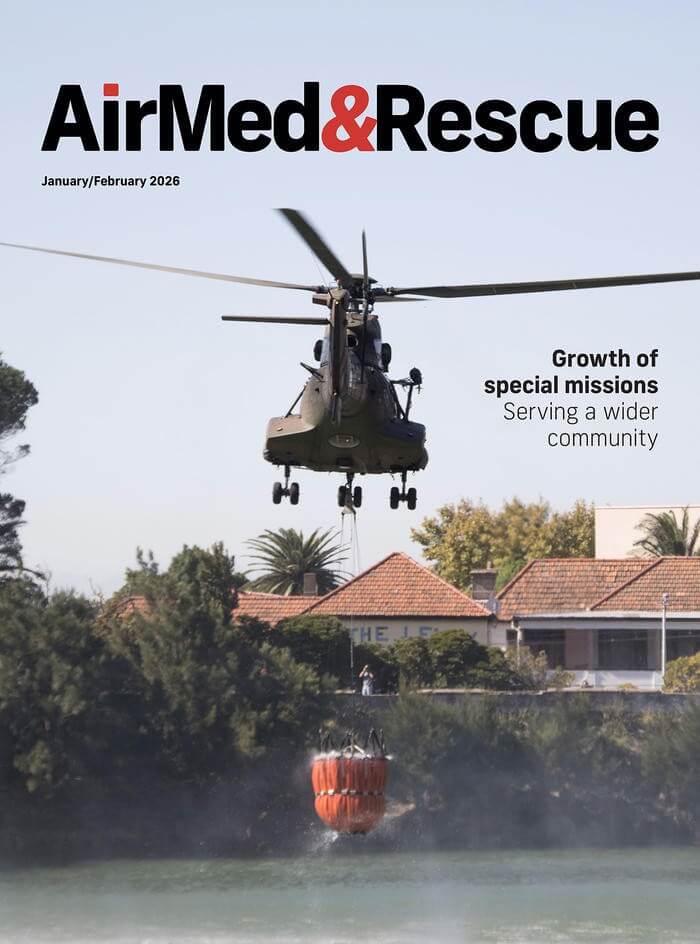
A new year and a new edition, and with it comes articles relating to special missions from all across the globe. We have features that look into the special missions in the Middle East and Africa; the benefits and differences associated with leasing helicopters; and the way that aerial firefighting is conducted at night.
Mr Michael Benton,
Michael is an aviation safety and operations professional
with experience across air medical, military, and civilian
aviation. His work focuses on safety management,
operational risk, and organizational learning