
Patient-centered care

WEINMANN prefers partner relationships and integrating teams with clinical backgrounds. Andy Mawson, UK Regional Manager at WEINMANN Emergency Medical Technology, explains what makes the products and services from WEINMANN stand apart
What’s your background with air medical operations?
I spent 10 years with the North East Ambulance Service as a paramedic on both ambulance and rapid response vehicles before joining the Great North Air Ambulance Service in 2010. I was privileged to do part of my medical training with London’s Air Ambulance. I became Assistant Director and then Director of Operations and CQC Registered Manager but always stayed operational as a Critical Care Paramedic (CCP).
How does WEINMANN develop and ensure airworthy medical equipment?
Many in the WEINMANN team have a clinical background, which ensures our devices are designed with the user in mind, hence our focus on simplicity, size and capability.
Being made in Germany we know our engineering processes are highly effective, our quality assurance is robust, and our compliance ensures that items like airworthiness are rigorously tested and adhered to.
WEINMANN has significant experience working with teams all over the world on different airframes, and we pride ourselves on providing a personalized service to these teams, therefore gaining a deep understanding of air medical operations.
Our MEDUVENT Standard ventilator, for example, was developed for reliable use in air rescue vehicles, where space, oxygen, and energy supplies are limited. It works with a powerful blower instead of compressed gas and is therefore independent of oxygen cylinders. Thanks to its compact design and low weight, it fits ideally into helicopter cabins and can also be used outside of air rescue vehicles. The oxygen supply is flexible and allows an O2 concentration of 21 to 100%. The device runs for up to 8 hours without an external power supply. Environmental testing confirms compliance with relevant standards and ensures safety in flight operations under extreme altitude, vibration, and temperature conditions.
What is the MEDUtrigger system, and what are its benefits?
MEDUtrigger provides manual ventilation using an innovative and uniquely designed button that enables the user to maintain a two-handed C grip if required. It can also be used with supraglottic airways or endotracheal tubes. It delivers a single breath, or two intra-arrest breaths at the specific tidal volume set, with an adjustable pressure protection. We don’t just measure tidal volume, we deliver it safely within about 5 seconds, minimising time off the chest. The patient is connected to a mechanical medical ventilator with all its advantages: ventilation pressure limit, alarms, etc.
Can you explain a bit about the novel Chest Compression Synchronized Ventilation (CCSV) mode for cardiopulmonary resuscitation (CPR)?
WEINMANN has been developing CCSV now for over 10 years, progressing from conceptual and technical development, through to animal studies and now human studies. CCSV provides a small ventilatory breath on the downward phase of each chest compression, whether manual or mechanical. This achieves a few key physiological advantages:
• Compression pauses for ventilation are eliminated
• Gas exchange is improved as airways and alveoli are splinted open – optimal conditions for alveolar gas exchange
• Blood pressures may be higher, which leads to better oxygen supply to the most important organs
• Scene management is easier as once the patient is established on CCSV it is completely hands-free, allowing the team to focus on gathering information and other interventions.
Cardiac arrest management is a topic of real interest currently both in the UK, and around the world. There are several innovations that have developed from improved intra-arrest monitoring and diagnostics that may mean we can nuance care more appropriately to the cause of arrest, rather than following the same algorithm for all.
CCSV may have a key role in the development of novel strategies due to the consistent physiological improvements.
Are there any other new or improved products from Weinmann that ambulance crews should know about, and how can people get to see or be trained on the ones that are available?
We have new devices in development and are working on adaptations to our existing technology to fit all markets, to enable and empower emergency medical services (EMS) teams to benefit from a mechanical ventilation capability.
We have extensive experience in the military market and are working with military medical services to ensure we are capturing emerging battlefield requirements.
From a training point of view, we can offer anything that is required, which I think is a real strength of our team. With our own academy we can provide anything from technical training, through to clinical demonstrations, drawing on the high number of practicing clinicians in the team.
At WEINMANN, we much prefer a partner relationship, rather than a traditional supplier/customer one. We recognize there is a patient in the center of our work, and recognize the fantastic effort made by emergency teams around the world.
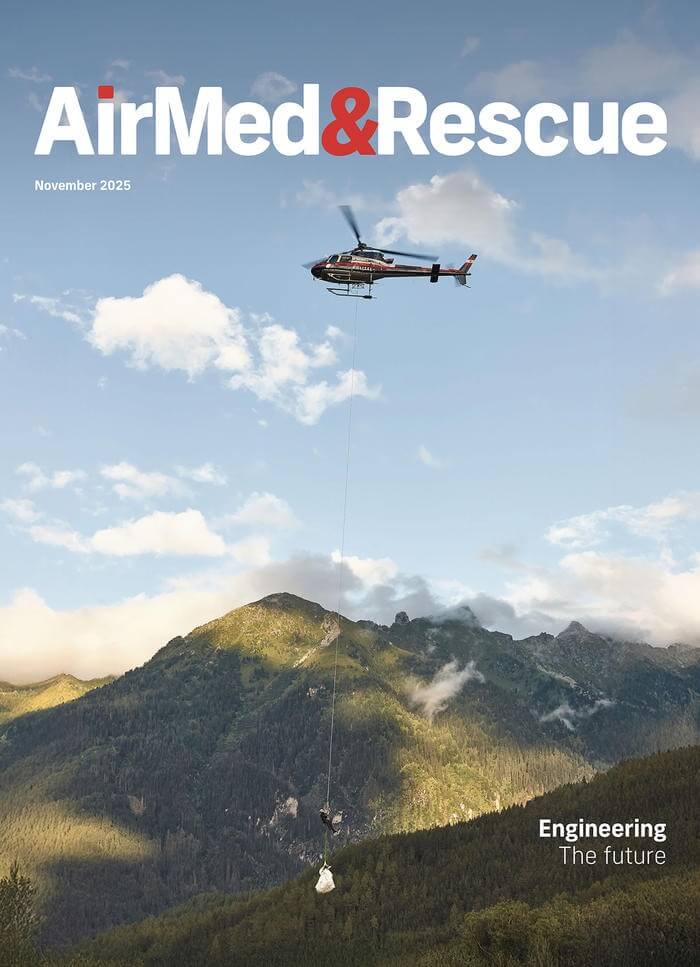
November 2025
Issue
Our November edition is packed with content relating to special missions from around the world. We have features that explore the design and engineering that go into modern rotorcraft; the interactions between ground and air teams on helitack operations; the tools and attire needed for successful water rescues; and the new onboard technology that is revolutionizing special missions by detecting and communicating with cell phones.
Editorial Team
The AirMed&Rescue Editorial Team works on the website to ensure timely and relevant news is online every day. With extensive experience and in-depth knowledge of the air medical and air rescue industries, the team is ready to respond to breaking industry news and investigate topics of interest to our readers.