
Pilot safety – the cockpit equipment keeping you safe

The equipment with which pilots work nowadays reduces workload and increases safety. But which have made the most difference to HEMS operations? Mike Biasatti outlines some of the most significant developments in recent history
Back in 1989, when I was in pursuit of my private helicopter license in the US, the only study material was a rather slim tome titled The Basic Helicopter Handbook. The very first chapter introduced Newton’s Three Laws of Motion, the third of which – as any respectable rotor wing aviator can tell you – is often phrased as every action has an equal and opposite reaction.
Fast forward to 2021. In the 32 years since, that particular law makes me think of the evolution of safety as applied to the Helicopter Air Ambulance (HAA) industry. The amount of information available inside a modern air medical helicopter is impressive, but what is actually enhancing the safety of the crew as they perform patient transports? For every air medical helicopter that crashed, for every crew and in some cases patient that was lost, was there an ‘equal and opposite’ action in the advancement of safety?
Helicopter Terrain Awareness Systems
In 2014, in response to an increase in fatal HAA accidents, the US Federal Aviation Administration (FAA) implemented new operational procedures and additional equipment requirements for helicopter air ambulance operations. This final rule also increases safety for commercial helicopter operations by revising requirements for equipment, pilot testing, and alternate airports. As of 2017, Federal Aviation Regulation (FAR) 135.605 mandated the installation of a Helicopter Terrain Awareness System (HTAWS) on all HAAs.
The HTAWS is an alerting system intended to provide terrain and obstacle visual and aural alerts and reduce the risk of Controlled Flight into Terrain (CFIT) accidents by providing increased situational awareness of the surrounding terrain and obstacles. This is primarily during the cruise phase in Visual Meteorological Condition and in Instrument Meteorological Condition (IMC) under Instrument Flight Rules (IFR), but also during approach in areas containing obstacles, towers or other structures that penetrate the intended aircraft course based on things like rate of descent and airspeed.
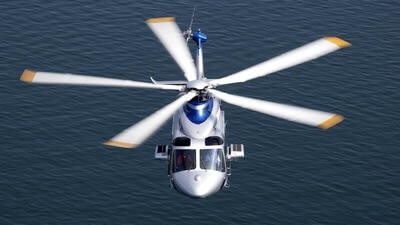

HTAWS is not intended to be used as an aid for navigation, but since helicopters operate at lower altitudes and often land and take off in varying unimproved locations, the early alert audio provided can be a life saver. With CFIT being one of the most frequently cited reasons in too many NTSB Probable Cause Reports, HTAWS is a welcome addition to the cockpit.
Night-vision goggles
One piece of safety equipment – and my personal favorite, which sadly the FAA decided not to mandate in the newly minted HAA section of the 2014 regulations – are night-vision goggles (NVGs). Fortunately, most US-based air medical operators have made the investment and provided their teams with these invaluable safety tools. With a 40-degree field of view, NVGs take whatever little light is available and intensifies it up to 35,000 times and displays it in shades of green. This ability to illuminate an otherwise pitch-black night is particularly useful when ceilings are starting to form. With the use of NVGs, you can see and discern cloud bases and tops that may be five or 50 miles ahead that are completely invisible to the naked eye.

One of the most cited contributing cause to the high accident and fatality rates for air medical teams is inadvertently entering IMC. With the use of NVGs, pilots will be able to see deteriorating ceilings and reduced visibility well in advance and choose an alternate route, return to base, or divert to an area with Visual Flight Rules (VFR) weather conditions. VFR pilots who have inadvertently entered IMC often end up losing aircraft control before they ultimately impact a surface, and it has been a root cause of many fatal helicopter crashes.
many operators provide a set to the entire crew to further promote crew resource management and vastly improve safety
Being equipped with NVGs enables prompt and practical decision-making and keeps crews safer. Instrument current pilots operating an IFR-certified helicopter can see ahead and pick up an IFR clearance to continue the flight safely under IFR. This has been particularly useful for me operating at night as temperature and dew point begin to close in on one another. A flight might take several hours to complete, and the weather typically degrades as the earth gives up the heat it absorbed throughout the day. Having the freedom to transition a routine VFR flight into an IFR flight to land safely at an airport has more than once kept me away from feeling that I had to get the patient to the hospital, and allowing for pride, obligation, or ego to impact my decision making.
Personally, having flown for 10 years in the HAA industry without the use of NVGs on some seriously dark south Texas nights, and now having had them for the last nine years, I cannot imagine how I would ever go without. The difference they provide is unbelievable, and many operators provide a set to the entire crew to further promote crew resource management and vastly improve safety.

Automatic Dependent Surveillance-Broadcast Out
In January 2020, the FAA implemented FAR 91.225 – the requirement for all aircraft to be equipped with Automatic Dependent Surveillance-Broadcast Out Equipment (ADS-B). This is a surveillance technology in which an aircraft determines its position via satellite navigation or other sensors and periodically broadcasts it, enabling it to be tracked. The information can be received by air traffic control ground stations as a replacement for secondary surveillance radar, as no interrogation signal is needed from the ground. It can also be received by other aircraft to provide situational awareness and allow self-separation. While ADS-B is ‘automatic’, in that it requires no pilot or external input, it is ‘dependent’ on data from the aircraft’s navigation system.
For programs really wanting to up their commitment to safety, ADS-B In allows the receiving aircraft a host of safety features. Improvements include free surveillance of surrounding traffic, which is available on all ADS-B In receivers. Free access to weather and flight information is available on ADS-B In receivers that can receive Universal Access Transceiver (UAT) broadcasts.
For programs really wanting to up their commitment to safety, ADS-B In allows the receiving aircraft a host of safety features
While ADS-B equipage increases, Traffic Information Service (TIS-B) significantly enhances pilot situation awareness for additional safety benefits. With traffic displayed in the cockpit, pilots and air traffic controllers are able to communicate with shared awareness of conflicting aircraft traffic. With TIS-B, a pilot will not only see ADS-B air-to-air traffic, but also the radar targets sent from ground stations, resulting in a more complete picture of traffic.
Flight Information Service (FIS-B) is a free service available to aircraft who can receive data over 978 MHz (UAT). FIS-B automatically transmits a wide range of weather products with national and regional focus to all equipped aircraft. As aircraft continue to adopt ADS-B In avionics, more applications will further improve safety.

Airborne and Traffic Collison Avoidance Systems
Another tool that has helped this pilot avoid a mid-air collision, particularly during peak times around busy airports, is the Traffic Collision Avoidance System (TCAS), also known as the Airborne Collision Avoidance System (ACAS). TCAS is a system designed to increase cockpit awareness of nearby aircraft and serve as a last defense against mid-air collisions. The system monitors airspace around an aircraft for other transponder-equipped aircraft that may present a collision threat. TCAS operates independently of ground-based equipment to provide pilots with guidance on how to avoid a potential collision.
More advanced systems, commonly found on air medical helicopters, might offer a suggested action to be taken by the pilot
Depending on the system installed, the pilot will receive a visual alert of surrounding aircraft with operating transponders, typically with a relevant altitude reference. Some systems may indicate the conflict target’s direction of flight, and most will issue an aural alert when any conflict breaches a range of separation. More advanced systems, commonly found on air medical helicopters, might offer a suggested action to be taken by the pilot such as climb, descend, turn left, but ultimately, the pilot in command is responsible for any course and altitude changes.
Electronic Flight Bags
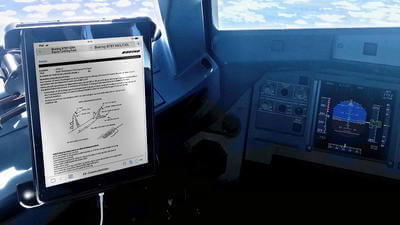
Even for the most modestly equipped aircraft, the advent of the iPad and electronic flight bags has made it much easier for operators to add on some amazing features through subscription. These include weather applications like ForeFlight, which offers an ever-improving array of incredible graphics and features like synthetic vision, real-time weather, NOTAMS, airports, and anything else you can imagine.
The test will be if you can exercise the discipline to not form a dependence on all these wondering bells and whistles and keep your head on a swivel when flying, divide your attention inside as well as outside, and allow technology to enhance your safety while not relying on it to provide it. Fly safe!
Keep on reading
Issue 119 | August/September 2021
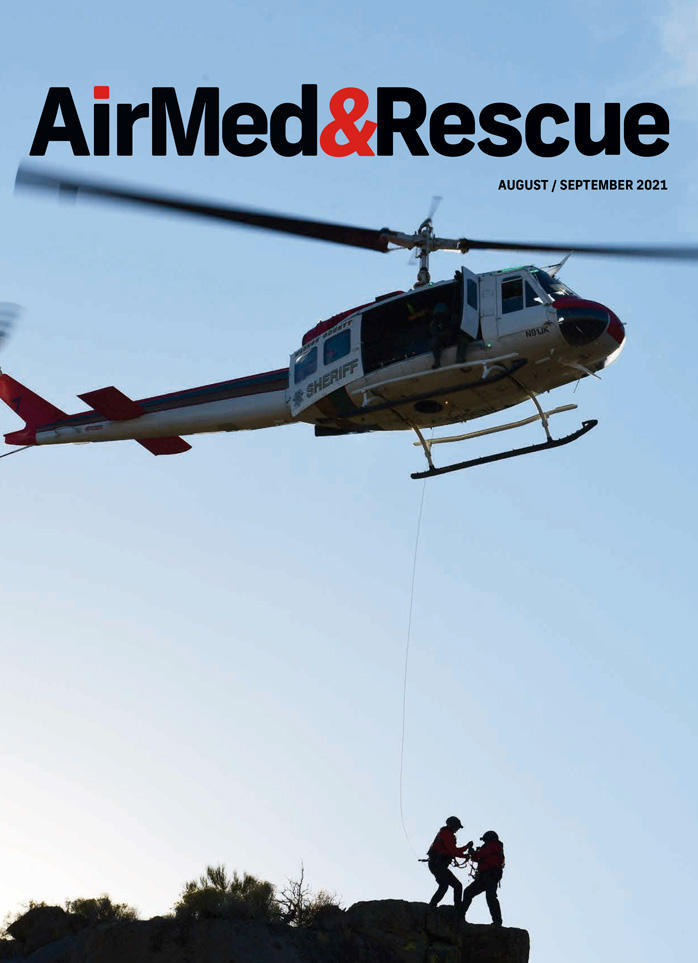
In this issue:
The Frisco Three’s journey to safeguard crash survivability and resolve loopholes in FAA regulations
How technology innovation and new materials are changing the test pilot role
Line operations safety audits in live combat aeromedical evacuation
The cockpit equipment keeping pilots safe
SAR innovation by necessity across three US states
An interview with London’s Air Ambulance Charity’s Dr Mike Christian
Provider Profile: Babcock Australasia and Ambulance Victoria
And more
In this issue
August 2021
Issue
In this issue:
The Frisco Three’s journey to safeguard crash survivability and resolve loopholes in FAA regulations
How technology innovation and new materials are changing the test pilot role
Line operations safety audits in live combat aeromedical evacuation
The cockpit equipment keeping pilots safe
SAR innovation by necessity across three US states
An interview with London’s Air Ambulance Charity’s Dr Mike Christian
Provider Profile: Babcock Australasia and Ambulance Victoria
And more
Mike Biasatti
A helicopter air ambulance (HAA) pilot in the US for 20 years and a certificated helicopter pilot since 1989, Mike Biasatti continues to enjoy all things helicopter. In 2008, the deadliest year on record in the US HAA industry, he founded EMS Flight Crew, an online resource for air medical crews to share experiences and learn from one another with the goal of promoting safety in the air medical industry. He continues to write on the subject of aviation safety, particularly in the helicopter medical transport platform with emphasis on crew resource management and communication.