

A practical, all-weather hybrid-electric aircraft

Brandon Robinson, CEO and Co-Founder of Horizon Aircraft, explains the speed, efficiency, and benefits that the Cavorite X7 and its HOVR wing bring to the special missions sector
Did your experience as a military fast-jet pilot inform your decision to create a novel form of aerial transport?
My operational experience as a military pilot, not specifically as a fast-jet pilot, inspired me to develop a unique hybrid-electric vertical takeoff and landing (VTOL) aircraft designed to complement the many all-electric VTOL concepts emerging across the advanced air mobility industry.
During my military service, I frequently flew in challenging conditions including poor weather, cold climates, and remote regions with limited infrastructure and support. Those experiences highlighted an opportunity to create a VTOL aircraft capable of operating independently of ground charging infrastructure, particularly in remote environments. From the outset, the aircraft was designed to perform in cold weather, operate under instrument flight rules (IFR), and target flight into known icing (FIKI) certification.
The result is a practical, all-weather hybrid-electric aircraft designed to expand the range of missions that VTOL platforms can perform safely and reliably.
Horizon Aircraft’s hybrid-electric Cavorite X7 is an eVTOL maximized for longer range, higher speeds and larger useful loads. Were emergency-response missions a consideration from the design stage or is this use case an advantageous function reflective of its versatility?
Emergency response missions were considered at the earliest stages of the design phase. Specifically, emergency medical services (EMS) and disaster relief were exciting opportunities where a faster, more cost-effective, and safer aircraft that could operate in any weather conditions would dramatically improve survivability for people in trouble across the world.
The HOVR technology on the Cavorite X7 is unique in the industry. How does this make the platform better suited for certain special missions over alternative aircraft?
We wanted the simplest, most robust, and safest VTOL concept that offered the efficiency of a fixed-wing aircraft. Our patented HOVR wing was the result of a lot of technical work but was also grounded in decades of operational experience. The unique concept allows the aircraft to fly 98% of its mission just like a normal aircraft in a very low drag configuration. This allows the X7 to fly almost twice as fast as a typical helicopter in a much safer way, at operational costs up to 75% lower per available seat mile.
This high-performance, low-cost combination provides tremendous opportunity to have goods and services more widely accessed, regardless of geography or presence of supporting infrastructure.
How do you envision advanced air mobility fitting into the airborne special missions sector – can it fit into a niche that is not already covered, or can it improve on some of the services already provided?
The Cavorite X7 has the potential to significantly enhance a wide range of existing services while dramatically reducing operating costs. Imagine delivering critical medical supplies such as donor organs, blood products, or life-saving pharmaceuticals to a hospital in half the time and at a fraction of today’s cost. The same advantage applies to EMS where faster transport can mean better outcomes for critically injured or ill patients, and delivering surgeons, medical personnel, and essential supplies more efficiently to remote and underserved regions can improve healthcare access to communities worldwide.
Brandon Robinson
Brandon is Co-Founder and CEO of Horizon Aircraft, developer of the hybrid-electric Cavorite X7 eVTOL. A former CF-18 fighter pilot and ‘Top Gun’ graduate, he managed $4 billion in defense programs. Brandon holds engineering and MBA degrees, and multiple aerospace patents, and leads Horizon’s certificationfocused innovation strategy.
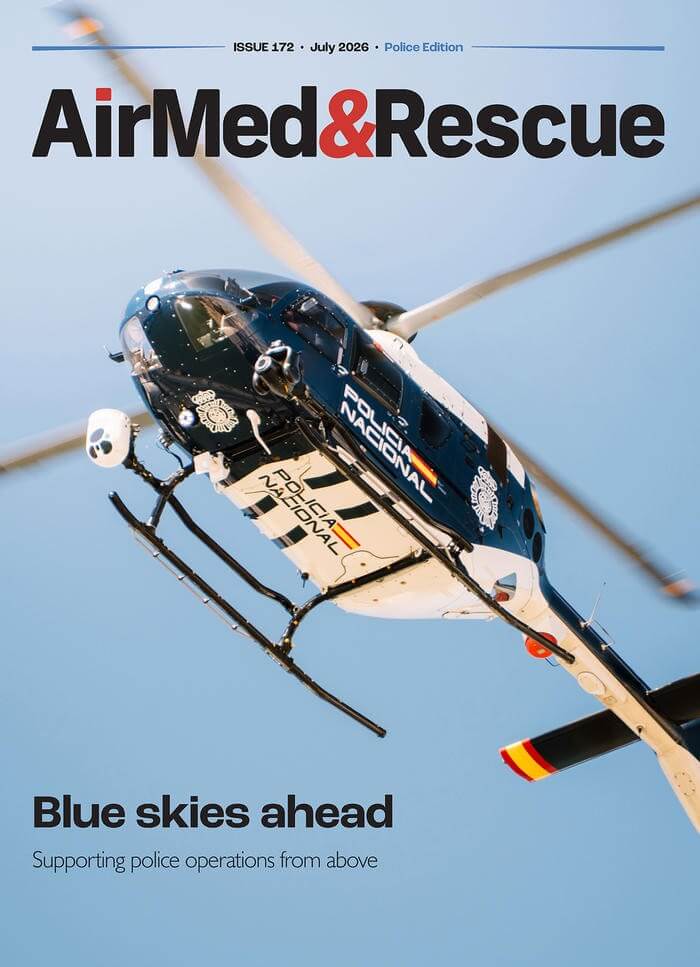
July 2026
Issue
As another July rolls around, it’s wonderful to bring you the airborne policing edition of AirMed&Rescue. We have features on the development and strategies used during aerial missing person searches; the active threats that affect aviation and law enforcement services particularly; the bread and butter of police aviation, the patrol and support operations; and the increasing use of drones as a force multiplier and sometimes as a first responder.
Editorial Team
The AirMed&Rescue Editorial Team works on the website to ensure timely and relevant news is online every day. With extensive experience and in-depth knowledge of the air medical and air rescue industries, the team is ready to respond to breaking industry news and investigate topics of interest to our readers.