
Provider Profile: Air Mercy Service

Farhaad Haffejee, CEO of the South Africa Red Cross Air Mercy Service Trust, speaks to Oliver Cuenca about his organization’s work
The Air Mercy Service Trust (AMS) – established in 1966 – is a non-governmental air ambulance service that provides coverage across the country. Originally founded as a branch of the South African Red Cross Society, the AMS was later spun off as an entirely separate trust in 1994. The trust’s CEO, Farhaad Haffejee, explained that despite this, the AMS remains dedicated to ‘the principles and objectives of the International Red Cross and Red Crescent movement’.
“The objective of the organization is to create effective, efficient and sustainable air medical and ground resources to support healthcare systems,” he said.
Since the trust’s establishment, it has grown into a ‘comprehensive air medical service … utilizing volunteers, professionals, and strong partnerships with the departments of health, not-for-profit organizations and the private sector,’ Haffejee explained.
Fixed-wing and rotorcraft
The organization currently has a fleet of eight Leonardo AW119 helicopters, as well as three Pilatus PC-12 fixed-wing aircraft, located across six bases in Cape Town and Oudtshoorn, Western Cape; King Shaka International Airport, KwaZulu-Natal; and East London, Mthatha and Gqeberha, Eastern Cape. AMS also maintains ‘supportive infrastructure’ in the provinces of Northern Cape, Free State and Mpumalanga. It also provides ground-based ambulance services.
“Each aircraft,” explained Haffejee, “is crewed by either one or two pilots, accompanied by a minimum of two medical crew members – this combination changes depending on the mission and patient requirements.”
He added that the AMS’s air medical services are licensed and operated under the terms of the aviation regulatory frameworks of the South African Civil Aviation Authority (SACAA).
Coordinating operations
Aircraft operations are coordinated by the AMS’s National Operations Centre (NOC), which operates 24-hours a day, 365 days a year.
“The NOC has the capacity to deal with all logistics relating to both the medical and aviation aspects of the service,” confirmed Haffejee. “The coordinators are medically trained personnel who understand the air medical environment, as well as the capabilities and limitations of the fleet.”
He added that when planning a mission, the coordinators at the NOC will seek to match patients with ‘appropriate medical facilities’ that meet their needs, ‘ensuring that [they] receive the appropriate level of care’.
The NOC’s 24-hour operations reflect AMS’s own ability to provide air ambulance services at all hours of the day. The trust’s aircraft are equipped with night vision goggles (NVG), enabling them to respond to call-outs after the fall of darkness. This, said Haffejee, is particularly helpful in ‘facilitating access to rural hospitals and clinics that were previously unreachable at night’ due to a lack of sufficient lighting.
The trust’s aircraft are equipped with night vision goggles, enabling them to respond to call-outs after the fall of darkness
Working with other organizations
The AMS is currently contracted to provide air medical services to the provincial health departments of the Eastern and Western Capes, but ‘will respond to requests from various provincial departments of health to transport a patient or patients from one location to another,’ said Haffejee, including from ‘an accident scene, or from one hospital or clinic to another’.
He added: “During times of disaster, the National Department of Health may request our assistance to support disaster relief efforts.”
Haffejee noted that his organization collaborates with a variety of other organizations and individuals when necessary, including non-profits, the government, private ambulance services, and volunteer or rescue organizations, in support of a ‘common humanitarian goal of reducing pain and suffering for all’.
Despite this, the AMS remains reliant on the support of individual and corporate donors to continue its operations.

Difficult terrain
One of the challenges of working in South Africa is the country’s sparsely populated rural areas. Such regions offer difficult terrain, and ‘many underdeveloped airfields and limited technologically advanced equipment for aircraft take-off and landing,’ said Haffejee.
Such poor infrastructure ‘can be a significant challenge,’ he explained, but added that in response to this, the AMS typically chooses aircraft capable of landing and taking off from short airstrips to support its operations. Aircraft are also equipped with a range of appropriate technology, including NVG, ‘which facilitates access to rural hospitals and clinics that were previously unreachable at night by helicopter’. “As a safety enhancement system, this service is only provided to and from known and operationally familiarized landing zones,” he explained.
AMS pilots undergo rigorous training to operate in challenging terrain and circumstances
Rigorous training
Haffejee added that AMS pilots ‘undergo rigorous training to operate in challenging terrain and circumstances,’ including ‘input that exceeds the minimum aviation training regulations with regard to service delivery – pilot currency, qualification on aircraft type, night-time and NVG training, unprepared landing areas, mountain flying, confined area operations, external load operations [and] root cause analysis’.
Additionally, the service offers ‘stringent training programs for hoist operators, focused around safety and efficiency,’ taking into account ‘international and local military best practices’.
The training builds on a rigorous hiring process: “We look to appoint experienced and well-trained crew, whether locally or from abroad and where necessary, to undertake professional developmental programs,” he stated.
Further, Haffejee explained that as a ‘starting point,’ AMS medical crews are given emergency medical services training in compliance with national standards, alongside ‘additional courses that clinically benefit the patients we serve’.

Alongside extensive training for its full-time crew, AMS also operates a ‘volunteer pilot development program’ – a bursary and sponsorship-based career program that offers young pilots ‘the opportunity to develop their skills, knowledge, and experiences, with access to industry leading training and mentoring through professional pilots’.
AMS also operates a volunteer pilot development program – a bursary and sponsorship-based career program that offers young pilots the opportunity to develop their skills, knowledge, and experiences, with access to industry leading training and mentoring through professional pilots
Haffejee explained: “The volunteer pilot development program is … aimed at assisting successful candidates with funding to obtain a Pilatus PC-12 conversion and license.”
AMS also provides ‘trade apprenticeships in the engineering field, as well as learnership opportunities in the administration environment,’ he added.
“The AMS believes in investing in the future by developing skilled specialists and making a significant contribution to the aviation and healthcare industries,” said Haffejee. “The organization actively pursues programs that address the shortage of skills within the air medical field.”
A positive outlook
Looking to the future, Haffejee is optimistic about AMS’s development. The organization is ‘constantly looking for areas to improve our services,’ he explained. In the coming year, AMS will be investing in a range of equipment, including a ‘new medical interior for one fixed-wing aircraft, new lightweight incubators, external cardiopulmonary resuscitation devices, point-of-care ultrasound devices, portable blood gas machines and video laryngoscopes, to mention a few.’ Alongside this, the AMS will continue its work developing its health support outreach programs for primary and specialist healthcare in ‘resource-constrained areas,’ among other things.
“We can proudly say that we have already paved the way for many improvements and new technologies as industry leaders and will continue to do so,” Haffejee concluded.
Header image credit: Grant Duncan-Smith
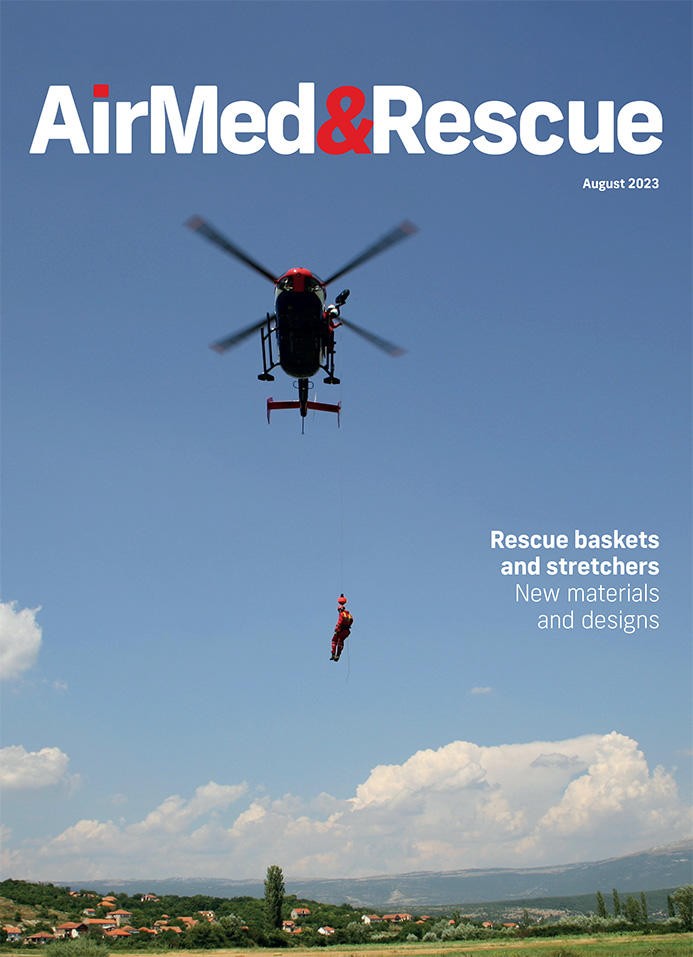
August 2023
Issue
We have a wonderful edition, covering aerial ECMO provision; hoisting and the lessons to be learned; the benefits of fixed-wing air ambulances; preparation for fire seasons; progress towards sustainable aviation fuel; and the variety rescue baskets; plus more of our regular content.
Oliver Cuenca
Oliver Cuenca was a Junior Editor at the Voyageur Group. He was previously a News and Features Journalist for the rail magazine IRJ until 2021, and studied MA Magazine Journalism at Cardiff University. His favourite helicopter is the AW169 – the workhorse of the UK air ambulance sector! He also led the creation of Waypoint: The AirMed&Rescue podcast, serving as its Production Editor and co-host.