

Provider profile: New Zealand Flying Doctor Service

Arthur Ruddenklau, Operations Manager at the New Zealand Flying Doctor Service (NZFDS), talks to Oliver Cuenca about his organization’s work in the air medical sector
The New Zealand Flying Doctor Service (NZFDS), an air ambulance program that specializes in providing inter-hospital air transfers on behalf of the New Zealand government, operates 24 hours a day, year round, and flies an average of around 1,500 patients per year.
The service, explained Arthur Ruddenklau, NZFDS’s Operations Manager, employs a “full-time team of 14 pilots, 20 intensive care flight nurses … and a small, dedicated neonatal and midwifery team”.
NZFDS is a subsidiary of Garden City Helicopters Aviation Group (GCH Aviation), a Christchurch-based aviation services provider founded in 1983. Based primarily at a site adjacent to Christchurch International Airport, the service also operates a base at Nelson Airport.
Aircraft and maintenance
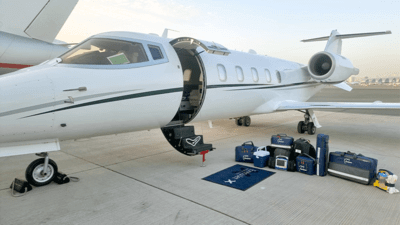
The service currently operates a fleet of three Beechcraft King Airs – two B200Cs and one B200. “The B200C King Airs are based in Christchurch, while the B200 is based in Nelson,” said Ruddenklau.
NZFDS previously operated a mixed fixed-wing fleet, but has since been working to “standardize”. The organization, Ruddenklau explained, sold its former Cessna Conquest and Beechcraft King Air C90B planes “in the past year”, and is now expecting “a fourth King Air B200 to join the fleet later this year”.
The fleet’s “day-to-day” maintenance is provided in-house by two engineers directly employed by NZFDS. However, Ruddenklau added that when it came to more complicated procedures such as “all phase inspections”, the service typically contracts maintenance, repair, and overhaul (MRO) firm Hamilton Aero Maintenance to do the work.
Government contract
NZFDS operates its services under contract with the Health New Zealand / Te Whatu Ora government agency to provide air medical flights throughout New Zealand. As part of the arrangement, all members of its medical flight team are employees of the agency, and are supplied to NZFDS as part of the contract.
Meanwhile, the organization’s flights are managed by a flight coordinator based at a hospital in Christchurch.
However, while the service does receive some funding from the New Zealand government through its contract with GCH Aviation, the amount is insufficient to cover the cost of operations – with a shortfall of roughly NZ$3 million (US$ 1.8 million) per annum.
To that end, the organization operates the NZFD Trust, which works to raise additional funds through other methods. Additionally, the service receives support from several community trusts and foundations, such as Air Rescue and Community Services – an organization that operates gaming machines to raise funds for charitable purposes. NZFDS also receives support from a number of businesses, such as ROA Mining, which is the key sponsor of the Christchurch-based planes.
New Zealand’s mountainous geography and maritime climate can present unique challenges in how NZFDS operates
Geography challenges
New Zealand’s mountainous geography and maritime climate can present unique challenges in how NZFDS operates, Ruddenklau explained.
The country is split between two main islands: the 113,729km² North Island, which is the more populous, being home to around four million people; and the South Island, which has a population of around 1.3 million.
The South Island’s total landmass encompasses around 150,400km², of which 60% is covered by large mountain ranges – with the tallest peak, Aoraki / Mount Cook, reaching a height of 3,724m.
“Due to the surrounding oceans and Southern Alps,” explained Ruddenklau, “we experience a wide variety of weather conditions – from polar blasts during the winter months to raging westerly winds during the El Niño season, which brings wetter weather to the western parts of the country.”

Serving remote communities
A standard mission for NZFDS, said Ruddenklau, would involve flying from the Christchurch base to small primary hospitals in remote communities, and then transferring the patients to a tertiary healthcare facility in a larger urban center.
Common but frequently challenging destinations that NZFDS may be called out to, he continued, include Greymouth – “situated centrally in the West Coast district of the South Island” – as well as the Chatham Islands, also known as Rēkohu, an archipelago located “about 500NM (926km) east-northeast of Christchurch”.
Greymouth is an isolated, “thin stretch of flat land sandwiched between the Southern Alps and the Tasman Sea”. While the journey is in fact “one of our shortest flights … with a flight time of between 30 and 35 minutes”, Ruddenklau explained that the region’s remoteness and westerly “prevailing weather patterns” can be challenging for aviators to fly in. Average annual rainfall in the high-altitude areas of the West Coast region can regularly exceed 10,000mm.
Weather in the Chatham Islands can also be challenging, with a relatively frequent number of days in which they are affected by low cloud, drizzle, mist, and fog
Weather in the Chatham Islands can also be challenging, with a relatively frequent number of days in which they are “affected by low cloud, drizzle, mist, and fog”, said Ruddenklau. He added that, while average mean wind speeds are around 16kts over the entire year, “it has been reported that for at least 120 days per year, the wind speed … exceeds 35kts”.
Despite this, Ruddenklau argued that the service’s King Air B200s were “well suited for these flights”, being able to carry a full medical team and two pilots, and still have “enough fuel to reach the island and divert back to the mainland if required”.

Training
To ensure that the NZFDS team is ready for anything – including difficult weather – flight crew are required to undertake a range of training each year, including “12-monthly instrument rating renewals; route and aerodrome proficiency checks; … company standard operating procedures; and six-monthly operational competency assessments”, said Ruddenklau.
Additionally, they will take a number of regular written or oral exams, covering items such as “rules and regulations, aircraft systems and procedures, navigation, air traffic control and meteorology, emergency procedures, [and] patient loading and unloading”.
Both flight and medical crew undertake regular “safety and emergency procedure training, life raft and water survival training, and general survival briefings and courses”, Ruddenklau continued. “The medical crews also complete helicopter underwater escape training (HUET), as they are also involved in helicopter transfers.”
NZFDS also allocates a six monthly “study day”, in which the team will explore specific topics, hear from guest speakers, and “discuss the missions that have been completed during the preceding six months”, he noted.
Ruddenklau added that NZFDS maintains a “basic G1000 King Air procedural trainer” at its Christchurch site “which we use to introduce new flight crewmembers to the aircraft type, avionics system … along with our standard operating procedures”. More advanced flight crew, meanwhile, use the simulator to “run different scenarios and hone their skills”.
The service continues to grow year on year, we are now flying more miles for each patient than ever before
Additionally, the organization will regularly send crew to Australia to use a full-motion Level D simulator owned by aviation training firm Flight Options.
A bright future
While patient numbers continue to grow in line with the general population, NZFDS’s future seems promising. “The service continues to grow year on year,” noted Ruddenklau, who added that, as New Zealand’s hospital system continues to centralize on a smaller number of larger healthcare facilities, “we are now flying more miles for each patient than ever before”.
He concluded: “The future is bright, and the service is always looking for ways to expand and provide better cover for our communities.”
May 2024
Issue
In our June edition, find out about the technology helping to make safety management better; learn about the tools that are reducing risks in flight; discover the challenges and problems facing the aerial firefighting community with suppressants and retardants; and read about what goes into electro-optical/infrared multi-sensor systems used by the police aviation sector; plus more of our regular content.
Oliver Cuenca
Oliver Cuenca was a Junior Editor at the Voyageur Group. He was previously a News and Features Journalist for the rail magazine IRJ until 2021, and studied MA Magazine Journalism at Cardiff University. His favourite helicopter is the AW169 – the workhorse of the UK air ambulance sector! He also led the creation of Waypoint: The AirMed&Rescue podcast, serving as its Production Editor and co-host.