
In pursuit of the perfect hoist for imperfect hoisting conditions

Amy Gallagher talks to manufacturers, instructors and end users to find out what makes a successful hoist system, how crews are trained in their use, and how technology is developing to make hoist rescues smarter and safer
There are many moving parts and pieces to mitigate a successful hoist rescue, in the decisions of electric or hydraulic hoisting and knowing what makes the perfect rescue hoist. Whether during a wildland fire, a hurricane, a flood, or in a combat environment, it goes far beyond the term ‘multitasking’, and yet perfection in application is always expected.
From experts in rescue hoists and hoisting, AirMed&Rescue learned about the mechanics of hoist rescues and the next phase of growth in the evolving technology and tactical applications of rescue hoisting.
The world’s only dedicated hoist provider
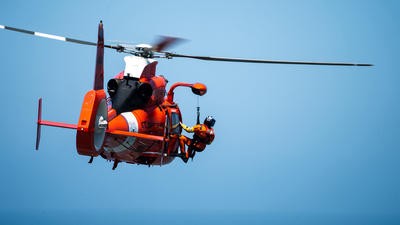
In 1926, Breeze-Eastern, based in the US state of New Jersey, began developing and manufacturing the first technologies for helicopter rescue hoists and cargo winches, and, later, cargo hooks and weapons handling for military and commercial operators. Today, Breeze-Eastern is the world’s only dedicated hoist and winch provider and its second-largest cargo hook systems original equipment manufacturer.
So, what exactly goes into making a good and versatile hoist?
“From the engineering and design side, lots of lessons learned and unique mission requirements; however, most [important] of all is the great quality of products we manufacture,” said Breeze-Eastern’s Business Unit Manager, Rescue Hoists, James DeCuollo. “We accept nothing less than excellence in our designs.”
As a point in design capability, the Breeze-Eastern cargo hook payload ranges from 1,500lb (680kg) to 36,000lb (16,329kg), while one of the company’s most notable rescue hoist systems is the HS-10300, which has been the leading hydraulic rescue hoist system for over 30 years, DeCuollo explained.
“Our hydraulic rescue system is operated on known platforms like the MH-65, as well as other notable systems such as the HS-20200, which is installed on light and medium helicopters,” he said.
All future platforms, however, will involve electrical power, he added.
Electrically powered rescue hoist systems generally perform with more efficiency and speed
“Electrically powered rescue hoist systems generally perform with more efficiency and speed,” said DeCuollo. “While the hydraulic hoists continue to serve the industry well, operators are demanding faster and more efficient products.”
While the use of internal or external mount is mostly platform specific, DeCuollo said the company’s rescue hoist systems are externally mounted, which is a great option as it does not take up precious space inside the cabin.
“Today, there are very few modern aircraft in production that require an internally mounted hoist,” he added.

Putting the hoist to the rescue: ‘big game changer’
The capabilities of the rescue hoist are equally as impressive as the abilities of the teams who put the rescue hoists to work, whether in a wildland fire or hurricane with flooding.
“The use of the products we manufacture is very humbling, knowing that we design our products to withstand the most austere conditions possible,” said DeCuollo. “Our hoist systems have served the air rescue mission since November 1945.”
To add to the company’s successes in rescue hoists, DeCuollo highlighted the extensive design and development of a ‘big game changer’ that also happens to be a cost saver.
“Our next-generation rescue hoist cable, ‘Four Strand’, mitigates cable looseness by design, which required several years through the development process to ensure quality and safety standards,” he said.
In order to navigate the Federal Aviation Administration (FAA) and European Union Aviation Safety Agency (EASA) supplemental type certificate (STC) processes toward certification solutions for aeronautical challenges, a bilateral agreement between the FAA and the EASA issues STCd certification that confirms approval of the initial design of the product. The Breeze-Eastern ‘Four Strand’ rescue hoist cable is designed to comply with EASA and FAA standards for ‘STCd’ or Significant Standards Differences (SSD) between FAA and EASA airworthiness codes. “We are supremely confident that this STCd design (EASA and FAA) will reduce the direct maintenance cost of ownership of a rescue hoist – less cable replacements leads to less in-flight (blade spin) load tests, which reduces costs exponentially,” DeCuollo explained.
“The Four Strand provides ease of use with its form and fit as a functional replacement of the existing wire rope cable,” he said. “It’s essentially a 600lb rated load, and is qualified to exceed all required safety factors.”
You want a highly reliable system that ensures the safety of the rescuers and the people being rescued
The bottom line, said DeCuollo, is that when there’s a lot on the line, you want a highly reliable system that ensures the safety of the rescuers and the people being rescued, and you want a product that can be maintained as organically as possible.
Hoist training: The ‘most dangerous classroom in the world’?
Helicopter hoist training has been termed the ‘most dangerous classroom in the world’, which is where Bluedrop USA comes in. Launched in 2020, Bluedrop USA is the sister company to the technology developer Bluedrop Training and Simulation, based in Halifax, Canada.
“We provide a safe environment for helicopter hoist operators to train mitigating complex environments under high-risk conditions,” said Bluedrop USA’s President and CEO, retired US Naval Aviator Dr Brett Ulander, who emphasized the company’s high-fidelity simulation solution, the Hoist Mission Training System (HMTS).
“Through a full-crew mission rehearsal, we train ab initio students in the most challenging and dangerous environments as a controlled exposure to simulated malfunctions, such as snagged cable, rotor wash and hot hoist,” explained Dr Ulander.

Focus on rear crew for whole-crew training
“Our focus is on rear-crew training for all vertical lift aircraft, which includes the US Army’s Chinook and Black Hawk helicopters, US Navy and US Air Force H-60s, the joint services V-22 tiltrotor aircraft, as well as the civilian search and rescue (SAR) helicopter community,” he said.
“At the company’s new state-of-the-art training facility in Orlando, our customers train on perfecting their communication skills as a seamless interaction between the front and rear crew in full-crew coordination, developing the experience of cable management for rear-crew operators,” said Dr Ulander.
“Not only is this simulated training
more efficient and effective than live flight training, it saves valuable ‘blade hour’ costs,” he explained.
One of the organizations that utilize Bluedrop USA’s Simulation as a Service is Seminole County Sheriff’s Office. Lieutenant Steve Farris, Chief Pilot and the department’s Aviation Section Commander, advocates the use of Bluedrop USA’s Training Center.
“We’ve used simulators for pilots for decades, but to be able to do this with crewmembers is the next level,” Farris said. “I was able to fly as a pilot and work with one of my crew chiefs in this virtual simulation scenario.”
We’ve used simulators for pilots for decades, but to be able to do this with crewmembers is the next level. I was able to fly as a pilot and work with one of my crew chiefs in this virtual simulation scenario
Through the ‘proficient calculated risks’ application of the company’s HMTS, Bluedrop USA’s high-fidelity simulation brings both virtual reality (VR) and mixed reality (MR) solutions into the simulated training environment.
Adding value to the customer’s on-location training, Bluedrop’s portable HMTS is deployed to sites throughout the world as an easy transportable asset, said Dr Ulander. “This is great for individual training or when linked with front-end training devices,” he added.
Cornerstones and pivotal objectives
Charged with positioning the company’s next phase of growth, Dr Ulander’s focus is on “expanding market presence while increasing innovation and technology in defense and homeland security markets as the cornerstone that serves as our pivotal objectives,” he said. “The increasing innovation and technology in training services are key to our growth.”
Additionally, Bluedrop USA offers comprehensive courseware development and high-fidelity courseware tools through its Learninglogics suite, which includes the Learning Management System (LMS), Learning Content Management System (LCMS) and Technical Document Manager (TDM).
“The Bluedrop USA suite of courseware tools, Learninglogics, allows faster, better and cost-effective delivery of courseware,” said Dr Ulander. “It automates functions that other courseware tools still have to do manually. Learninglogics has been adopted by nine US Air Force platforms and is under evaluation by the US Navy as well.
Our capabilities to bring all crew mission rehearsal in a controlled environment, networked with other simulated or live players, is a game changer in both defense scenarios and in SAR missions
“On the simulation front, our capabilities to bring all crew mission rehearsal in a controlled environment, networked with other simulated or live players, is a game changer in both defense scenarios and in SAR missions,” said Dr Ulander. “The ultimate goal is to improve training outcomes for all of our customers.
“Our capabilities in R&D and innovative solution development are reflected in the variety of configurations in full-size simulators or for mobile simulators Bluedrop USA offers. Systems allow an immediate reviewable log of the sim training while being able to bring training to the point of need. Whether at a US location, forward deployed or deployed on a ship, Bluedrop USA’s training device will improve trainee proficiency and do it in an economical manner,” he explained.
Transforming benefits as solutions
Since 2015, Vita Inclinata has revolutionized helicopter hoist operations across critical industries in SAR, law enforcement, military, and firefighting. Through its subsidiary Air Rescue Systems (ARS), the company offers a comprehensive ecosystem of advanced technology, comprehensive training, and field-proven equipment for hoist rescues.
Led by Executive Vice President Matt Christensen, the ARS team of instructors brings over 125 years of expertise that translates into an annual output of over 13,000 hoists, 550 flight hours, and 650 students trained.
“By pairing training with advanced technologies, spotlighted by our Vita Rescue System (VRS), ARS provides a ‘total team solution’ that improves hoist missions in a range of complex operations, transforming benefits as multifaceted solutions,” he said.
These solutions include enhanced crew safety through reduced hover times and eliminated taglines, improved mission efficiency with faster hoisting speeds and precise control, significant cost savings from reduced live flight hours and fewer accidents, and rapid skill enhancement through comprehensive high-impact training programs.
“With a focus on these key areas, ARS is improving hoist operations and is fundamentally transforming the entire operational system by setting new standards for safety, efficiency and capability in challenging operational environments,” Christensen said.

Revolutionizing rotor hoisting operations
Training remains crucial at Vita Inclinata, with ARS continuing to develop specialized modules for new technologies and techniques to safely extract victims and assets in challenging environments. The ARS curriculum spans from basic safety to advanced human external cargo (HEC) techniques, featuring innovative elements like Fluid-Dynamic Hoist Training.
“This approach to learning ensures practical, mission-specific experience with equipment rescue teams will use in real-world scenarios,” said Christensen.
While the ARS training utilizes client-owned aircraft, the company owns an MD 902, which can be applied to training its global clients either in the USA or their location.
“Our ARS training team integrates innovative equipment into comprehensive and customized helicopter search and rescue (HSAR) training programs, enhancing training effectiveness and product integrity,” he said.
One such innovation the team features in its rescue training is the recently launched PELICAN Rapid Extraction Device (RED), a full-capture rescue solution for water, land, and vertical extractions. “Its unique design and rapid deployment ensures full victim capture for the rescue technician and eliminates the ‘double lift’ process, increasing the speed and safety of rescue victim extrication,” explained Christensen.
Its unique design and rapid deployment ensures full victim capture for the rescue technician and eliminates the ‘double lift’ process, increasing the speed and safety of rescue victim extrication
The Vita Rescue System (VRS) is an advanced semi-autonomous stabilization system, which is integrated into the ARS training on helicopter hoist operations. It autonomously stabilizes rescue litters during hoist and short-haul operations, reducing preventable accidents and improving rescue capabilities.
“Our VRS enables four times faster rescues with precision control from 1,000ft away, measuring 1,000 data points per second for stability,” said Christensen.
The VRS is a quickly attached, helicopter-agnostic system which improves speed, safety, and control. It sets a new standard in rescue efficiency and lifesaving potential, and with the remote control of the VRS, it removes the need for taglines.
Enhancing precision control and expanding partnerships
For the future, Christensen explained that ARS continues to expand its intelligent lifting solutions by looking at the safety ecosystem of each component, enhancing precision control, speed, and safety by minimizing hover time, reducing pilot fatigue, increasing rescue technician focus on patient care, and mitigating the risk of incidents and accidents.
He also noted: “We are specializing in the development of advanced components integrating with existing systems. ARS also envisions the potential of expanding partnerships with hoist manufacturers in the future. As a key differentiator in the market, ARS integrates training and the unique VRS to enhance safety and efficiency in hoist operations to meet our clients’ unique missions.”
January 2025
Issue
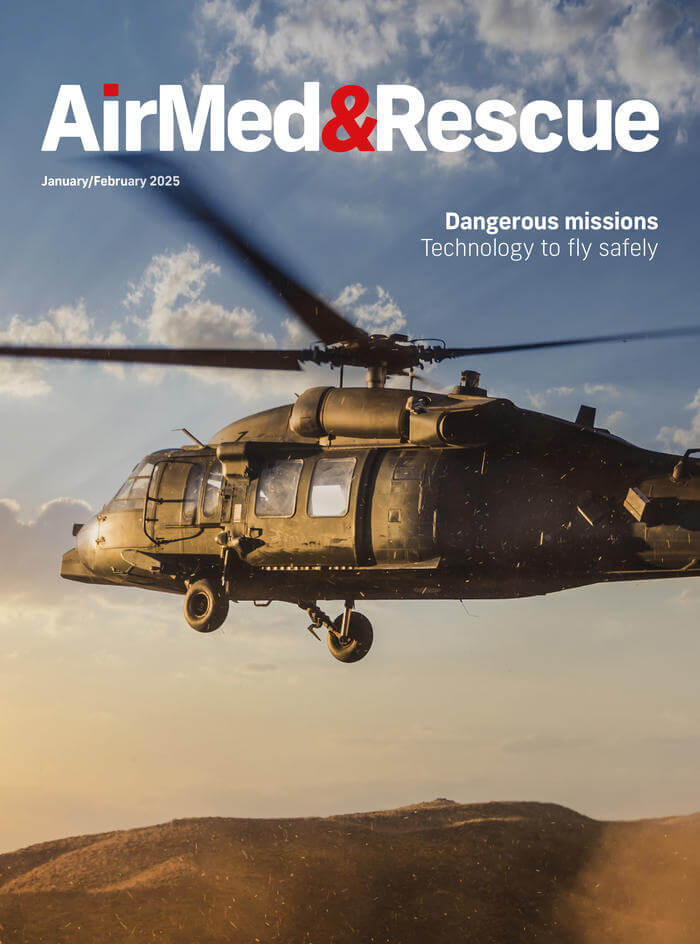
In our combined January/February edition, explore how islanders get emergency medical aid; find out about the way technology is being used to improve safety through increased situational awareness; discover all about hoist systems used in special missions; and see what is coming to the world of aviation in new platforms, technology and equipment; plus more of our regular content.
Amy Gallagher
Amy Gallagher is an internationally published journalist covering aviation, rescue, medical and military military topics, including training and technology, as well as evidence-based research articles. As a journalist by education and certified English instructor, Amy has worked in both agency and corporate communications, providing educational and promotional writing and training services.