
Rear crews benefitting from the latest simulation training capabilities

Jean-Claude Siew, Executive Vice President for Technology and Simulation at Bluedrop Training & Simulation, explains where the company has come from and the future of training rear crews to continuously improve proficiency
You recently celebrated your 10-year anniversary with Bluedrop. What has changed in the last decade regarding the simulation technology that you provide?
Bluedrop was mainly known as a reliable courseware service provider for Air Force and Navy programs. For the last 10 years, Bluedrop has heavily invested in research and development to add new training solutions to its capabilities. To improve its efficiency for courseware design and production, Bluedrop has evolved its unique Learninglogics software suite to provide productivity tools, which has saved more than 30% in traditional courseware production. Learninglogics is now used on all major Canadian defense programs and is also used on US defense programs, providing an efficient, rich media production capability and a high level of cybersecurity. As a complement to training, Bluedrop now provides technical publication services taking advantage of the synergies between the two outputs.
On the simulation product side, Bluedrop’s innovation has focused on bringing simulation training to helicopter rear crew and helicopter hoist operators. We have been successful in combining the latest virtual reality (VR) / mixed reality (MR) technology with high-fidelity haptics to provide a real-time, fully-immersive training environment so rear crews can benefit from the latest simulation training capabilities.
In both the above training solutions, the advent of VR/MR, high-fidelity helmet mounted displays (HMDs), and AI have influenced and transformed our solutions.
Looking at the next 10 years, what developments do you see happening with Bluedrop’s systems?
I believe that while the simulation technologies will continue to evolve, more importantly, Bluedrop systems will be complemented with a training process and methodology to facilitate the adoption of simulation training for rear crews as an integral part of helicopter operations. This training methodology will provide an objective, measurable performance-based evaluation of trainees’ initial and recurrent training requirements. The goal is to provide a way for helicopter operators to use simulation to train their crews efficiently and safely, and leverage all the advantages simulation training brings. To achieve this goal, the training will be bespoke and adaptable to the helicopter operators’ needs and operational environment. In addition, simulation training offers a theater to practice emergency procedures and mission rehearsals without worrying about blade time and the number of sorties. The simulation training methodology will be leveraged to have hoist operators 100% ready for successful in-flight ‘line checks’.
The system Bluedrop will put in place will leverage our Learning Management System (LMS) to provide evidence-based, personalized trainee assessment. This will provide access to objective data that will show skills improvements or gaps, and thus continuously improve proficiency.
How have the growth of special missions and the diversity of the mission profiles challenged simulation training and what solutions does Bluedrop offer?
This is not a big challenge for simulation training; it is actually an advantage that virtual environments offer. However, where Bluedrop differentiates itself from regular VR/MR solutions is the focus on the complementary fully dynamic haptics required to provide a realistic immersive environment. For example, in our Hoist Mission Training System, the simulation and the haptics provided by the cable is so close to reality that any trainee will just focus on the job at hand and will forget about being in a simulator. The physical interaction aspect of the training is as important as the virtual environment.
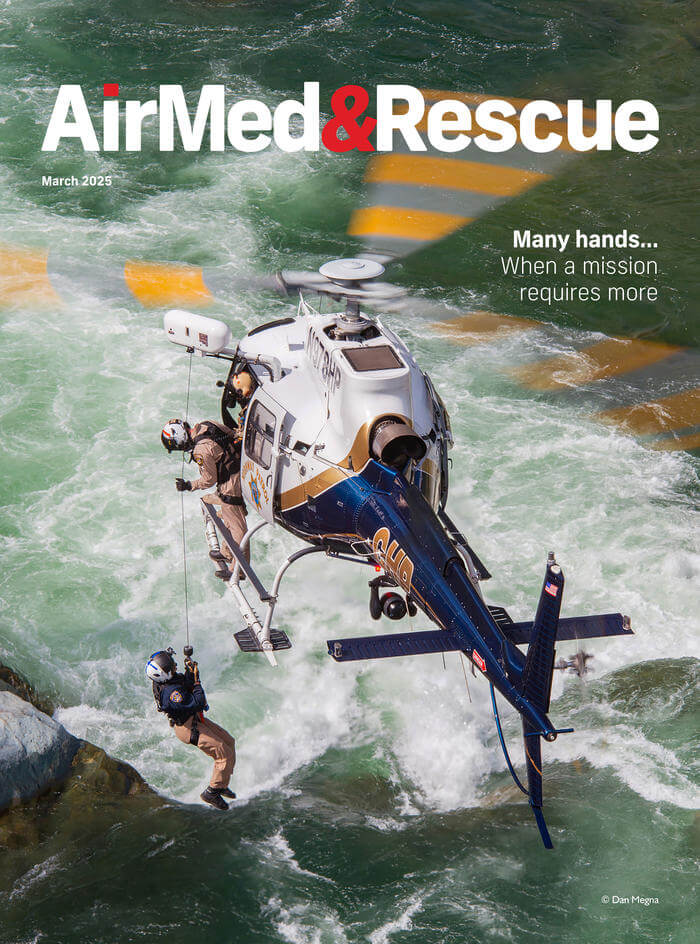
March 2025
Issue
Our March edition has features that let you discover the level of training provided by simulators; learn the ins and outs of medical interiors in aircraft; find out about how health and usage monitoring systems are changing special missions; and see how aerial firefighters communicate and coordinate their missions across multiple agencies and stakeholders; plus more of our regular content.
Editorial Team
The AirMed&Rescue Editorial Team works on the website to ensure timely and relevant news is online every day. With extensive experience and in-depth knowledge of the air medical and air rescue industries, the team is ready to respond to breaking industry news and investigate topics of interest to our readers.