
Rugged, portable, certified secure and ready to fly when others can't

Peter Fuchs, Co-Founder and President of Ascent AeroSystems, discusses the origins of the company and the inspiration behind its coaxial drones, and why they are ideal for public safety special missions
You co-founded Ascent AeroSystems a little over a decade ago. What inspired you to set up a drone company?
Ascent’s origin story is really one of the right people, with similar passions and the vision to want to build a better drone, meeting at the right time.
I met Ascent AeroSystems’ co-founders – brothers Jon and Nate Meringer – in an online drone forum in 2014. They were working at a rocket company in Arizona at the time and spent a lot of their downtime hiking and rock climbing. They would often get to the top of a climb, look back, and see there was a much easier way to get where they needed to be to start the climb. If only they’d been able to get this aerial view before heading out. Sure, consumer, hobbyist drones were available, but they knew they needed something really compact, lightweight, and durable, that could easily fit in a backpack.
On the other side of the country, I was working as a partner at a global consulting firm, and feeding my own lifelong passion for aviation and building things that fly in my home workshop. It’s something that I have been doing since I was a kid. I was working on a similar coaxial concept and struggling a bit. There is a huge online community for hobbyist drone builders and operators, and one night, I was in one of the forums and I ran across Jon and Nate’s prototype of a coaxial form factor drone that looked very similar to what I was working on, so I reached out. We connected, started talking, and right away we agreed… coaxial technology is hard. It is hard to get right, especially at such a small scale, but it is a better technology: more capable, more efficient, and the only technology that could deliver the combination of durability, portability, and performance we were all looking for.
Now, the coaxial technology at the heart of Ascent platforms is not new, it’s been around for decades. Why don’t more companies build coaxial propulsion drones and helicopters? Because it is hard. But when you compare coaxial technology to a quadcopter or other multi-rotor systems, especially on a smaller scale, the laws of physics and aerodynamics favor coaxial technology: two rotors are more efficient than four or more. Larger overall rotor diameter in a smaller footprint equals more lift. The cylindrical shape of the airframe produces less drag when in flight versus quadcopters, which then delivers better speed and greater range for the same power. We knew we had something. We co-founded Ascent AeroSystems in 2014 and began developing what was to become our first product – the Sprite. We launched a Kickstarter campaign for the Sprite in 2015. And, unlike almost every other crowdfunded consumer drone at the time, we actually built and delivered every product that was ordered.
Ascent’s Spirit and NX30 uncrewed aerial vehicles (UAVs) have this unique shape with a coaxial design. What are the other benefits of this type of vehicle over the ‘traditional’ designs?
Traditional quadcopter and multirotor designs are simple. They are easy to build and manufacture, and successfully deliver the ability to put a small vertical take-off and landing craft (VTOL) in the air where none existed before. And for consumer or hobbyist applications, for which they were developed, they are great. In contrast, our coaxial rotor systems have been shown to achieve exceptional performance and represent a significant step forward in the evolution of UAV technology.
The cylindrical shape of the Ascent airframe combines the simplicity of a sphere with the utility of a cube, enabling better structural strength and lower weight compared with conventional systems. The simplified airframe also has fewer moving parts and allows us to enclose critical components, making it more resilient to harsh handling, and allowing it to operate in environments that traditional quad- and multirotor aircraft cannot. Fewer parts also mean a simplified supply chain, easier maintenance, lower operating cost over time, and increased operational readiness and dispatch reliability. With the growing importance of drone-as-a-first-responder technology, having a system that is durable, portable, and ready and able to fly whenever necessary, is paramount.
In both our Spirit and NX30 platforms, combining the cylindrical shape with the centrally mounted coaxial blade system and the ability to carry a variety of different payloads, Ascent’s coaxial propulsion UAVs enable entirely new operating concepts that are not possible with traditional systems. They can be launched much more easily from moving vehicles (including trucks, aircraft and ships) and they take up a lot less room on the ground, so they’re easier to store and to transport.
With the ability to fly longer, farther, and faster while carrying more, Ascent’s coaxial drones deliver better performance in a smaller, easier-to-handle system that is ideal for public safety, military, paramilitary, and other emergency response operators who don’t have the luxury of choosing when or where they fly.
Having a platform that can perform in all weathers is a great asset for special missions. Was this by design, and how does it achieve this feat and out-perform other UAVs?
The short answer is yes, delivering a rugged, portable, all-weather capable aircraft was by design. From the very beginning our mission at Ascent AeroSystems has been to redefine how small UAVs are used; to deliver superior performance across all metrics – speed, endurance, payload flexibility, reliability – in even the most demanding environments. To do that, we knew we had to do something different. Right away we recognized that propulsion system and form factor needed to change.
Ascent’s cylindrical form factor enhances structural integrity, making it more resilient to harsh handling and extreme environments. The simplified airframe architecture also has fewer moving parts than traditional systems and an enclosed propulsion system. With all the critical components sealed within a waterproof core, Ascent platforms are able to operate in extreme conditions that might ground other aircraft (like high winds, heavy rain, intense heat, and low visibility), enabling effective, efficient operation in challenging conditions.
What else makes Ascent AeroSystems products stand apart from the rest of the market?
Beyond appearance, the most important differentiators of the Ascent platforms versus other similarly sized uncrewed systems lie in:
• Payload flexibility
• A credible legacy of aircraft-grade manufacturing
• Dispatch reliability.
The modular, open systems architecture (MOSA) strategy for both the hardware and software lets operators select the battery and sensor configurations best suited to the mission at hand. This flexibility, not available in comparable systems, mitigates platform obsolescence, even as sensor and software technology advances. Backed by Robinson Helicopter Company’s more than 50 years of Federal Aviation Administration-certified manufacturing expertise, Ascent UAVs are built using the same materials, processes, and standards found in the production of type-certificated crewed aircraft. Ascent’s small uncrewed aircraft system (sUAS) platforms are the only aircraft-grade platform available in their class.
For operators that don’t get to choose when or even where they fly, the rugged durability of the Ascent Spirit and NX30 platforms allows reliable dispatch in conditions that don’t support the deployment of crewed aircraft. Unlike many commercial-grade quadcopters – which are not designed for extreme conditions – the coaxial design excels in even the most challenging, austere, or hazardous environments.
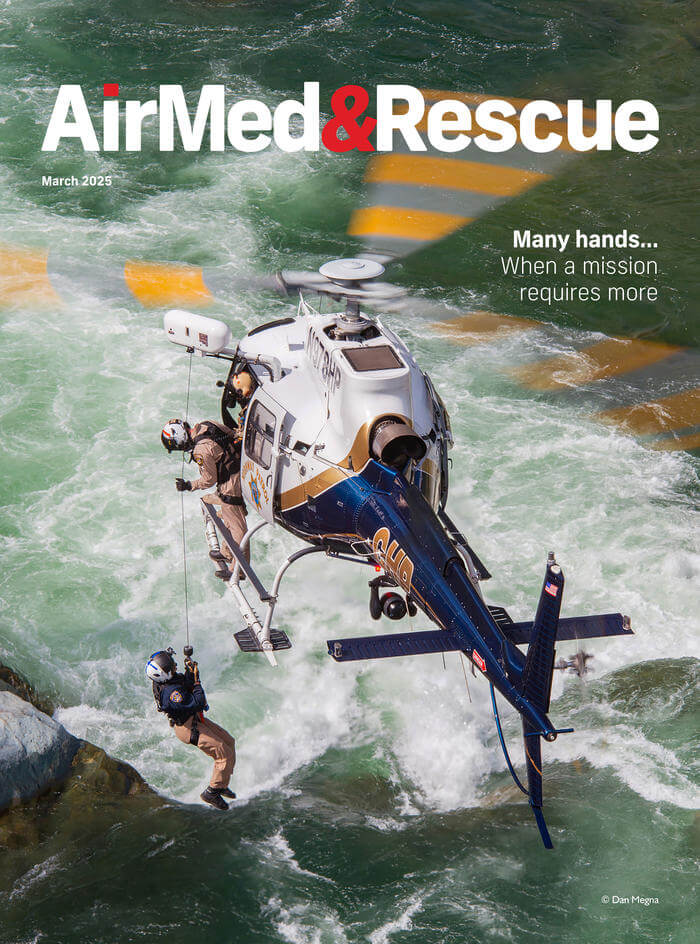
March 2025
Issue
Our March edition has features that let you discover the level of training provided by simulators; learn the ins and outs of medical interiors in aircraft; find out about how health and usage monitoring systems are changing special missions; and see how aerial firefighters communicate and coordinate their missions across multiple agencies and stakeholders; plus more of our regular content.
Editorial Team
The AirMed&Rescue Editorial Team works on the website to ensure timely and relevant news is online every day. With extensive experience and in-depth knowledge of the air medical and air rescue industries, the team is ready to respond to breaking industry news and investigate topics of interest to our readers.