

Safety first

Leonardo’s commitment to safety culture and strategy for rotorcraft is found at every level
A commitment to safety as a fundamental characteristic of Leonardo’s products and services is part of the company’s culture. Customers’ flight safety is its top priority and delivering safe helicopters is its primary objective. This approach is at the heart of all Leonardo’s activities, from design and production to customer services, with the aim of exceeding the most rigorous safety standards and continuously developing and supporting safety in every aspect. This is key for all applications and markets, including rescue and emergency response duties with the relevant products, technologies and services. Leonardo’s safety management approach is reflected in every structure of its internal organization and throughout the entire business network. Leonardo is a unique and structured entity, encompassing the full helicopter lifecycle: design and related certification (including supplier management), manufacturing, sales, maintenance and continued airworthiness, training for all personnel, and support for accident/incident investigation agencies.
Leonardo’s commitment to customer proximity and improving its helicopters’ availability and efficiency help to ensure the fulfilment of its primary duty of guaranteeing safe operations. The new area dedicated to customers provides direct access to all updated publications and information including the latest manuals, bulletins, maintenance instructions, information letters and safety information documents, which are essential for maintaining up-to-date safe helicopter operations.
Safe operations require thorough training and awareness from flight and maintenance operators. Leonardo believes in the key value of sharing the best safety practice through training, which is designed around products, experience, customers and their operations.
Safety requires collaboration, including with every stakeholder. Leonardo is an active partner in all the major safety networks and a proactive player in numerous safety-related initiatives and promotion activities in its sector. This cooperation ensures that the company stays up-to-date with the latest safety developments and provides a seat at the table for all major discussions and projects, national and international, that aim to promote and improve safety.
Leonardo’s product range meets or exceeds the latest certification and safety standards set by the relevant world’s aviation organizations. With transmissions and in-house avionics integration and development among its core areas of excellence, Leonardo’s types feature unique equipment, systems and capabilities, such as main gear boxes exceeding 30min run dry capability (50+ for the AW189 and 60+ for the AW139), proprietary collision avoidance systems such as the Obstacle Proximity LiDAR System (OPLS), the world’s first certified instrument flight rules single pilot four-axis automatic flight control system (AFCS) with search and rescue (SAR) modes, or the AW169’s auxiliary power unit (APU) mode to name a few examples.
Leonardo has also developed and reinforced over years the broadest spectrum of support and training services and technologies leveraging synthetic environments and simulation, digital remote support and advanced diagnostics/ prognostics and predictive maintenance, for example developing the Diagnostic Service Tower based in Sesto Calende and leveraging the davinci-1 high performance computer. Training includes all main simulation devices, from virtual interactive procedural training to Level D full-flight simulation, from virtual and ground maintenance trainers to mission trainers (eg for hoist operations and networked collaborative training).
Even in design, the growing use of digital technologies is further supporting safety by using development simulators for certification by simulation, function/ system and human–machine interface development, and digital twin applications before the latest developments are embedded and tested on real aircraft.
May 2024
Issue
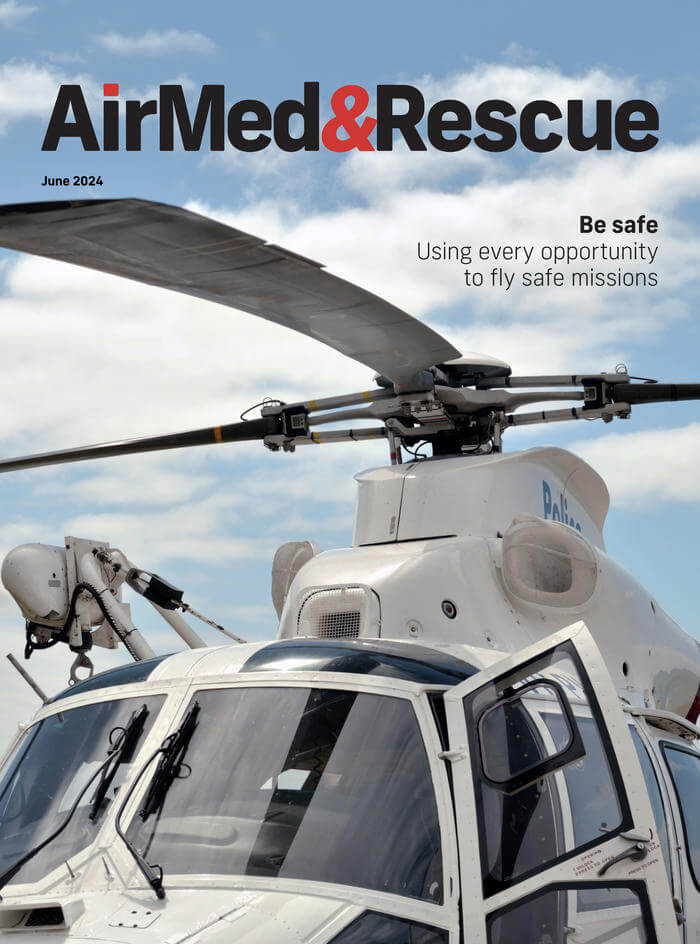
In our June edition, find out about the technology helping to make safety management better; learn about the tools that are reducing risks in flight; discover the challenges and problems facing the aerial firefighting community with suppressants and retardants; and read about what goes into electro-optical/infrared multi-sensor systems used by the police aviation sector; plus more of our regular content.
Editorial Team
The AirMed&Rescue Editorial Team works on the website to ensure timely and relevant news is online every day. With extensive experience and in-depth knowledge of the air medical and air rescue industries, the team is ready to respond to breaking industry news and investigate topics of interest to our readers.
