
SAR operations in Indonesia, the world’s largest archipelago state

With natural disasters, transport accidents and a challenging landscape to contend with, how do SAR agencies operate effectively in Indonesia? Strong leadership, cross-border cooperation and good technology certainly help, writes Robyn Bainbridge
In 2004, one of the world’s deadliest natural disasters to occur in the 21st century struck 14 countries lying along the Indian Ocean coastline. The Boxing Day earthquake and tsunami – which claimed the lives of over 220,000 people – hit the northwest coast of Sumatra, in Indonesia.
The havoc it wreaked was unimaginable, matched only by the tremendous humanitarian response that followed. Funding poured in from nations around the world, and search and rescue (SAR) teams were deployed from countries as far-flung as Sweden.
While this catastrophe was unusually savage in scale, it’s not an isolated incident for Indonesia. The devastating effects of natural disasters are felt here year after year.
A disaster-prone region
Over 17,000 islands make up the archipelago. Dotted along tectonic plates, Indonesia sits precariously between the Pacific Ring of Fire and the Alpide Belt. It’s no surprise, then, that the Australia-Indonesia Facility for Disaster Reduction warned that almost all regions of Indonesia had a probability of being hit by a tsunami disaster.
But it’s not just natural disasters that make the news here. Plane crashes and ferry sinkings occur on a frequent basis. And these kinds of incidents aren’t expected to abate: the International Civil Aviation Organization (ICAO) points out that aviation and maritime traffic is due to increase in Asia Pacific (APAC) in the coming years (the region already accounts for over one-third of the world’s passenger kilometers travelled). And with this growth, ICAO says, we’ll also see an increased need for aeronautical SAR services.

Indonesia’s national search and rescue agency
With all of this to contend with, SAR operations can be no easy feat. Luckily, Indonesia’s SAR agency, Badan Nasional Pencarian dan Pertolongan (Basarnas), is a model of coordination – which is critical for implementing an effective SAR response here.
“In Indonesia, Basarnas holds a position as a SAR agency equivalent to a ministry, with a direct responsibility under the President,” the agency told AirMed&Rescue. It’s tasked to coordinate and conduct SAR operations for maritime and aeronautical distress, as well as other disasters.
In 2021 alone, Basarnas carried out 2,264 SAR operations, including operations for airplane and ship accidents, as well as natural disasters and other life-threatening situations.
Basarnas cites the vastness of Indonesia’s territorial water (3.1 million km²) and land (almost 2 million km²) as a particularly challenging aspect of SAR
And this is no simple achievement. Basarnas cites the vastness of Indonesia’s territorial water (3.1 million km²) and land (almost 2 million km²) as a particularly challenging aspect of SAR. What’s more, the country’s population continues to grow (it’s believed to have exceeded 278 million in 2023, according to Basarnas) – further demanding SAR resource across this arduous landscape.
Cooperation across oceanic territories
So how does SAR come to be in a place like this? ICAO sums it up pretty neatly: “Considering that many of the APAC states have the challenging responsibility for providing a SAR service over vast and remote areas, including three of the world’s five oceans, the importance for states with oceanic SAR responsibility to cooperate, collaborate and share resources with their neighboring and regional/sub-regional Rescue Coordination Centers (RCC) is essential.”
It makes sense, then, that Basarnas has established 43 regional SAR offices – spanning the Sumatran province of Aceh all the way to Papua in New Guinea – to ensure that rescue services are on the scene at a moment’s notice when disaster strikes.
In recent years, Basarnas’ fleet has included the fixed-wing ATR 42-320, the AS365 Dauphin helicopter, the Messerschmitt-Bölkow-Blohm Bo 105 and the Agusta-Westland AW139. The aircraft are equipped with critical search and rescue equipment, including hoists for helping with evacuations.
Of course, a little neighborly help is always at hand as well, should they need it: “Basarnas has direct collaborations with foreign countries such as Singapore, Malaysia, Papua New Guinea, Australia, the USA, India, Sri Lanka, China, Vietnam, and others,” the agency said.

Reflecting on effective coordination
Collaboration is a key aspect of SAR operations in Indonesia. And, because Basarnas is centrally responsible for SAR relief across the country, it is at an advantage when carrying out a coordinated SAR response.
Because Basarnas is centrally responsible for SAR relief across the country, it is at an advantage when carrying out a coordinated SAR response
“Law Number 29 of 2014 requires all other ministries and institutions to provide SAR assistance when needed,” Basarnas said. Regulations like this give Basarnas an extra level of control when implementing a collaborative response. They also help the agency avoid unnecessary obstacles, like sociopolitical challenges.
That being said, coordination isn’t without its difficulties. “Whether it be airplane accidents or large-scale disasters in Indonesia … coordinating between stakeholders in the execution of SAR operations presents its own set of challenges,” Basarnas said. Reflecting on its response to the 2021 Sriwijaya Air plane crash, the agency praised strong leadership, masterful communications and the timeliness of the joint response effort (see box).
A shared responsibility
There are many players working alongside Indonesia’s SAR industry to improve the safety of its population. Unsurprisingly, the Indonesian meteorology and geophysics agency, BMKG, collaborates with Basarnas to provide early-detection systems for earthquakes, tsunamis, extreme weather, volcanic eruptions and other disasters. “This information is disseminated to Basarnas’ 43 SAR offices to provide the initial response in evacuating people,” Basarnas said. Other efforts to reduce disaster risk include community education programs on safety and evacuation procedures during disasters.
Elsewhere, Basarnas explained that an “abundance of volunteers” plays a key role in Indonesia’s disaster response activities. AirMed&Rescue reached out to the International Federation of Red Cross and Red Crescent Societies (IFRC) to learn a little more about this. The IFRC explained that Palang Merah Indonesia (PMI), the Indonesian Red Cross, has been known to perform SAR operations in support of Basarnas. “PMI also sometimes conduct SAR joint trainings with Basarnas, in both headquarters level and branch level,” the organization added. The representative said that IFRC has been known to provide funding support to PMI to conduct these trainings – particularly for PMI HQ, but this isn’t a regular part of its program.


The high price of large-scale rescue operations
On the topic of funding, Basarnas said that this element can pose a problem when large-scale SAR response is required: “The implementation of a mass rescue operation or large-scale search and rescue operation undoubtedly requires a very high cost.” The agency references incidents, such as AirAsia, Lion Air and Sriwijaya Air disaster response operations, where “substantial funding was needed”.
“Private insurance systems and volunteers can help reduce the state’s expenditure in carrying out SAR operations,” Basarnas said. “And currently, technological advancements within SAR can also reduce operational costs.”
Keeping up to date with evolving standards
This brings us neatly on to ICAO’s involvement in the SAR landscape. ICAO has a vested interest in improving SAR operations in Indonesia and beyond, particularly to mitigate future airline disasters.
AirMed&Rescue spoke to ICAO about some of the work it’s currently doing: “Both ICAO and International Maritime Organization (IMO) share the same goal of ensuring that SAR services are available globally,” it said.
ICAO has produced a substantial set of guidelines for SAR operations in the APAC region
ICAO has produced a substantial set of guidelines for SAR operations in the APAC region, known as the Asia/Pacific Search and Rescue (SAR) Plan. This document provides recommendations for APAC countries to “consider for the enhancement and improvement of national, sub-regional and regional SAR capability”. This includes things like:
- The harmonization of aeronautical and maritime SAR services
- Civil/military cooperation and coordination (including information sharing and use of airspace)
- Identifying and addressing any deficiencies in SAR capability
- Adherence to ICAO’s Standards and Recommended Practices.
From an outside perspective, Basarnas has done much to comply with these guidelines. But the truth is, evolving standards can be difficult to keep pace with. Especially without sufficient funding for up-to-date technology.
Take, for example, the Global Aeronautical Distress and Safety System (GADSS) – also established by ICAO in order to address “the vulnerabilities in the air navigation system (including the SAR system)”. It talks specifically of the “timely identification and localization of aircraft in distress”. A feat that relies upon advanced technology – for both the aircraft and the receiving response unit.
Similarly, Basarnas noted that the Global Maritime Distress and Safety System (GMDSS) “constantly adapts to the latest information technology”. Basarnas reasons that uncrewed aerial vehicles (UAVs) will be of great assistance to SAR: “These technological advancements significantly aid in the search and rescue process, as well as enhance the safety of both aviation and maritime activities.” But, as the agency wisely concludes: “The greatest challenge faced currently [by the SAR industry] is the rapid advancement of technology. This technological progress needs to be complemented by a skilled human resource pool.”
Disaster prevention and the future of SAR in Indonesia
Let’s go to back to the original scene. Yes, the 2004 earthquake and tsunami was an unusually large-scale disaster requiring an international response – both strategically and economically. But if we’ve learned anything from Sir David Attenborough, we know the role that global warming is to play in exacerbating natural disasters over the coming years.
Basarnas has demonstrated its mastery of SAR coordination. But for a country like Indonesia, the importance of advanced and unified technological resources cannot be undermined. Especially considering how critical things like UAVs can be for responding to less accessible distress situations.
Looking ahead, it seems very likely that collaborations, like those between natural disaster detection centers and SAR agencies, are likely to become central to operations in this region over the next decade. As Basarnas put it, SAR is a shared responsibility – coordination and cooperation is key to the success of any mission.
April 2024
Issue
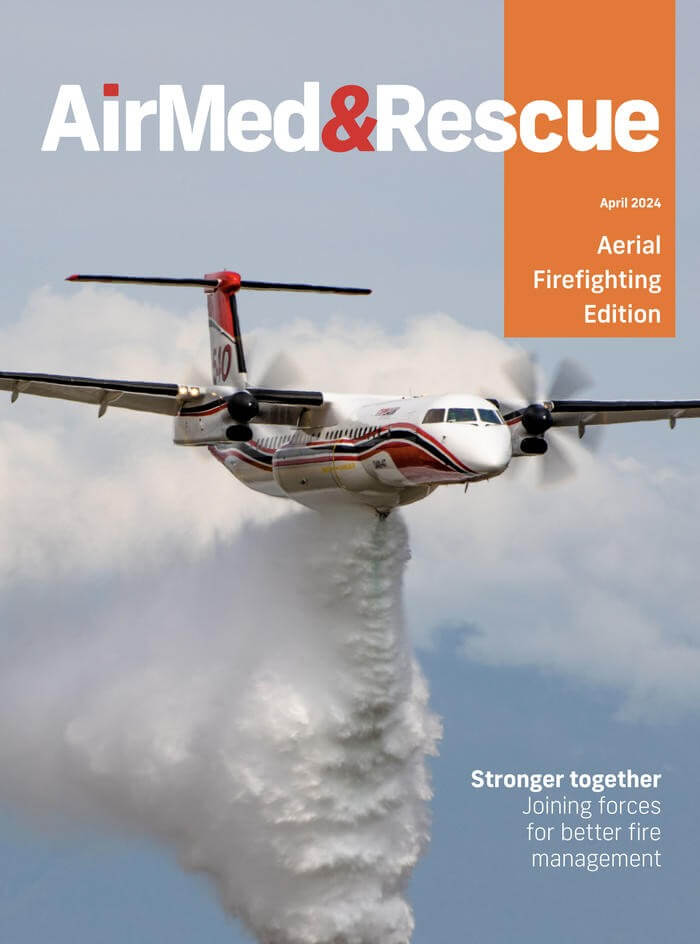
In the April special aerial firefighting edition, learn about the techniques and tools being employed; find out about the diverse capabilities of uncrewed aerial vehicles; see how the European Union is consolidating resources; review the damage that Australia has suffered from bushfires; explore Indonesian search and rescue processes; and consider if your helmet is due for a service or replacement; plus more of our regular content.
Robyn Bainbridge
Robyn is a writer with a degree in English Literature and over four years’ experience in creative journalism. She enjoys the inspiring ingenuity of the Gossamer Albatross (as well as the name).