
Stand-alone or integrated – ARTEMIS is capable of both

Peter Myers, Co-Founder of Smith Myers, explains how ARTEMIS, a multi-awardwinning mobile phone detection and location sensor designed specifically for airborne search and rescue (SAR), disaster relief, law enforcement, and border security missions, is versatile in its application
ARTEMIS is currently in operation in SAR roles from the Arctic Circle to the deserts of the Middle East. It’s been cited as a game changer by many users including the Royal Norwegian Air Force, Norway’s SAR operator. The system is available in several configurations suitable for crewed and uncrewed aerial platforms, and is a significant upgrade to any aircraft, either on its own or in conjunction with electro-optical (EO) / infrared (IR) sensors.
ARTEMIS
ARTEMIS is a hardware device that can turn any mobile phone into a location and communication beacon. It does not need any specific software running on the mobile phone, and the system can work within local cellular network coverage or in areas with no coverage at all.
The most popular ARTEMIS configurations for crewed aircraft are cellular only (T-U), and cellular with Automatic Identification System (AIS) and Search and Rescue Satellite Aided Tracking (SARSat) receivers (T-A). Both configurations only require two antennas mounted on the belly of the aircraft, and a connection to a GPS feed either directly or via ethernet connection. Neither requires a dedicated screen, as any existing screen with a web browser and IP connection (cable or Wi-Fi) can be used, including an electronic kneeboard.
ARTEMIS can detect and locate (resolved to latitude (lat) and longitude (long) coordinates) thousands of phones simultaneously 360 degrees around the aircraft. It can send text messages to all the detected phones (broadcast text) or to only targeted phones. ARTEMIS can receive texts from any of the connected phones, and can make and receive individual voice calls to/ from any of the detected phones. The location and other information are stored in MySQL database format and are easily shared with any integrating third party.
SAR AND MORE
In addition to the obvious SAR application, it is also possible, for instance, to determine the success of an evacuation by counting the number of phones before the evacuation, then counting again at intervals after the evacuation, and contacting the people still in the area.
The system can also give the location of members of the rescue teams on the ground. Real-time updates from overhead aircraft to ground teams enhance coordination, which is especially critical in fast-moving wildfire/disaster situations. Additionally, the fact that ARTEMIS is fully integrated into Civilian Team Awareness Kit (CivTAK), Android Team Awareness Kit (ATAK) and Apple Team Awareness Kit (iTAK), means for better all-round situational awareness.
STAND-ALONE
The core cellular transceiver used by the T-U system is also part of the T-A system, so has the same cellular performance.
Both systems operate using an embedded webserver where the user interface is via any web browser connected to the unit. This same interface gives access to any third-party mapping/mission system, permitting access to all of the connected mobile phones including the derived location.
The embedded mapping within ARTEMIS is standard, allowing detection and simultaneous display of thousands of mobile phone locations. ARTEMIS can filter out the unwanted identities and just calculate and display the lat/long of the phones of interest, then a specific phone can be selected and a voice call or text message sent directly.
INTEGRATED SYSTEM
As well selecting a specific phone, any mission system can easily read these locations, display on its own mapping and, if commanded, slew an EO/IR sensor to ‘look’ at any of the derived locations. This combination of avionics is a huge step forward in any SAR and/or police mission. In addition to speeding up the detection and location of any person, the combined system aids missions in instrument meteorological conditions (IMC) or low light conditions to have a very high probability of a successful outcome. The IR glow from the sensor pointing at the phone of interest can then be positively identified as the person you are looking for. Therefore, ARTEMIS offers a huge force multiplier to any existing aircraft with EO/IR sensor capability by accelerating the detection and identification of a person of interest.
ARTEMIS uses industry standard IP to communicate to any third-party mapping/ mission system from vendors such as Shotover, CarteNav, Hendsoldt, Flysight, Trakka, Teledyne FLIR, Rapid Imaging Solutions etc. Integration with an existing system can simply be the connection of a cat5 cable, power, two antennas and access to a GPS signal or reading.
Having already invested in the aircraft, EO/IR and training, it’s a small addition but a huge benefit to integrate ARTEMIS. The next move is yours, make sure it’s in the right direction.
March 2025
Issue
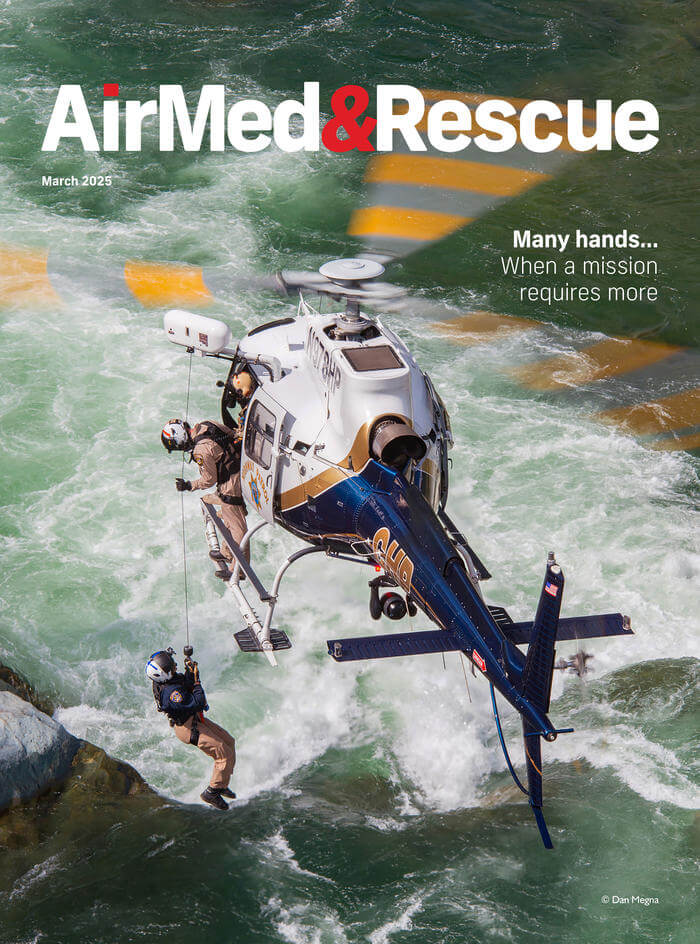
Our March edition has features that let you discover the level of training provided by simulators; learn the ins and outs of medical interiors in aircraft; find out about how health and usage monitoring systems are changing special missions; and see how aerial firefighters communicate and coordinate their missions across multiple agencies and stakeholders; plus more of our regular content.
Editorial Team
The AirMed&Rescue Editorial Team works on the website to ensure timely and relevant news is online every day. With extensive experience and in-depth knowledge of the air medical and air rescue industries, the team is ready to respond to breaking industry news and investigate topics of interest to our readers.