
From systems to workflow: improving decision-making in air medical operations

As airborne special missions grow in complexity, the challenge is no longer just managing individual systems. Increasingly, the focus is on how those systems support the full operational workflow, from initial request through to mission completion and follow-up. Krister Genmark, Senior Vice President of Revenue at Vellox Group, explains how this shift is changing the way teams operate day to day
There has been a lot of focus on integration. How is that changing the way operations are managed in practice?
We are starting to see a shift from managing systems individually to managing the workflow as a whole.
In many operations, each part of the mission has traditionally been handled in its own system. Dispatch, flight operations, safety reporting and maintenance all work well in their own areas, but the connection between them is often manual.
For example, once a mission is underway, information is often passed between teams at different stages, rather than flowing naturally through the operation. That creates extra steps and increases the chance of inconsistencies, particularly when teams are working under time pressure.
As systems become more aligned, the focus moves to how information flows between each stage. That means fewer handovers, less duplication, and a clearer link between what happens before, during and after a mission.
Where do you see the biggest gaps today when it comes to operational workflow?
The gaps are usually not within individual systems, but between them.
For example, when a mission request comes in, key details are captured early on, but those same details often need to be reentered later in the process, whether that is during dispatch, reporting or follow-up. That creates small delays and increases the chance of inconsistency.
We also see situations where a decision made in one part of the operation is not immediately visible to another team. That might be a change in aircraft status, a crew limitation or an operational constraint.
Those gaps are not always obvious, but they add up over time. In time-critical situations, even small delays can affect how confidently a decision is made. Closing them is less about adding new functionality, and more about ensuring that information moves reliably across the operation.
How does improving that flow of information change day-today operations for teams?
It makes the operation feel more joined up.
When information moves naturally from one stage to the next, teams spend less time managing systems and more time focusing on the mission itself, particularly when coordination needs to happen quickly. There is less need to double-check data or follow up on missing information.
It also improves coordination. When dispatch, operations, safety and maintenance are all working from the same flow of information, decisions are more consistent and easier to manage across teams.
That becomes especially important as operations scale or become more complex, where coordination across locations and teams becomes more demanding.
What does this shift mean for operators in practical terms over the next 12–18 months?
In practical terms, operators should expect systems to better support the full lifecycle of an operation, rather than individual steps.
That means less time moving information between systems, and fewer manual handovers between teams. Information captured at one stage of a mission should carry through to the next without needing to be re-entered or checked again.
It does not mean everything becomes a single system, but it does mean those systems work together in a more structured way. The focus is on reducing the effort required to manage information across the operation.
As that improves, operators will also start to see clearer insight into how different parts of the operation connect, whether that is safety, utilization or performance.
Ultimately, the goal is to make operations easier to manage day to day, while supporting faster, more confident decisions when it matters most.
June 2026
Issue
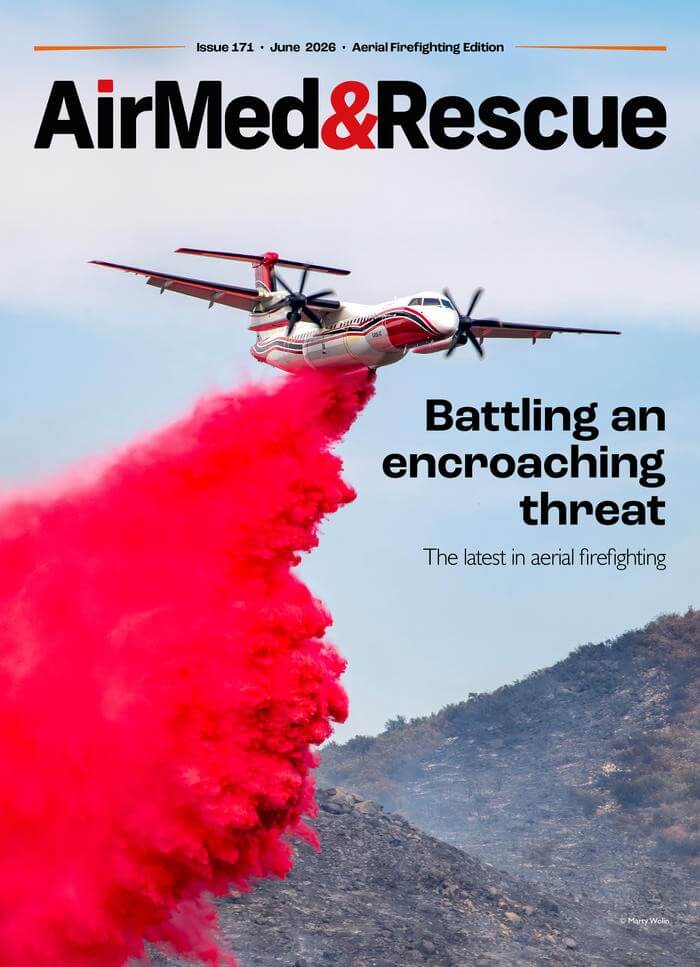
As the northern hemisphere heats up for another hot summer, I’m pleased to bring you the aerial firefighting edition of AirMed&Rescue. We have features on how climate change is accelerating firefighting technology; the improvements in Australian firefighting capacity; and getting ahead of wildfires before they become unmanageable.
Editorial Team
The AirMed&Rescue Editorial Team works on the website to ensure timely and relevant news is online every day. With extensive experience and in-depth knowledge of the air medical and air rescue industries, the team is ready to respond to breaking industry news and investigate topics of interest to our readers.