

Tactical intelligence: transforming real-time imagery into actionable information

Using the latest images to enhance situational awareness and support coordinated responses, FlySight is paving the way for more effective special missions
In modern operational environments, the ability to collect, process and interpret information rapidly has become a key factor in mission effectiveness. The increasing availability of high-resolution electro-optical (EO) imagery, combined with advanced data processing and visualization technologies, is transforming the way that tactical intelligence is generated and shared.
Today, the challenge is no longer only the acquisition of images. The real challenge is converting large volumes of sensor data into reliable, timely and actionable information that can support coordinated decisions across different operational domains.
Data fusion
EO systems provide critical visual information by capturing detailed observations of the environment. However, a single image source is rarely sufficient to build a complete understanding of a complex scenario. Effective tactical intelligence requires the integration of multiple data sources, including imagery, platform information, geographic references and metadata describing sensor position, orientation and acquisition parameters.
This is where advanced data fusion approaches become essential. By combining information from different sources into a unified representation, operators can achieve improved situational awareness, faster interpretation of events and enhanced coordination between distributed systems.
Simulation environments play a fundamental role in enabling these capabilities. Before deployment in operational scenarios, sensor systems and mission applications must be integrated, validated and tested under controlled conditions. A realistic digital environment allows developers and system integrators to verify data flows, communication interfaces and visualization capabilities without relying exclusively on live flight campaigns.
Architecture and AI
Open and standards-based architectures are particularly important in this context. Technologies supporting standardized video streams, metadata exchange, and interoperability between systems enable seamless integration between EO sensors, mission systems and external applications. This approach reduces integration complexity and accelerates the transition from sensor data to operational awareness.
The evolution of tactical intelligence is also closely connected to the increasing role of artificial intelligence and automated processing. Advanced algorithms can assist operators by identifying relevant information, highlighting potential areas of interest and reducing the cognitive workload associated with monitoring complex scenarios. However, human decision-making remains central: technology must provide clearer information, not replace operational judgment.
For this reason, the future of tactical intelligence will rely on a combination of high-quality sensors, robust data management, simulation capabilities, and intuitive visualization tools. The ability to reproduce realistic operational scenarios, validate system behavior and optimize information workflows before deployment will become increasingly important for nextgeneration defense and security systems.
Operational advantage
FlySight’s approach focuses on enabling this transition by providing advanced simulation and visualization solutions designed to support EO sensor integration, data validation, and system interoperability. By creating a digital environment where sensors, metadata and applications can interact seamlessly, OPENSIGHT helps organizations accelerate development cycles and improve the readiness of complex airborne systems.
In a world where information speed and accuracy directly influence decision-making, tactical intelligence is evolving from simple image collection into a complete ecosystem where data becomes knowledge, and knowledge becomes operational advantage.
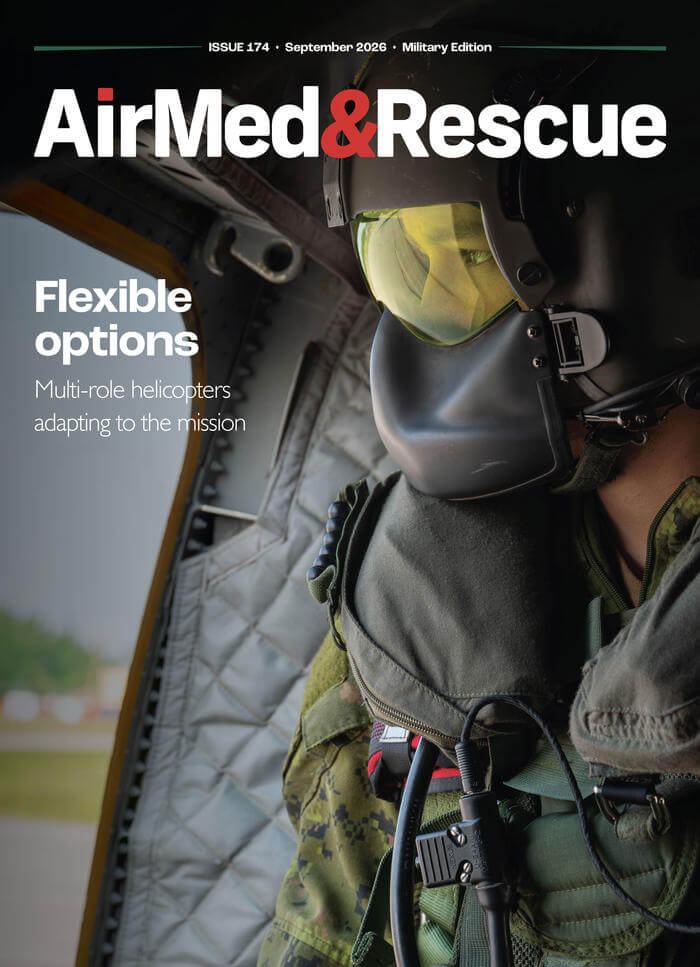
September 2026
Issue
As we reach the equinox, I’m happy that we have an interesting military edition of AirMed&Rescue for you to read on those longer nights. We have features on the benefits of governmental institutions having a multipurpose helicopter; why military operators are at the forefront of exploring optionally piloted aircraft; how uncrewed aerial vehicles are serving as platforms for sensors that can operate in extreme situations; and on the equipment that is essential to carry on board an emergency medical services aircraft.
Editorial Team
The AirMed&Rescue Editorial Team works on the website to ensure timely and relevant news is online every day. With extensive experience and in-depth knowledge of the air medical and air rescue industries, the team is ready to respond to breaking industry news and investigate topics of interest to our readers.