

Train the mission, not just the role

Hans Jákup Venned, FSTD Technician and Hoist Instructor at Atlantic Airways Aviation Academy, explains how the combination of the latest simulation technology at the Academy combined with the experience of operationally active instructors brings out the best training environment for pilots and rear crew
In most helicopter training programs, pilots and hoist operators are trained separately. Yet during a real search and rescue (SAR) or helicopter emergency medical services (HEMS) mission, neither works in isolation.
At Atlantic Airways Aviation Academy, that gap is addressed by connecting an AW139 full flight simulator with a mixed-reality hoist trainer, allowing cockpit and cabin crews to train together in the same scenario.
Work together, train together
The concept is straightforward. Pilots’ decisions affect hoist operations, and information from the hoist operator can directly influence what happens in the cockpit. Training individual skills remains important, but mission success often depends on how effectively the entire crew works together.
That thinking has shaped the helicopter training program offered by Atlantic Airways Aviation Academy in the Faroe Islands.
The operational backdrop is highly relevant. Atlantic Airways operates two Leonardo AW139 helicopters and provides 24/7 SAR and HEMS coverage in an environment that can be demanding even on a good day. Crews regularly operate around steep mountains, exposed coastlines and open sea while managing rapidly changing weather conditions. Missions can take them as far as 200 nautical miles offshore.
Those operational realities have directly influenced the Academy’s approach to simulation training.
At the Academy’s facility in Vágar, a Thales Reality H AW139 Level D full flight simulator is integrated with a Thales mixed-reality hoist trainer. The two systems can be linked so pilots in the simulator and hoist operators in the hoist trainer participate in the same mission simultaneously.
This is where the concept comes into its own. A pilot can manage aircraft positioning, weather, terrain, or an abnormal situation while the hoist operator works beneath the aircraft. Both are responding to the same scenario, sharing information and communicating exactly as they would during an actual operation.
The focus is not simply on individual competence, but on crew coordination, decision-making and communication across the entire mission.
“In a real SAR or HEMS mission, pilots and hoist operators are constantly influencing each other’s actions. We wanted to create a training environment where crews can practice those interactions in context, learn from the same scenario, and develop as a single team,” said Hans Erik Jakobsen, Head of Training at Atlantic Airways Aviation Academy.
A flexible system for varied situations
The integrated system can support offshore rescue scenarios, operations in difficult terrain, moving vessels, search patterns, and a wide range of hoist activities. Emergency and abnormal situations can also be introduced, including communication failures, stuck hoist cables, and cable-cut procedures. Night vision imaging system (NVIS) and forward-looking infrared (FLIR) operations can be incorporated into the training environment as well.
For operators, one of the key advantages is flexibility. Scenarios can be designed around the missions that crews actually perform.
A SAR operator working predominantly offshore may have different training priorities from an organization operating in mountainous terrain. Military and government operators may wish to focus on specific procedures, mission profiles, or operational requirements. The integrated environment allows those requirements to be incorporated into a shared exercise involving both cockpit and cabin personnel.
Beyond operational realism, simulatorbased training allows crews to practice situations that would be difficult, costly or impractical to recreate in the aircraft. Complex scenarios can be repeated multiple times in a controlled environment, enabling crews to test procedures, evaluate decisions, and maximize training value while reducing aircraft utilization.
Instructors also have far greater flexibility than they would during a live flight. A scenario can be paused and discussed, weather conditions can be changed, or an emergency can be introduced at a specific point in the mission. Crews can immediately repeat the same exercise and assess how different decisions influence the outcome.
That ability to repeat and refine is particularly valuable when training communication and procedures.
Clear crew communication
During hoist operations, cockpit and cabin crews rely on clear communication and a structured sequence of actions. Small misunderstandings can quickly affect the flow of an operation. By training together in the same scenario, crews can practice those interactions in context rather than in isolation.
The debrief then becomes equally valuable. Pilots and hoist operators review the same mission together, analyzing decisions, actions and communication from both perspectives.
No alternative better than experience
The Academy also brings operational expertise directly into the training environment.
The pilots and hoist operators delivering the training are active members of Atlantic Airways’ SAR and HEMS operations. Their experience comes from the same types of missions being recreated in the simulator, often under challenging Faroese conditions.
For many operators, that operational connection is as important as the simulator technology itself. Training can move beyond aircraft handling to focus on the practical realities of SAR and HEMS operations, including crew coordination, decisionmaking, and mission execution.
Atlantic Airways Aviation Academy already delivers training to civil and military helicopter crews from several European countries, including specialist SAR and HEMS operators and defense organizations.
Depending on customer requirements, programs can include integrated SAR and HEMS scenarios, hoist operations, NVIS, FLIR, and emergency procedures. Where appropriate, simulator training can also be combined with training in operational AW139 helicopters operated by Atlantic Airways.
The objective is not to replace aircraft training, rather, it is to use simulation for what it does best: practicing demanding situations safely, repeating critical procedures, challenging crews, and strengthening coordination across the entire mission team.
For SAR and HEMS operators, the ability to bring cockpit and cabin crews into the same training scenario offers a more complete way of preparing for complex missions. The technology itself is important, but the real value lies in allowing the entire crew to train, communicate, and learn together.
In an operational environment where coordination is essential, that shared experience can be every bit as important as individual proficiency.
Atlantic Airways Aviation Academy
Atlantic Airways Aviation Academy in the Faroe Islands specialises in search and rescue (SAR) and hoist training. Combining an AW139 full flight simulator with a connected mixed-reality hoist trainer, the Academy brings pilots and hoist operators together for realistic mission training, guided by instructors with active operational experience.
November 2026
Issue
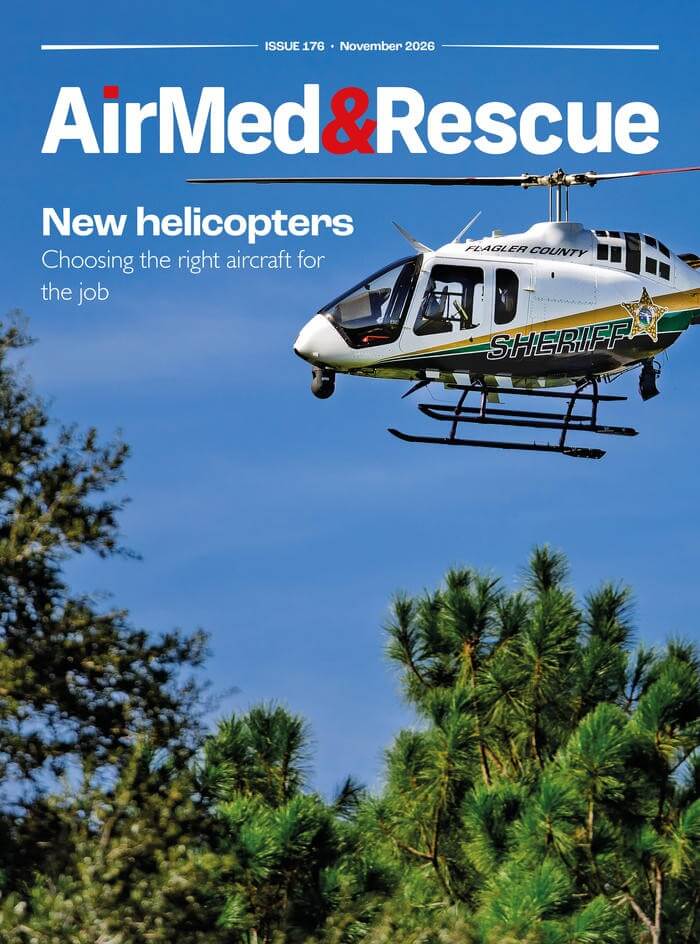
The November edition of AirMed&Rescue has a wealth of articles to keep you informed and engaged. We have features that explore the challenges associated with cable snag and entanglement; determine how and why special missions operators choose a new helicopter; look at the risks, regulation, and requirements of temporary helicopter landing sites; and examine the inroads that are being made by the drone industry into the medical sector.
Editorial Team
The AirMed&Rescue Editorial Team works on the website to ensure timely and relevant news is online every day. With extensive experience and in-depth knowledge of the air medical and air rescue industries, the team is ready to respond to breaking industry news and investigate topics of interest to our readers.
