
Training for any emergency – without the risk

Skills development and retention through simulation exercises are explored by Jennifer Ferrero as she talks with experts in the field
Simulation training is essential for skills development, preparedness, and effective stress management in helicopter emergency medical missions.
Skills development for emergency services personnel within Spokane County
In 2005 in Spokane County, Washington state, the Spokane County Sheriff’s Department received a Bell OH-58 helicopter from the US Army, designated as ‘Air 1’. The Spokane Regional Air Support (SRASU) unit was formed for search and rescue (SAR), fugitive searching, fire suppression, surveillance, homeland security critical infrastructure checks, natural disaster damage assessment, and patrol services to the Inland Northwest region of the USA.
Since then, it has partnered with the Spokane, Spokane Valley and Liberty Lake Police Departments, the Spokane Valley Fire Department and Spokane County Fire District 4. The sheriff and police departments act as tactical flight officers in the group, and the fire department offers clinical support with eight helicopter rescue medics (HRMs) and certified firefighters/paramedics. It has since acquired two more helicopters, a Bell 205 A+++ Super Huey and a Bell 505 Jet Ranger X, and has developed a 50ft-tall outdoor helicopter flight simulator for training.
Chief David Ellis of the Spokane Valley Police Department (and Vice President of the Airborne Public Safety Association) has advocated for helicopter emergency rescue and the collective operation of the SRASU. He said: “I think it is unique in that we have so many partner agencies coming together to provide this: the fire departments have the medical background, so it falls into their job descriptions and duties. The crew chiefs are the law enforcement officers of the organization, so they coordinate the missions with the Spokane County Sheriff’s Office. It flows well with the job responsibilities.” He noted that the pilots come to them already trained and experienced, but they also train as a team to ensure consistency and communication.
Ellis added that the training is in-person, hands-on and doesn’t use virtual reality or gamified simulation. However, they practice hoist operations, along with various emergency mission-related scenarios. They also employ manikins and live models to serve as victims in scenarios. “We aren’t doing virtual reality or simulators, but we create different terrains, weather conditions, patient injuries, body types, and scenarios to cover a variety of topics,” he said.
Ellis mentioned that when training emergency personnel, they provide modules on how to de-escalate stress. He emphasized the importance of communicating about workloads in managing stress. He also mentioned that using a training tower is less expensive than training during flights, and allows them to practice tasks such as hoisting patients repeatedly in order to be well prepared. According to Ellis, on-site training helps to reduce stress during practice.
Large-format air medical services US-wide through Air Methods
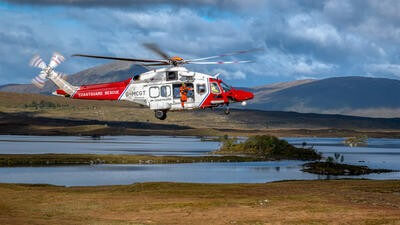
Air Methods is a sizable US-based company with over 5,000 employees with 300 bases in 38 states. It offers services with 450-plus helicopters and fixed-wing aircraft. It also provides clinical training
for paramedics and nurses, and pilot training. Air Methods considers itself “industry leading” in pre-hospital care
with air medical staff who “can handle diverse medical emergencies, including specialty transports”.
Its diversified simulation training offers two key areas: the clinical simulation department, led by William Belk, Director of Simulation and Innovative Education, and the pilot program, led by Kevin Drew, Chief Pilot.
The clinical education and simulation department’s mission is to provide world-class educational resources and simulation training to Air Methods’ employees, partners and customers, with a focus on enhancing patient outcomes and safety through evidence-based practices and continuous learning. Air Methods offers a variety of training opportunities, from online training to state-of-the-art simulation centers with manikin and cadaver-based hands-on training, as well as remote and in-person virtual reality experiences. According to Belk, all of its training solutions are based on evidence-based practices, current research and internal data collection to ensure programs meet or exceed industry standards.
Belk has been with Air Methods for 10 years and has been responsible for the company’s simulation program since 2018. He said: “Simulation cases are based upon an ongoing needs assessment. We look at what’s going on clinically as a company, our performance metrics, and our goals for the year. From there, we design simulations that address key performance indicators.”
We design simulations that address key performance indicators
They routinely develop new scenarios, which take 40–80 hours to design – write, test, and review for accuracy. “Every new scenario goes through a multi-step process to ensure quality and accuracy; we focus on including subject matter experts who are better versed in treating a specific patient population to review the details of the case.” He indicated a question they may ask in scenario development is: “Do these lab values match up with the patient’s vital signs?”
In some cases, when developing scenarios, they are asking what type of incident has occurred – a vehicle or industrial accident, or perhaps a drowning. They ask how that specific patient would present. For example: “Is it a closed injury like certain fractures or a head injury? Is the patient bleeding out because of an amputated leg? Are they in shock?” He said that with each scenario, they must understand the simulated patient’s injury or illness to accurately portray their presentation, lab results, vital signs, and mental state.

“A significant amount of effort goes into these cases.” They write 30 to 50 simulated cases per year. A ‘scenario’ or ‘case’ refers to a simulated patient encounter lasting 15–30 minutes. Each of these is a learning event for the clinicians. Ultimately, they want to prepare clinicians to respond to real-life emergencies. “We are trying to prepare them for anything they could run into while also assessing their ability to do the stressful job they’ve been hired and trained for.”
Regarding stress management during patient encounters, Belk said: “We replicate patient conditions as realistically as we can, so when they are called out, they are focused on the patient in front of them and are able to openly communicate with their partners in stressful situations.” Air Methods trains all employees on crew resource management (CRM) and closed-loop communication, to reduce the risk of errors and improve patient and crew safety.
Drew conducted training with pilots and said it differed from the training conducted with clinicians. He shared that they have five flight simulators in Denver, Colorado. They use them for helicopter training and check pilots annually and for recurrent training. They also have fixed-wing flight simulators in different spots around the USA. “Simulation puts pilots in real-life scenarios where we look at core competencies – decision-making, use of automation, manual skills, and CRM. We can do all of these things in a relatively safe environment.”
They record the sessions to enhance learning and look for learning in their debriefs
They record their training events and say they can put pilots in scenarios and conditions outside their comfort levels and in reduced visibility. Drew asks: “Can they recover the aircraft? Can they fly in the clouds (which they train the pilots to avoid)? We can evaluate their ability to utilize core competencies.” They record the sessions to enhance learning and look for learning in their debriefs. He said he could let the pilots get into more profound situations than if they were flying. This is a great exercise in simulation, Drew said, and the learning curve is higher because they don’t need to intervene or stop the exercise. To him, using simulation means “you aren’t increasing the risk to a pilot’s life or health”.
International simulation training with software and equipment
Bluedrop Training & Simulation, a small/medium enterprise based in Halifax, Nova Scotia, Canada, stands out in the industry with its specialized simulators for rear crew training using mixed and virtual reality platforms. Jean-Claude Siew, EVP Technology and Simulation, a nine-year veteran of the company, revealed their strategic expansion from Canada to the USA and now into Europe, Australia, and Asia.
Siew said that rear crew simulation is an expanding industry, whereas pilot simulation training is well known and broadly accepted. “We are bringing structure into training methodology – initial, recurrent, and mission or tactical training. It is a work in progress as organizations see the benefits as much as pilots do with simulation training. The goal is to get adoption of simulation training for rear crew and make use of simulation as much as for the pilot – we have the same high-fidelity simulation level for the rear crew.”
Bluedrop’s simulation training not only enhances the rear crew’s readiness but also reduces costs and increases proficiency. Siew highlighted: “Simulation training allows for unattainable readiness levels in real-life scenarios. With the advancement of technology, we can replicate situations that are too risky to attempt to train in a real helicopter.”
Siew stated that hoist mission and rear crew training is very physical work, not only in procedures but also in physically acting on the cable and equipment. “You need to be able to physically manage the cable and operate equipment for muscle memory. You can do classroom and virtual static training to get ready, but the training needs to be on the equipment.”
You need to be able to physically manage the cable and operate equipment for muscle memory
Bluedrop’s training programs include hoisting in good weather and flat terrain, then training in inclement weather and rough terrain. “The gain is getting people to do recurrent training for low-repetition, high-risk scenarios, for example trying to save sailors from a sinking ship in adverse conditions. You don’t want to do it in real life, but when you do it, you want to be able to do it right. You put people in stressful situations and react to the mission; you introduce difficulties to make the situation more realistic, using the capabilities of the simulator to become proficient.”
Siew explained that when teaching fine motor skills in simulation, Bluedrop worked extensively with subject matter experts to understand how a cable operates in the wind with weight. He said that small things like the location of the door handle in the helicopter must be in the right place. He added: “To ensure proper muscle memory and motor skills, the simulator must combine the physical elements with mixed and augmented reality. The student may wear a head-mounted display looking over the ocean at 200ft, then look to the left to see a control panel and see their own hands.”
Putting customers’ needs at the forefront of simulation provision
Entrol is a Spanish simulation company that develops, produces and delivers a range of flight simulators around the world. Explaining how it approaches its development goals from its formation in 2005 to the present day, Claudia Calleja, Business Manager, said: “We collaborate closely with our customers to provide products that meet their expectations. Our improvements are driven by customer feedback, ensuring we are headed in the right direction. Since November 2024, we have enhanced many of our products and solutions. For example, we have launched the first LED visual system featuring a cylindrical screen and floor setup. This innovative solution allows users to have better definition, contrast, and look down during missions, making a significant difference and closely resembling real flights and missions.”
Simulation is only effective if the fidelity of the simulator is high. That means the visual cues are realistic and the physical environment within and without the craft closely resemble the real world. Calleja described how important it is to have access to affordable and realistic simulators for pilots and the type of work that they have to do: “Simulators are essential tools since the safety of pilots and missions depends on their training. A cost-effective solution that allows for more training hours than the strictly necessary enhances aviation safety. Every pilot who has used our simulators has remarked on how realistic they feel compared to flying the real aircraft. We strive for excellence in each of our simulators. For example, our full-flight simulators feature ENVISION, our latest high-definition image generator based on Unreal Engine. The quality of the graphics and the ability to customize databases provide an exceptionally high level of realism.”
With an in-house simulator, you can conduct more training hours than just the minimum required for proficiency checks, thereby enhancing safety
Calleja continued: “The main objective of Entrol simulators is to make training cost-effective and accessible. Operating a real aircraft can be expensive and potentially dangerous, especially depending on the type of training. On the other hand, external full-flight simulators often come with long wait lists, high costs, and the need to relocate pilots for training sessions. Given the current pilot shortage, this may not be the most efficient option. With an in-house simulator, you can conduct more training hours than just the minimum required for proficiency checks, thereby enhancing safety. Additionally, training using your own databases allows for more realistic training, particularly for operators involved in SAR, helicopter emergency medical services (HEMS), firefighting, police work, and similar fields.”
Simulation products are not ‘one-and-done’; they are constantly evolving, iterating and improving, like many other aspects of aviation training and technology. Entrol is no different, explained Calleja: “Entrol is constantly improving and investing in new developments to stay at the forefront of technological advancements. While we focus on perfecting cockpit details, we are also committed to improving our additional features, such as the mixed reality hoist operator station, the different visual systems (e.g. LED visual systems), the image generators, etc.” Furthermore, they can be added to, upgraded and adjusted depending on one’s requirements, said Calleja: “We like to refer to simulators as ‘living things’: this means you can upgrade them by adding additional options to expand their capabilities.”

Entrol works with the special missions sector to help provide training that is needed in the specialized and unique situations in which operators are expected to fly. Calleja detailed how Entrol tailors its training for a range of missions: “In an Entrol simulator, operators can train for a variety of missions, including firefighting, SAR, HEMS, law enforcement, and offshore operations. Our ENVISION IG features a mission package that recreates realistic mission scenarios, allowing operators to practice in their specific databases and mission locations. This is crucial because realistic training ensures that operators are well prepared for real-life situations, even considering the unpredictable challenges that may arise.”
She continued: “During missions, numerous factors must be taken into account. The more control operators have over the situation, the safer the outcomes tend to be. This can be improved with more training in the simulator.”
Effective training for multi-crew operations is crucial for the success and safety of operators in complex mission environments
Many organizations will have fleets where craft will have a complex crew makeup, and multiple craft operating on a scene at one time. Coordination within and between craft is essential not only to prevent duplicating work or working across purposes, but also to ensure the safety of everyone involved. This is reflected in training and having the ability for simulators to account for this added layer of complexity. “Effective training for multi-crew operations is crucial for the success and safety of operators in complex mission environments. To address this need, we have developed innovative solutions, such as the mixed reality hoist operator station. This solution enables communication among the pilot, co-pilot, and hoist operator, ensuring that each member of the team is well coordinated during critical rescue missions. Additionally, our simulators can be interconnected, allowing operators with larger fleets to train simultaneously and create collaborative scenarios, fostering teamwork and strategic thinking,” explained Calleja.
The approach to training using simulators is not simply to practice flying, but it also affords the opportunity for companies to focus and maximize the effectiveness of the training on their staff in a safe way, locally. Calleja stated: “With your simulator, you can provide training beyond the regulatory requirements to enhance operational security and efficiency. It allows for the training of emergency situations, cockpit management, CRM, etc. You can also create scenarios that combine specific operations with emergency training. Another advantage is that you can standardize company procedures using the simulator instead of real aircraft. This approach can reduce costs compared to training on an actual helicopter or with an external full-flight simulator. Additionally, training in-house increases the operational availability of pilots, as it eliminates the need to travel abroad for full-flight simulator training.”
Adaptable and standardized training for global special missions
Air Rescue UK has been supporting mainly SAR operations in the Falkland Islands, Europe and Africa and has, on an ad hoc basis, supported other operations and operators in the Far East, Middle East and the Caribbean. Although its core experience is in SAR, it also has experience in other areas of helicopter operations employing rear crew. Alongside operations, Air Rescue UK has been providing training support and direct training for eight years. Through its relationship with Bluedrop Training & Simulation, Air Rescue UK has been providing helicopter hoist operations (HHO) training on the Hoist Mission Training Simulator (HMTS).
With training, in the traditional manner and with simulators, having instructors that are experienced and capable is as important as having the right tools. Ian Bonthrone, Air Rescue UK’s Managing Director, said: “Experienced instructors are vital to delivering training. Rear-crew operations in helicopters are far more than just demonstrating certain skills, particularly in hoist operations where the context of the mission, other crew, environment, external actors and the nature of the casualty all have a bearing. Likewise the diversity of student has changed over the years and nobody has the luxury that might have been available in the military of providing extended mentored time ‘on the job’. Good instructors, to deliver positive outcomes without too much attrition, need to understand not only the learning process required for individual students, but also have the ability to understand more than what the student needs to improve and be able to discover what the barriers to advancement are. Key to learning is not just experienced instructors but supportive instructor professional development system and support, that includes development of the skills for synthetic teaching and assessment.”
Using simulators may seem like it’s all virtually difficult to quantify the benefits, but it has real results, said Bonthrone: “Partnering with Bluedrop Simulation & Training in Canada, we have been successfully using their HMTS with a diverse range of students. In the past year we have assessed and trained 24 external HHO crew, trained five HHO crew for oil and gas SAR, returned an HHO crew person to flying after 25 years away from the industry, trained overseas military in hoist and emergency procedures, and conducted return to flying training for a crewman who had lost his confidence. Additionally, we bring all our HHO crew on oil and gas SAR back to the simulator each year for hoist emergency procedure training that cannot be realistically carried out on the wing. Those numbers alone demonstrate the benefit of simulation.”
Bonthrone detailed how the training process can be molded to the needs of the students, but also standardized so that the training is equitable: “We have built a model of training that, based on a comprehensive training needs analysis and student gap analysis, quickly allows a program of training to be constructed that meets the requirements. From that model we can, if required, build the content of each core module to meet the regulatory requirements or existing operations manuals of the customer and, if needs be, we can change the simulation environment so that it replicates the usual areas, worldwide, where the student will be flying. Moreover within those same modules we can change the aircraft being used. The key benefit of a set of standardized modules and in-built content is that each student has equity! In that they will each conduct the same scenario in exactly the same position with exactly the same environmental conditions.”
The key benefit of a set of standardized modules and in-built content is that each student has equity! In that they will each conduct the same scenario in exactly the same position with exactly the same environmental conditions
Simulation also provides benefits beyond training in situ. Bonthrone said how the simulator can be used to reinforce and review training, as well as provide lessons to a wider student body: “Previously in flying training for rear crew, performance was wholly based on the subjective view of an instructor at a moment in time and for debriefing what that instructor had remembered. The ability to record and review training has some large benefits: firstly the instructor has evidence to back up what he wants to debrief and if he thinks he may have missed something he can review before debrief. Additionally the instructor can use the recorded evidence within the debrief to demonstrate good and poor performance behaviors. Finally vicarious learning can be achieved through mutual peer review amongst a group of students.”
Simulation for realistic and safe training
Simulation training methods can include physical helicopters positioned at a height, virtual reality experiences using headsets, and mixed reality incorporating physical elements and gamification. Interviewees said they focus on gathering data and creating various rescue and clinical scenarios involving factors such as victims, weather conditions, terrain, and stress management for training purposes. Therefore, using and analyzing data is critical in preparing training scenarios that create more realistic and memorable simulations.
March 2025
Issue
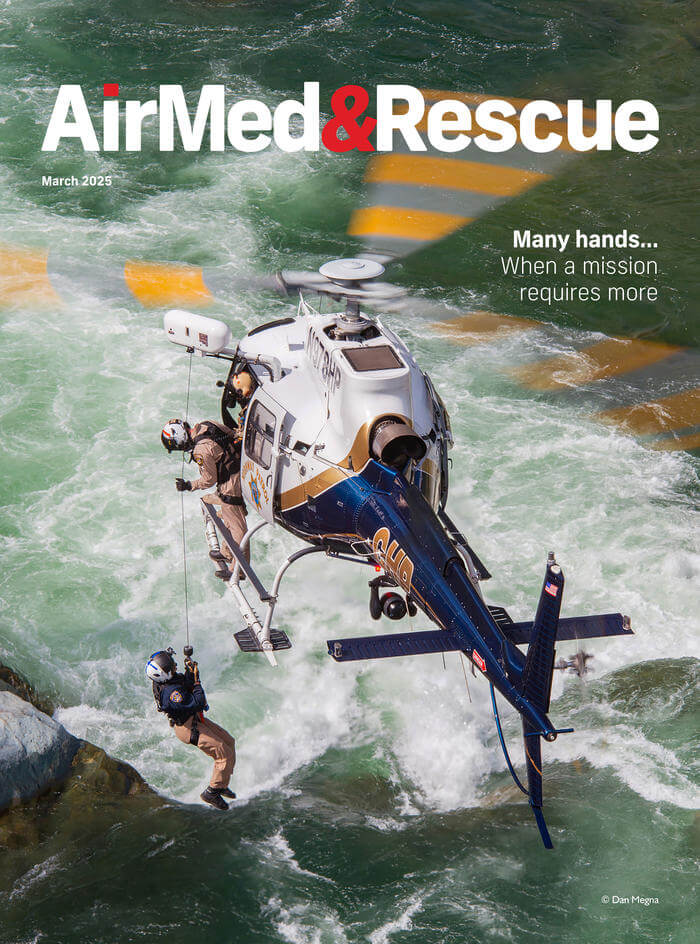
Our March edition has features that let you discover the level of training provided by simulators; learn the ins and outs of medical interiors in aircraft; find out about how health and usage monitoring systems are changing special missions; and see how aerial firefighters communicate and coordinate their missions across multiple agencies and stakeholders; plus more of our regular content.
Jennifer Ferrero
Jennifer Ferrero owns Ferrero Agency. She focuses her writing on feature stories for aerospace and manufacturing trade publications. She also provides marketing and public relations services. She has been an entrepreneur and writer for over 25 years. She lives in Spokane, Washington.