

Training with custom visual models

Tailoring a service with authentic real-world environments ensures that pilots trained by Coptersafety are fully immersed and prepared for the missions they perform
Level D full-flight simulators provide a realistic training environment almost identical to training in the real aircraft, due to immersive elements such as a full motion platform, vibrations, smoke generation and more.
GOING FURTHER FOR REALISM
Visual fidelity is key in creating a realistic training environment. For helicopter pilots, seeing a realistic landscape from the cockpit – even outside the perimeter of the airport – is of great importance. The whole world is already available in our full-flight simulators, with the Whole Earth Generic Database, which provides a ‘default’ scenery of the globe. It may not always be fully detailed as needed, particularly with buildings or roads, so we take it one step further by creating custom visuals for operators with recognizable and detailed environments for their training.
Our in-house visual modeling team can create and tailor custom scenarios through realistic gaming areas and environments. Whether it’s an airport, hospital, oil rig, ships, powerlines, etc. any structure or landscaping can be modeled.
CUSTOM SCENARIOS
Rather than generic scenes, pilots can train with visuals specific to their operational environment. This provides a custom and tailored training, that can be combined with tailored training scenarios, and a flight instructor whose experience can match the operation.
While it is easy for instructors to change the visuals in the simulator with the press of a button, the process of creating custom visuals can take a couple of weeks to a couple of months, depending on the size of the area.
Let’s use an example of creating custom visuals for a helicopter emergency medical services (HEMS) operation with models of a hospital helipad, and a nearby airfield where the heli-base is located. We aim to model as large areas as possible, to include the surrounding area from the hospital to the heli-base. Alternatively, we can model the hospital and heli-base as separate items, with the surrounding area as default scenery.
REALISM AND IMMERSION
We need data to build models. Whether that’s aerial and satellite images to represent the terrain, or high-quality photographs taken by the operator, for example, a good photo of a heli-base wall can texture the helibase model, making it more realistic.
Modeling thousands of buildings in a large city would be costly and time-consuming, so autogenerating buildings with datasets can offset some of that time. However, most work with custom models, such as hospital area buildings and airfield buildings, is still done by hand.
Even when a full model is ready in daytime lighting, our team ensures that the model also has a night version and has accurate dawn/dusk versions. We also create winter versions of the model. This ensures that the pilots can train for operations that happen any time of day, in any weather.
“Making any model is always a challenge. It is a new entity somewhere in the world, that very often we have never visited or know anything about. So, there is always some learning about new places, countries, cities, and so on, involved in the process. We like creating all kinds of models, but the most interesting are large areas, since they pose the most challenges,” said Markus Vuorinen, Visual Modeler.
It is important for us to ensure pilots trained at Coptersafety have the most realistic and immersive training experience. From custom visuals in the simulator, a tailored training program, to pairing the pilot with an instructor with decades of experience in the same mission, we aim to customize training for your mission at every step.
May 2026
Issue
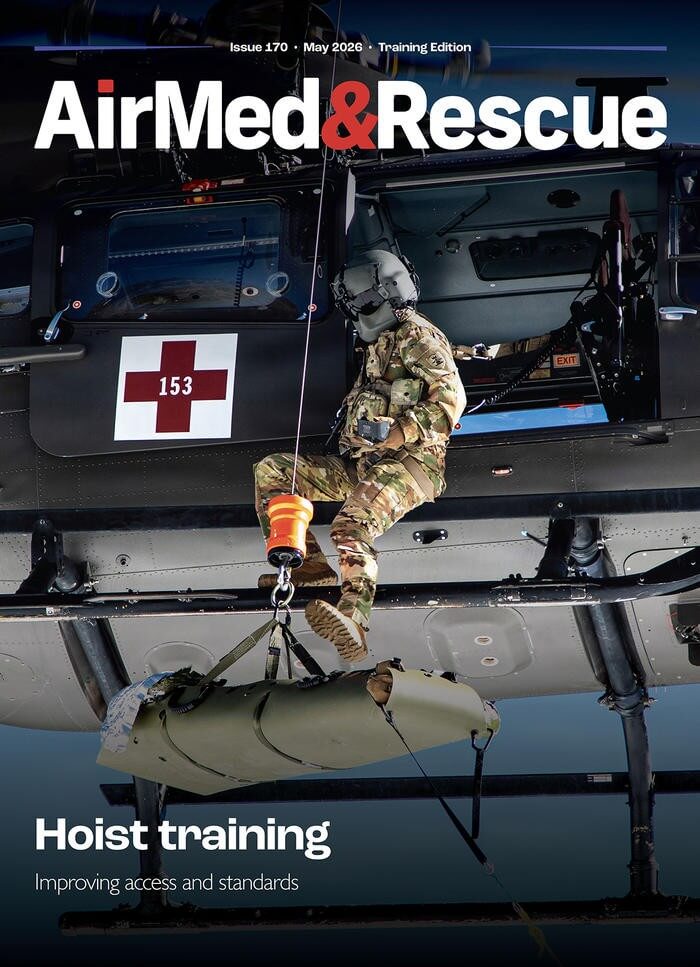
Training for special missions is on another level, so it’s a great pleasure to bring you the training edition of AirMed&Rescue for May. We have features on night flights for police aviators; the simulators for military special missions training; the systems and scenarios for hoist operations; and engineering training for airframe and powerplant mechanics.
Editorial Team
The AirMed&Rescue Editorial Team works on the website to ensure timely and relevant news is online every day. With extensive experience and in-depth knowledge of the air medical and air rescue industries, the team is ready to respond to breaking industry news and investigate topics of interest to our readers.