
Training evolution in the HEMS hoist environment – from day operations to night capability

Trevor Abraham, Managing Director of Air Rescue UK, details how a review of an Italian helicopter emergency medical services operator revealed a need for a reduced dependency on aircraft availability and an increased training frequency and flexibility to meet operational demands
In 2017, I had my first opportunity to work in Italy within a helicopter emergency medical services (HEMS) environment. What I encountered was a mature, hightempo European rescue system operating at a scale and intensity that differed significantly from my previous experience. The clinical side of the operation ran continuously, day and night, while simultaneously integrating a new aircraft type and expanding its capability. From the outset, it was clear that structured, scalable training was fundamental to sustaining safe and effective operations.
Over time, the operation transitioned from daytime hoisting to a fully integrated 24/7 rescue service. This evolution incorporated capabilities such as night vision goggles (NVG), enabling operations to extend safely into the night environment. This shift was not simply an extension of working hours; it fundamentally changed the risk profile and required a step change in training standards. Existing hoist skills had to be adapted to a degraded visual environment, where depth perception, spatial awareness, and crew co-operation became more complex.
To support this transition, training evolved beyond basic qualification and moved toward continuous skill development. Crews were required to build upon established hoisting competencies while integrating new techniques specific to NVG operations. This included refined communication procedures, enhanced crew resource management, and a greater emphasis on standardisation. Rather than replacing existing skills, night operations added another layer to the ‘toolbox’, reinforcing the need for adaptable and resilient operators.
A key factor in this development was the strengthening of relationships within and across crews. Trust and familiarity became critical, particularly in high-risk environments such as confined areas or mountainous terrain at night. Over time, these relationships enabled more effective teamwork, faster decision-making, and a shared understanding of operational expectations.
However, as the operation expanded, it became clear that traditional training methods – heavily reliant on live flying hours (‘blade time’) – were not sufficient to meet demand. This led to the introduction of the Hoist Mission Training System (HMTS), which represented a significant shift in training philosophy. By incorporating simulation-based training, the organisation was able to reduce dependency on aircraft availability while increasing training frequency and flexibility.
The HMTS enabled several key advancements. It supported ab initio training for new crewmembers, allowing foundational skills to be developed in a controlled environment before exposure to live operations. It also provided a platform for instructor development, ensuring that training standards could be maintained and scaled as the operation grew. Importantly, it allowed crews to practice complex or high-risk scenarios that would be difficult or unsafe to replicate in real flight conditions.
This blended approach, combining live operations with synthetic training, enhanced both safety and efficiency. Crews were better prepared, instructors were more consistent, and the organisation was more resilient to operational pressures.
In conclusion, the transition from day-only hoist operations to a fully integrated day–night capability required more than new equipment; it demanded a comprehensive evolution in training. By building on existing skills, fostering strong team relationships, and embracing simulation technology, the operation was able to expand safely and sustainably. This case highlights the critical role of adaptive training systems in supporting modern HEMS operations, particularly in environments where complexity and demand continue to grow.
Trevor Abraham
Trevor is Managing Director of Air Rescue UK and an experienced hoist operator across operations and training. He is passionate about advancing operational capability and improving safety in rescue aviation. A dedicated father and mental health advocate, he champions resilience, wellbeing, and strong team culture in highpressure environments.
May 2026
Issue
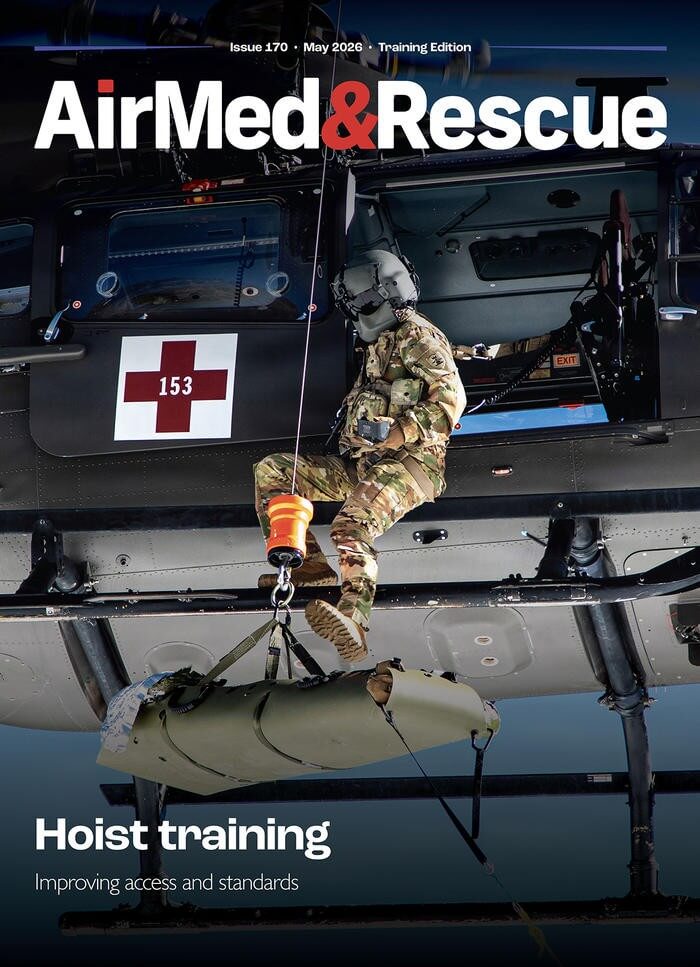
Training for special missions is on another level, so it’s a great pleasure to bring you the training edition of AirMed&Rescue for May. We have features on night flights for police aviators; the simulators for military special missions training; the systems and scenarios for hoist operations; and engineering training for airframe and powerplant mechanics.
Editorial Team
The AirMed&Rescue Editorial Team works on the website to ensure timely and relevant news is online every day. With extensive experience and in-depth knowledge of the air medical and air rescue industries, the team is ready to respond to breaking industry news and investigate topics of interest to our readers.
