
Training for NVIS in the simulator

Matt Presnal, Coptersafety’s Chief Theoretical Knowledge Instructor, Ioanna Athenasiou, Coptersafety’s Lead AW139 Theoretical Knowledge Instructor, and Eetu Peuraniemi, Coptersafety’s Chief Flight Instructor, explain the importance of making the most out of simulators for night flight training
For many operators, night vision imaging systems (NVIS) are an essential aid for low-light and night flying. Typically, NVIS consists of night vision goggles (NVGs) and corresponding cockpit lighting modifications. There has been an increase in the utilization of NVIS in civil operations, such as helicopter emergency medical services, search and rescue, and law enforcement.
NVGs provide pilots with some visual cues that they lose in nighttime flying, increasing operational safety by improving situational awareness. When properly trained, pilots can better manage night operational risks. The need for this system is put nicely in a Federal Aviation Administration (FAA) study (DOT/FAA/RD-94/21, 1994): “When properly used, NVGs can increase safety, enhance situational awareness, and reduce pilot workload and stress that are typically associated with night operations.”
A DIFFERENT PERSPECTIVE
However, NVGs provide a different view than what you can see during the day or even what is seen below or around the goggles. They affect your depth perception, field of view, and the green (or white) view creates a new working environment for pilots to adapt to. Pilots need specialized training to safely and effectively fly with NVGs.
The NVIS training philosophy is broken down into two parts: initial and advanced NVIS training. Initial training is a standard baseline to familiarize pilots with the basic principles of operating NVGs in normal and emergency conditions. Advanced training builds upon that baseline and focuses developing specialized skills for certain operational environments.
SAFETY FIRST
The most important factor is always safety – to learn safe practices to fly with NVIS, and to train safely. NVIS training with NVGs can be done in a full-flight simulator to train in a safe and controlled environment while developing specialized skills for their operations.
The simulator can be great for initial exposure and familiarization of the cockpit and NVGs, without taking an aircraft out of operation. It’s also beneficial for focused training on operational needs, with scenario diversity and repeatability for aircraft complex conditions, and weather / night lighting conditions. Simulator training is safer when practicing high-risk NVG tasks – such as wire and obstacle avoidance, confined area landings, aircraft and/or NVIS emergency procedures – without endangering the crew or the aircraft.
KEEPING SKILLS FRESH
Training in a simulator can also be extremely useful for pilots who do not regularly fly in nighttime conditions but need the skills due to the nature of their operation. Eetu Peuraniemi explained that “as a HEMS pilot, I’ve had to adopt a low amount of flight hours annually, but that [doesn’t change] the fact that I’m responsible for maintaining my skills to conduct demanding HEMS NVIS night missions with only a few minutes' readiness time. From my perspective, this is only possible via implementing efficient training scenarios. The simulator is the only place where I see my own ‘readiness’!”
Pilots need to understand the use and limitations of NVGs, and train effectively to ensure safe operations. By doing so, pilots will be better prepared for the mental workload of operating in NVIS conditions.
Our NVG training focuses on building the pilots’ skills, and the confidence in handling emergency scenarios with NVGs. Get in touch with our team to schedule your NVIS training.
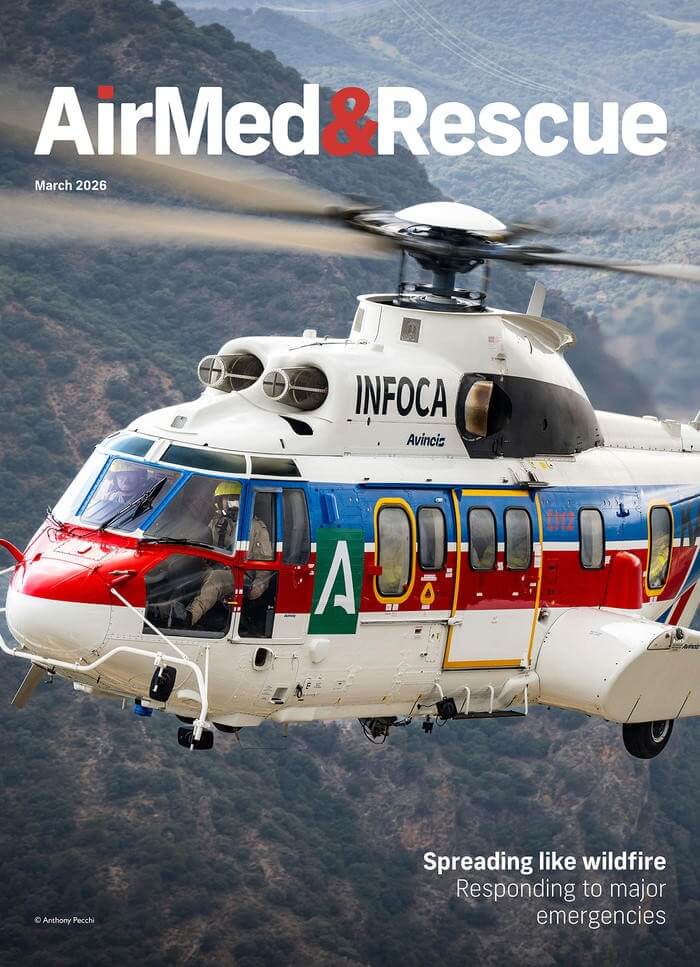
March 2026
Issue
This edition is bursting at the seams with articles from all corners of the special missions sector. We have features on the California wildfires that ravaged the state last year, what the cost–benefit analysis looks like for single-engine rotorcraft and autorotations, how the mission dictates the modification needed to the platform, and what can be done to further prevent the problems associated with inadvertent entry into instrument meteorological conditions.
Editorial Team
The AirMed&Rescue Editorial Team works on the website to ensure timely and relevant news is online every day. With extensive experience and in-depth knowledge of the air medical and air rescue industries, the team is ready to respond to breaking industry news and investigate topics of interest to our readers.