
Transmitting Patient Data

Flightcell DZMx allows aircrew and the emergency department to be in constant contact and to share critical patient information
Transmitting real-time patient data from an air ambulance to an emergency department (ED) is crucial – it provides patients with the best possible medical treatment and, in the direst of situations, can save a patient’s life. For this to occur, operators must have installed a communication system that provides 100% connectivity no matter how remote the location is. Flightcell provides the perfect tool for this and is also an approved flight data monitoring system capable of recording flight performance data, complying to Federal Aviation Administration (FAA) rule 135.607 for helicopter air ambulance operators.
Using cost-effective cellular services when in range, and the Iridium satellite network when out of cell range, the Flightcell DZMx provides air medical operators with the certainty that they can always communicate to ground personnel no matter where their mission takes them. DZMx is an all-in-one cellular and satellite voice, data and tracking system that easily fits into a standard avionics panel. It provides certainty to medical crew so they can send and receive patient data en route to the ED. DZMx uses high-speed data connections over ethernet or Wi-Fi to transmit patient data in real time. A common example of data being transmitted is electrocardiogram (ECG) data, where air medical operators regularly attend to patients suffering cardiovascular events. The DZMx can transmit 12-lead ECG data to the ED so cardiology specialists on the ground can be briefed and communicate back to the air medics on how to best treat the patient, all while preparing and determining the care required for when the patient arrives at the ED.
An optional addition to the DZMx is the Flightcell DZMx Remote Head, which is used by many of Flightcell’s air medical customers. The Remote Head unit allows users of the DZMx to control their voice, data and tracking functions from multiple remote locations in the aircraft. It is more often installed in the aircraft cabin by air medical operators, which allows air medics to communicate directly with ground personnel. This bypasses the need for communications to go through the flight crew, a significant benefit where every second counts in providing patients with the best care.
Flightcell is well trusted and proud to partner with several air medical operators in North America, Europe, Australia, and New Zealand. “We are proud to have longstanding relationships with Avincis, Classic Air Medical, and the Royal Flying Doctor Service to name a few – all who perform hundreds of emergency medical services missions every year,” said Jonathan McWatt, Flightcell Marketing Director. The DZMx is a versatile system and is installed on both helicopters and fixed-wing aircraft – helicopter installations are mainly on Leonardo, Airbus and Sikorsky platforms, while for fixed wing, the DZMx is mainly installed on the Pilatus PC-12 and PC24, and Beechcraft King Air.
The communication between air ambulances and hospitals is a significant factor in a patient’s treatment and medical outcome, and Flightcell is proud that their communication system plays a vital part in ensuring the best care is provided to every patient en route to the ED.
October 2024
Issue
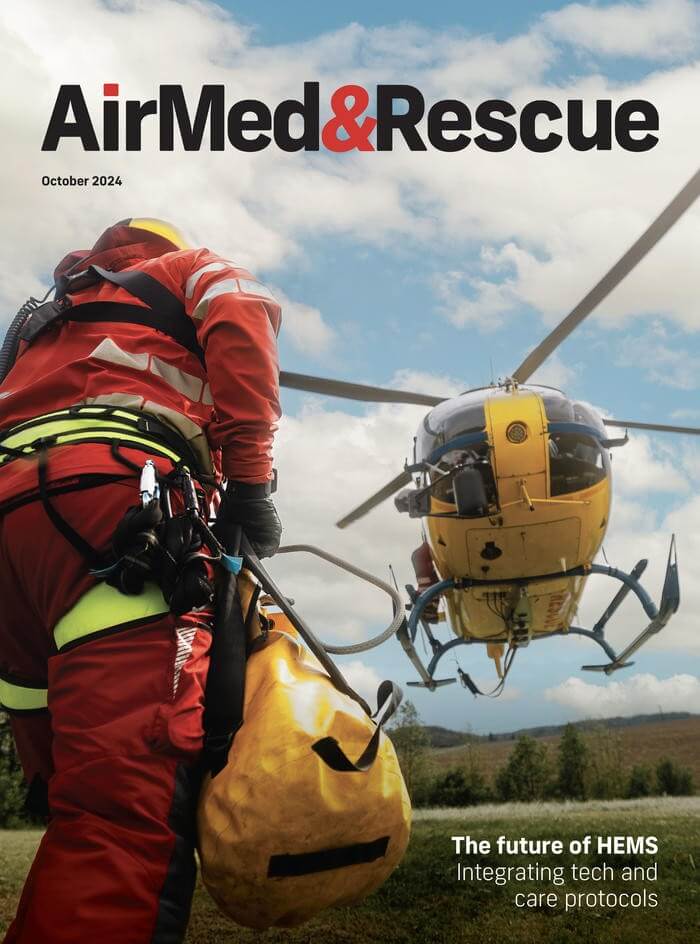
In the October edition, see how the training for special missions is achieved; discover the latest developments in emergency medical services; find out about the considerations needed for transporting neonatal and pediatric patients; review the effects of the northern hemisphere’s recent wildfire season; and learn about the importance of egress training; plus more of our regular content.
Editorial Team
The AirMed&Rescue Editorial Team works on the website to ensure timely and relevant news is online every day. With extensive experience and in-depth knowledge of the air medical and air rescue industries, the team is ready to respond to breaking industry news and investigate topics of interest to our readers.