
Ventilation makes a difference

Eva Wild and Vanessa Kühn from WEINMANN Emergency explain the advantages of a ventilator for improved outcomes
Airway management and ventilation are some of the most important, yet challenging situations faced by the emergency medical services (EMS). Manual ventilation seems to be an easy task but various studies show that it is difficult, despite regular training. In extreme situations, ventilation must maintain respiratory function and ensure oxygen supply if the patient is unable to breathe on their own. Resuscitation is one extreme situation where the quality of ventilation matters and consistent ventilation can be life-saving.
WHY IS MANUAL VENTILATION DIFFICULT?
Bag-valve-mask ventilation is a method that is frequently used because it is supposedly easy to do, fast and lightweight. It involves attaching a resuscitator, which is usually connected to an oxygen source, to a face mask. The mask is held on the patient’s face, covering both nose and mouth. At the same time, the resuscitator is squeezed, causing oxygen to flow through the patient’s airways. The valve prevents the oxygen flowing back into the resuscitator.
Free airways, an adequately sealed mask and the correct technique are key for this procedure. Two first responders are normally required. In actual fact, this method is not easy to implement, and studies show that even experienced EMS providers have difficulties with it.
“In only three out of 106 cases all guideline-relevant ventilation parameters were met with bag-valve-mask ventilation during CPR [cardiopulmonary resuscitation].”2
Most importantly, it lacks a reliable method for measuring the ventilation volume or the pressure that is exerted on the airways. The delivery of oxygen by squeezing the resuscitator can only be controlled to a limited extent. Without real-time feedback, there is a high risk of excessive ventilation volumes or dangerous pressure peaks that can cause damage to the lungs.
A further problem with bag-valve-mask ventilation can be an excessive ventilation rate with too many breaths per minute. This hyperventilation may have negative effects on the patient’s circulatory condition.³
ADVANTAGES OF VENTILATORS
Mechanical ventilation offers a number of advantages in direct comparison with bagvalve-mask ventilation. Studies show that mechanical ventilation leads to a better ventilatory status in terms of arterial blood gases and hemodynamic parameters of the patient even when transport times are short.4,5
Ventilators are also advantageous when it comes to crew resource management (CRM). Usually, two EMS providers are required for effective bag-valve-mask ventilation. Ideally, one person should attach the mask to the patient’s face and hold it in place, while the other person carries out the actual ventilation. However, this ties two EMS providers to one task.
In contrast, the advantage of ventilators is that EMS providers are able to perform other tasks and duties associated with emergency, so the patient can be given more effective care.6 This reduces the manual work required and allows medical staff to concentrate on the cause of the emergency.
“Using a ventilator, EMS providers can complete more tasks, document them more fully, and provide the patient with better care.”6
At first glance, the equipment for bag-valvemask ventilation looks more compact and lighter to carry, but ventilators can also be lightweight and portable. In addition, they are easy to operate, and their functionality is less dependent on the EMS provider’s precise technique than is often the case with bag-valve-mask ventilation.
WHAT IS NOW THE BEST WAY TO VENTILATE?
Coming back to the original question – from our perspective a bag-valve-mask is essential and will continue to have its place, at least as a back-up device. However, out-of-hospital mechanical ventilation should be established in EMS as early as possible to maximize patient safety and guarantee the best and most consistent treatment, even when transport times are short.
REFERENCES:
1. Idris AH, Ecenarro EA, Leroux B et al. Bag-valve-mask ventilation and survival from out-of-hospital cardiac arrest: a multicenter study. Circulation 2023;148(23):1847–1856.
2. Neth MR, Benoit JL, Stolz U, McMullan J. Ventilation in simulated out-of-hospital cardiac arrest resuscitation rarely meets guidelines. Prehosp Emerg Care 2021;25(5):712–720.
3. Aufderheide TP, Sigurdsson G, Pirralloet RG et al. Hyperventilation-induced hypotension during cardiopulmonary resuscitation. Circulation 2004;109(16):1960–5.
4. Hernández-Tejedor A, González Puebla V, Corral Torres E et al. Ventilatory improvement with mechanical ventilator versus bag in non-traumatic out-of-hospital cardiac arrest. Resuscitation 2023:192:109965.
5. Chauhan A, Rajesh VSP, Pujara J et al. Comparison of hemodynamic consequences of hand ventilation versus machine ventilation for transportation of postoperative pediatric cardiac patients. Ann Card Anaesth 2023;26(2):166–170.
6. Weiss SJ, Ernst AA, Jones R et al. Automatic transport ventilator versus bag valve in the EMS setting: a prospective, randomized trial. South Med J 2005;98(10):970-6
Vanessa Kühn
Vanessa Kühn is the Head of Marketing and Clinical Affairs at WEINMANN. She has a bachelor’s degree in biomedical engineering and has been working in the field of emergency and transport ventilation since 2012. Together with practitioners and researchers, Vanessa is involved in different research projects in the field of emergency ventilation.
November 2024
Issue
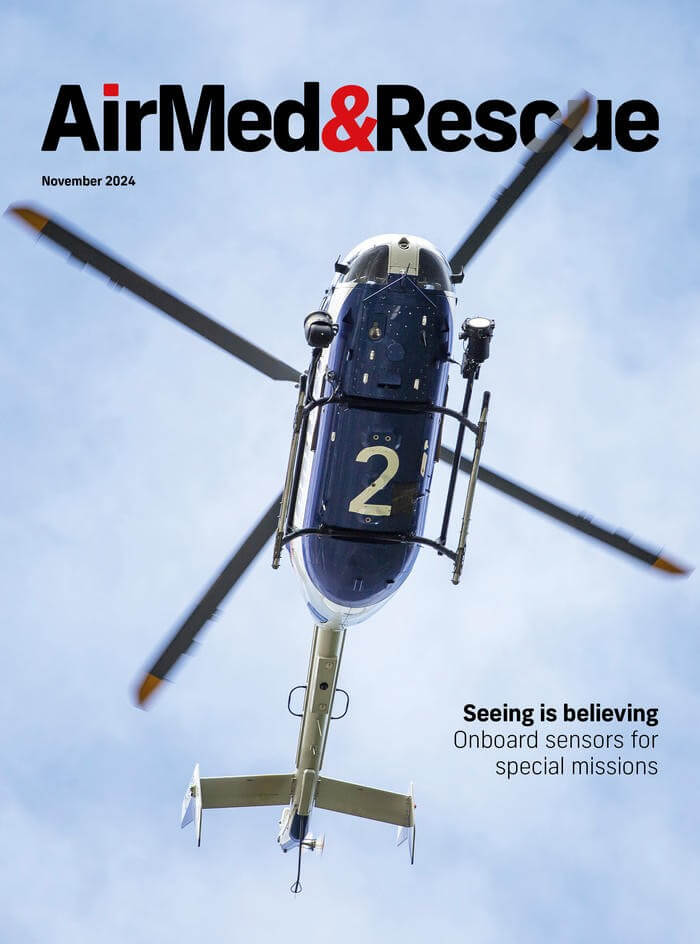
In the AirMed&Rescue November 2024 edition
Special missions often fly in challenging conditions covering large areas, so sensors are used to narrow the search, highlight targets of interest, and perform safer flights, among other benefits; aerial firefighting is facing greater demands upon its resources, so operators and organizations are expanding their assets and abilities with drones that can be flown at a low cost with a high safety margin, allowing the conventional crewed craft to focus on other roles; and the complexity of rear crew winching requires equally complex and involved training to ensure that live missions are conducted successfully and safely.
Plus, we have all of our regular content to keep you informed of the events relating to worldwide special missions.
Editorial Team
The AirMed&Rescue Editorial Team works on the website to ensure timely and relevant news is online every day. With extensive experience and in-depth knowledge of the air medical and air rescue industries, the team is ready to respond to breaking industry news and investigate topics of interest to our readers.