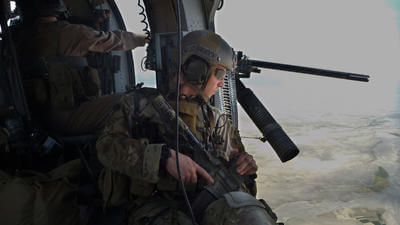

What does it take to become a US Air Force PJ?

Former US pararescueman Brian Silva shared some insights with AirMed&Rescue about what it takes to become a member of the elite US pararescue force
In terms of physical fitness, what is the test to become a PJ actually like?
The test for entry to pararescue involves minimum of each of these in two minutes: eight pull ups, 50 sit ups, 40 pushups. Then a 1.5-mile run in under 10 mins 20 seconds, a 500-meter swim in under 12 mins 30 seconds, and two 25-meter underwater swims at a three-minute interval.
This is just to get your foot in the door, there is no specific graduate standard for selection, but rest assured you will be pushed to your limit in order to see what you are made of.
Becoming a PJ is much more than being physically fit. What does it take mentally?
One of the biggest factors in being a PJ is that you will be working in small teams. The people you are working alongside will have to know that you have their back and will not quit no matter what the situation is. This means even if you feel as though the odds are stacked against you, you have to figure out a way to get the job done! PJs are very good at planning. Unfortunately, we also know we cannot account for every scenario, so we must be flexible in our way of thinking and make the best of whatever situation the team finds itself in.
What were the biggest problems you faced as an instructor at pararescue indoctrination?
At first, it was stepping into that instructor role and finding out what you can say to the students to get the most out of them and inspire them to push past their perceived limits. There is no real course for motivating students, or how you should react to a student crying after passing out underwater in the pool. Most of the lessons we taught the students were from our own experiences, and are things that motivated the instructors when they were going through the same course.
What were the biggest problems you faced as an instructor at pararescue indoctrination?
At first, it was stepping into that instructor role and finding out what you can say to the students to get the most out of them and inspire them to push past their perceived limits. There is no real course for motivating students, or how you should react to a student crying after passing out underwater in the pool. Most of the lessons we taught the students were from our own experiences, and are things that motivated the instructors when they were going through the same course.
What do applicants need to be aware of when they first apply to the PJ Assessment & Selection process?
It is going to take everything you have to make it and if you are not willing to sacrifice, you will not make it. This is something you should be thinking about from the moment you make the decision to start training until the day you die. The lessons you learn not only from selection, but from your career, will carry on making you the person you will become. It takes you beyond just having a job and becomes a mindset, which instills the confidence of being able to problem solve, organize, and act as a teammate, as well as a leader with extreme focus on accomplishing any objective that comes your way.

What’s the male to female ratio in the PJ role? Are women physically capable of meeting the demanding criteria?
Currently, there are no female pararescueman wearing the beret. The window for women to join has been open for about eight years now, I believe.
During your active service with the US Air Force, you were deployed around the globe to support operations in Iraq, Afghanistan, Yemen and elsewhere. What was the most demanding mission you can recount, and what makes this one particularly memorable?
The ones I remember most are the ones where I just don’t know what the outcome of the person ended up being. The hard part of being the person to pick patients up and drop them off at a hospital is just dropping them off and hoping you did a good enough job. This was the case when we picked up a Navy SEAL who had been badly burned and we had a four-hour flight across part of Africa when things went south. We had to create an artificial opening (cricothyroidotomy) in the patient’s neck to get him to breathe, and the ventilator was not working, so we had to manually give him oxygen for hours, which is very surreal to have a person’s life in your hands.
Why did you start your business, BE A PJ?
As an instructor, I saw too many people come in and not be prepared, or not have the resilience necessary, to endure the training. These were people who definitely had the right character, but did not know the magnitude of the tasks that would be placed in front of them, whether it was rucking, underwaters, team drills, or just running. People had no idea what to train for, and I wanted to get the right person the right training.
How important are organizations such as the Pararescue Association in supporting current and past members of the PJ family?
It is the core of the PJ family. Without the Association, we would lose what we have so proudly created through our struggles as a team. We need people to share stories with – who have also been there and experienced what we have – in order to let those men who have sacrificed so much to remember why they did so – That Others May Live.
Issue 117 | June 2021
In this issue:
- Building an aeromedical evacuation capability in the RCAF – Chinooks prove their worth
- Making the leap from military to civilian life – challenges and opportunities
- Black Hawk training – how does the US military prepares its pilots?
- Giving old aircraft a new lease of life as aerial firefighters
- Interviews: US Air Force PJs past and present; Dr Neville Vlok, HALO Aviation
- Provider Profile: Keewatin Air
In this issue
June 2021
Issue
In this issue:
- Building an aeromedical evacuation capability in the RCAF – Chinooks prove their worth
- Making the leap from military to civilian life – challenges and opportunities
- Black Hawk training – how does the US military prepares its pilots?
- Giving old aircraft a new lease of life as aerial firefighters
- Interviews: US Air Force PJs past and present; Dr Neville Vlok, HALO Aviation
- Provider Profile: Keewatin Air
Editorial Team
The AirMed&Rescue Editorial Team works on the website to ensure timely and relevant news is online every day. With extensive experience and in-depth knowledge of the air medical and air rescue industries, the team is ready to respond to breaking industry news and investigate topics of interest to our readers.
More from the Military Edition
Transitioning from military to civilian life
US Air Force new HH-60W combat rescue helicopter put through extreme weather tests