
Why a connected operational ecosystem matters for air medical and rescue missions

Krister Genmark, Senior Vice President of Revenue at Vellox Group, explains why a fully connected operation improves clarity, coordination, and effectiveness for your mission
At 02:17 hrs, a call comes in for a serious road traffic collision in a rural area. A nearby aircraft is technically available – but the crew is approaching a duty limit. Maintenance has an upcoming inspection flagged. Weather conditions are shifting along the route. The receiving hospital is waiting for confirmation. Dispatch has minutes to make the right call.
In air medical and rescue operations, these moments are not unusual. They are routine.
Behind every launch sits a web of moving parts: aircraft readiness, crew currency, maintenance status, risk assessments, weather overlays, hospital coordination and regulatory compliance. When any one of those pieces is unclear or out of date, friction enters the decision. Under pressure, that friction matters.
As programs grow across multiple bases, operate mixed fleets, or integrate ground and air assets, the complexity compounds. What was once managed through experience and informal coordination now requires structured, reliable visibility across the entire operation. The challenge is no longer simply responding quickly – it is responding confidently, with a complete and accurate operational picture.
For many air medical operators, the constraint is not operational capability but connectivity. Dispatch, operations, safety reporting and maintenance may each function effectively on their own. But when information does not move seamlessly between them, small delays accumulate, manual cross-checks increase, and decisions rely too heavily on individual memory rather than shared systems.
In a mission environment where minutes matter, clarity is not an added benefit. It is fundamental to effective response.
A CLEARER OPERATIONAL VIEW
At its core, connectivity is about visibility. When information is accessible, consistent and current, teams are better placed to make sound decisions.
Before a mission is assigned, dispatch needs confidence that an aircraft is serviceable, properly crewed and compliant. Operations managers need to understand any limitations that may affect the flight, including crew availability, duty constraints or operational restrictions. Maintenance teams need insight into utilization and technical status to anticipate upcoming requirements.
When those pieces of information are available within the same environment, even if delivered through different functional modules, the process becomes more straightforward. Teams are not chasing updates or reconciling conflicting data. They are working from a consistent operational picture that supports coordination rather than complicating it.
This shared visibility also reduces dependency on individual knowledge. When operational awareness sits within systems rather than in in-boxes or informal exchanges, continuity improves across shifts and teams.
During the mission itself, live tracking and operational updates can feed directly back to the operations center. Changes are visible as they occur, allowing teams to monitor progress and respond if conditions shift. After completion, flight activity, reports and technical notes remain linked within the same system landscape, reducing the need for manual transfer of information and follow-up reconciliation.
This does not require every function to be identical or collapsed into one screen. It requires systems to communicate reliably and present information in context. For air medical and rescue operators, that clarity can make a tangible difference to daily workflow and operational confidence.
CONNECTING SAFETY TO OPERATIONS
Safety management is increasingly expected to be proactive rather than reactive. Regulators and internal governance teams are looking for evidence that risk is being monitored continuously, not simply reviewed after an incident or event.
Achieving that level of oversight can be challenging when operational and safety data sit in separate systems. Extracting reports, consolidating information and identifying patterns often becomes an additional administrative task, removed from the realities of day-to-day operations.
A connected operational ecosystem helps reduce that divide. When safety reporting, flight activity and fleet data are aligned, it becomes easier to identify trends and review risk in context. Fatigue considerations, recurring technical issues or operational deviations can be assessed alongside current activity rather than retrospectively.
Over time, this closer alignment can support more consistent reporting and stronger internal accountability. Safety conversations become grounded in operational reality rather than abstract metrics.
This approach supports a more informed safety culture without adding unnecessary complexity for operational staff. It allows safety insight to sit closer to operational decision-making, supporting earlier intervention and more meaningful oversight.
SUPPORTING READINESS UNDER PRESSURE
Air medical and rescue services operate in environments where conditions can change quickly. Aircraft may become unavailable at short notice. Weather can disrupt carefully planned schedules. Demand may increase unexpectedly, requiring rapid reallocation of resources.
Responding effectively depends on timely, reliable information. If dispatch, operations and maintenance teams are relying on separate systems that do not share data easily, adjustments take longer. Conversations replace clarity, and decisionmaking becomes more fragmented.
When systems are connected, reassignment decisions can be made with greater confidence. Operations managers can review crew availability and limitations without cross-checking multiple platforms. Maintenance teams can anticipate scheduling implications based on real utilization data rather than after-the-fact reporting.
Connectivity does not remove operational pressure, but it helps reduce avoidable friction. It supports steadier coordination when circumstances are less than ideal, allowing teams to focus on managing change rather than chasing information.
In environments where response times and readiness directly affect outcomes, that reduction in friction can have practical consequences.
BUILDING TOWARDS GREATER INTEGRATION
For many operators, the journey toward deeper integration is ongoing. Few organizations can replace all legacy systems at once, and nor should they. What matters is direction and intent.
Choosing technology that is designed to connect and developed with aviation-specific workflows in mind provides a foundation for gradual alignment across the organization. Over time, stronger data relationships between dispatch, operations, safety and maintenance can reduce duplication and support more consistent reporting.
Importantly, this is not only about efficiency. It is about confidence. When leadership teams can see how operational decisions relate to compliance, utilization and technical status within one connected framework, oversight improves and uncertainty is reduced. Strategic planning becomes better informed because it reflects how the operation actually functions day to day.
Air medical and rescue operations will continue to evolve. Expectations around transparency, accountability and performance are unlikely to ease. In that context, connectivity becomes more than a convenience. It becomes a practical step toward more resilient operations.
By ensuring that dispatch, flight operations, safety management, tracking and maintenance can share information effectively, operators strengthen coordination without overcomplicating their systems. That balance, clarity without excess, allows teams to concentrate on delivering safe and dependable service when it matters most.
Krister Genmark
Krister is a purpose-driven commercial leader and Senior Vice President of Revenue at Vellox Group, with a global track record across sales, partnerships, and customer success. Known for leading from the inside out, he brings authenticity, clarity, and energy to building high-performing teams and driving strategic, mission-focused growth.
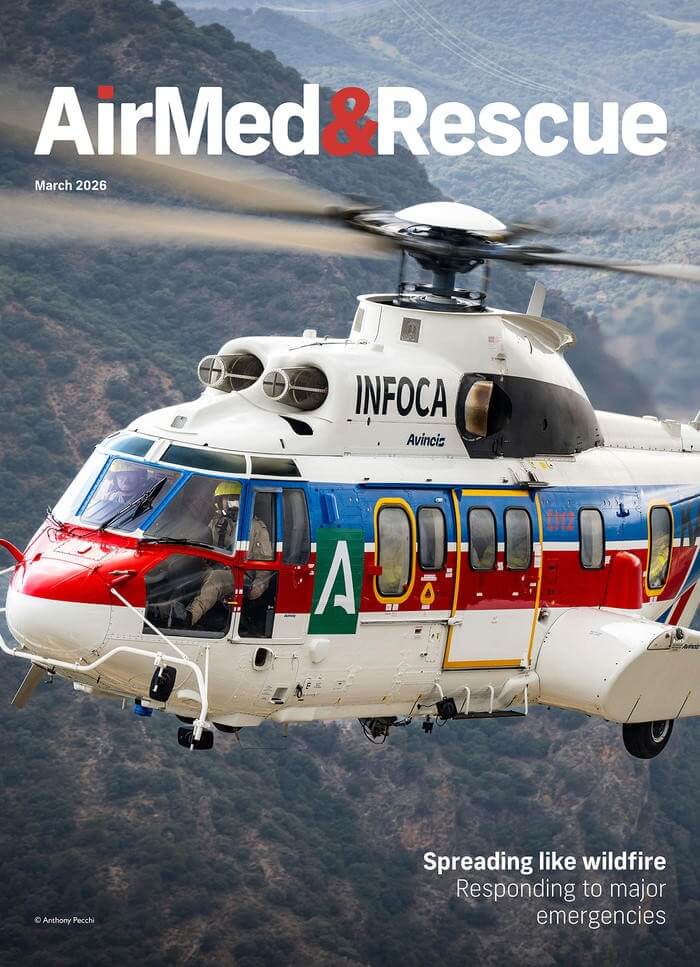
March 2026
Issue
This edition is bursting at the seams with articles from all corners of the special missions sector. We have features on the California wildfires that ravaged the state last year, what the cost–benefit analysis looks like for single-engine rotorcraft and autorotations, how the mission dictates the modification needed to the platform, and what can be done to further prevent the problems associated with inadvertent entry into instrument meteorological conditions.
Editorial Team
The AirMed&Rescue Editorial Team works on the website to ensure timely and relevant news is online every day. With extensive experience and in-depth knowledge of the air medical and air rescue industries, the team is ready to respond to breaking industry news and investigate topics of interest to our readers.