

Advertisement
Home Home

Main navigation

  • Digital Issue Archive
  • Podcast
  • Marketplace
  • Advertise
  • Subscribe now

Secondary

  • HEMS/SAR
  • Emergency Services
  • Avionics and Technology
  • Simulation and Training
  • Drones
  • Industry Moves

AirCARE1 receives fifth Learjet

HEMS/SAR
11 Jul 2019 | Robyn Bainbridge
Share
AirCARE1 Learjet 60
AirCARE1 Leajet 60A and Denise Waye, President of AirCARE1

An additional Learjet has been delivered to the US-based AirCARE1 team, growing its fleet of Learjet from four to five

The most recent addition is a Learjet 60, which joins three Learjet 35As and a Learjet 36A based in Albuquerque, New Mexico, with an additional base in the Phoenix, Arizona, area. The Learjet 60 will perform medical flights throughout North America, South America and Central America, and will also perform operations to Europe in the future.

The Learjet 60 can climb to its cruise level of 43,000 feet in less than 14 minutes when loaded to its maximum take-off weight of 23,500 pounds. And this high cruising altitude makes for a smoother flight, minimising turbulence. Once at cruise level, the Learjet 60 can reach speeds of up to 457 knots (525 mph). It has a transcontinental range of 2,590 miles, or 2,250 nautical miles, when carrying six or seven passengers. With the increased speed and longer range, AirCARE1 can transport patients more quickly and with less dependency on refuelling stops.
Keep on reading

Metro Aviation's EC145e, which it delivered to Utah towards the end of 2018

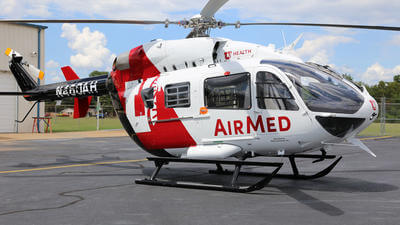
UW Health’s upgraded fleet

Friday 31 May, in Shreveport in Louisiana, US, saw the official commencement of Metro Aviation and UW Health’s Med Flight partnership, in which Med Flight began serving its 250-mile radius...
31 May 2019
|
Robyn Bainbridge
Learjet 60 interior
The Learjet 60 interior

In addition, the new aircraft outflies the 35A and 36A models, with a total flight duration of five to five and a half hours, the Learjet 60 has an increased flight time. And fewer fuel stops means less stops for patients too, which helps to reduce stress and anxiety levels for both patients and their loved ones. When it comes to medical transport, these reduced travel times can make a critical difference for patients with time sensitive conditions and treatment requirements. And further still, with an increased payload capability, more than one family member or loved one can fly alongside the patient.

HEMS/SAR
11 Jul 2019
Share

Robyn Bainbridge

Robyn is a writer with a degree in English Literature and over four years’ experience in creative journalism. She enjoys the inspiring ingenuity of the Gossamer Albatross (as well as the name).

Keep on reading

No results

There are no results available matching your search term.

Displaying 0 - 0 of 0

Why subscribe to AirMed&Rescue?

In-depth analysis

In-depth analysis

Unique insights and expert opinions on the latest industry developments

A wider perspective

A wider perspective

Get the global view on the topics that are trending in your region

Breaking news

Breaking news

AirMed&Rescue has all the latest news relevant to the global aviation special missions sector

Subscribe now
Home

Footer menu

  • About Us
  • Advertising
  • Writers
  • Contact
  • Privacy Policy
  • Terms
  • Voyageur

Social

  • Facebook link
  • LinkedIn link

© Voyageur Publishing & Events 2026

Close