

Baptism of fire

Since the first UAVs came into service with fire departments in the USA less than a decade ago, their use has spread like – well, like wildfire, as agencies recognize how they can unburden human firefighters from dull, dirty and dangerous tasks. Robin Gauldie investigates
In August 2023 the Hawaiian island of Maui experienced wildfires that killed more than 100 people and caused an estimated US$5.5 billion worth of damage. Among initiatives that followed was the Maui Fire Department’s (MFD’s) decision to acquire four uncrewed aerial vehicles (UAVs) – the most expensive costing around $10,000 – and train a nine-strong team of operators. In July last year (2024), the Crater Road outbreak provided a literal baptism of fire for the MFD’s drones and their pilots as they went into frontline action for the first time. Used nightly to seek out thermal hotspots and target them for retardant-dropping helicopters, they proved their value. MFD Fire Chief Brad Ventura said their efforts had been crucial to containing a conflagration that could easily have become as uncontrollable as the disastrous Lahaina fire the previous year.
The fires that caused “unprecedented destruction” to some 16,000ha (40,000ac) of the Los Angeles area in January, according to CAL FIRE, the state’s firefighting agency, are the latest reminder that US firefighting agencies are across the need to use every weapon they can find as the fire season in North America lengthens and wildfires become ever more powerful, fast-spreading and long-lasting.
With its often hot climate and fierce, dry winter winds, plus one of the USA’s largest urban sprawls, southern California is notoriously vulnerable to wildfires. The state as a whole regularly experiences some of the worst annual fire damage in the USA in terms of land burned and destruction of property, the US Forest Service (USFS) states. Overall, though, the Golden State suffers less wildfire damage each year than some other states, according to the US National Interagency Fire Center, with just over 309,000ac burned in 2022. That pales in comparison with the damage done in the same year in Alaska (3.1 million acres), New Mexico (859,906), Texas (671,800), and Oregon (456,082). But these are relatively thinly populated states – and have fewer celebrity residents. The destruction of millionaire mansions in Malibu will always guarantee more media attention than the scorching of thousands of acres of remote Alaskan forest.
Gaining acceptance
Adding UAVs to the suite of tools already available to US firefighting agencies was first mooted as recently as 2011. Since then, firefighters have adapted rapidly to the new technology. As it evolves further, so will the ways in which UAVs are deployed.
According to the International Association of Fire Chiefs (IAFC), a US-based forum for fire and emergency service leaders, uncrewed aerial systems (UASs) represent “a tremendous leap forward” for firefighters, especially for smaller agencies.
“They give smaller departments the ability to have an aerial program without expensive aircraft, pilots, and the maintenance associated with those assets,” states the IAFC on its website.
“The potential for new strategies and tactics could change operations drastically,” the IAFC contends, with UAVs offering unconventional ways of delivering on wildland firefighting tasks ranging from assessing smoke sightings and ascertaining their extent and location to determining the direction of fire movement, performing backlighting rapidly with fewer personnel, triaging exposures, and tracking the movements of fire crews on the ground.
UAV technology is advancing rapidly, even former doubters acknowledge. Users can expect to see longer battery life and bigger payload capacity, allowing UAVs to carry more cameras, including thermal imaging cameras. Artificial intelligence (AI) already gives advanced drones some autonomous capability and enhanced situational awareness. More advanced capabilities will soon come on stream, ranging from better telemetry and software integration to cutting-edge geographic information systems with improved three-dimensional mapping.
Users can expect to see longer battery life and bigger payload capacity, allowing UAVs to carry more cameras, including thermal imaging cameras
Encouraged by such enhancements to drone technology, including improved thermal imaging of hotspots, more than 500 US fire departments in almost every state now use drones to monitor the spread of fires and improve situational awareness for firefighters on the ground.
Texas and California have been among the keenest adopters – unsurprisingly, as both states are not only among the worst affected by wildfires but are also among the wealthiest in the USA, with substantial budgets allotted to their fire agencies.
California already has the world’s largest fleet of firefighting aircraft, so budgeting to add more drones would be a comparatively small investment. In January, CAL FIRE announced it had doubled the use of drones for critical tasks, including aerial ignition during prescribed burns, wildfire containment and real-time assessments.
By last year, USFS drones were flying upwards of 300 hours in the Service’s southern region, which covers major wildfire states including Texas. Around one-fifth of those hours are spent over active wildfires on duties such as aerial ignition.
Overall, around 50 UAVs were in use by Texan firefighters by 2024. Tasked by the State of Texas with deploying and maintaining a statewide network of firefighting teams, the Texas A&M Forest Service is currently revamping its UAS program, according to Erin O’Connor, Program Leader at the Service’s Mitigation and Prevention Department.

The bottom line
At first, purchase cost was a major obstacle to uptake of UAS technology by US fire departments. A 2018 survey by FireRescue1, a Frisco, Texas-based web publisher that operates a network of websites covering multiple aspects of the US fire service, reported that 40% of fire departments cited cost as the biggest consideration discouraging them from acquiring UAVs.
That was seven years ago. Since then, agencies and fire departments across the board have quickly recognized that UAVs are a worthwhile investment, and have increasingly integrated them into their firefighting strategies. Able to fly in darkness or low visibility, drones come into their own under conditions that would be unfeasible or unacceptably dangerous for crewed aircraft.
“There are times that it’s not safe for us to use manned helicopters or fixed-wing aircraft,” said Justin Baxter, USFS National UAS Operations Specialist.
There are times that it’s not safe for us to use manned helicopters or fixed-wing aircraft
Drones have their limitations in operation, though: notably their vulnerability to winds like the Santa Anas, which are such a major factor in California wildfires. During the most recent fires, winds of up to 70mph, vertical wind shear and severe turbulence all created conditions that UAVs found harder to handle than did crewed aircraft, according to CAL FIRE.
“The way we use UAS now is very much a supplement [to crewed operations],” said Baxter.
Compared with conventional rotorcraft or fixed-wing aircraft, they’re relatively cheap to buy and operate. Additionally, proponents point out, a drone is a one-off expense for fire department clients, unlike contracting for helicopters, specialized crew and flying hours.
According to the USFS, the hourly raw cost of operating a UH-60 Black Hawk or S-70 helicopter is around $4,000. UAVs from the leading manufacturers cost from around $20,000 for an entry-level thermal imaging platform to $90,000 and up for more sophisticated Type 3 platforms, such as the US-built heavy-lift Alta X, depending on specification and the customer’s choice of add-on equipment.
Training drone pilots takes less time and so is cheaper than specialist rotorcraft qualification, too. According to some agencies, aerial ignition training for UAV pilots, including Federal Aviation Administration (FAA) pilot license qualification, interagency remote pilot training and incident operations, can take up to two years. However, the USFS, which has trained more than 400 pilots and has created its own certification process for pilots and aircraft to set a benchmark for quality and safety, says its intensive courses, including FAA certification, take just two weeks. Pilots then work with mentors to ensure they follow high standards in emergency situations, according to USFS spokesperson Wade Muehlhof.
“We take training seriously and work closely with interagency partners,” Muehlhof added. “As technology advances, we’re ready to adapt.”
Drones in use
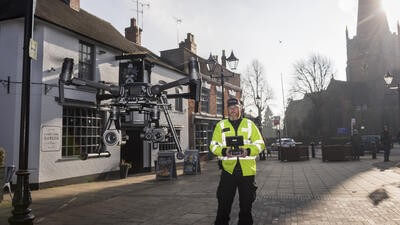
Tactically, UAVs are already playing a vital role in gathering live information that can be relayed to frontline firefighters in real time, as well as delivering aerial ignition to mitigate spreading fires. And above all, operators say, they own the airspace above and around wildfires when it’s too dangerous for crewed aircraft to fly.
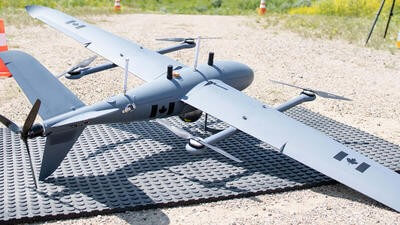
In action, the Forest Service launches drones such as its FVR-90 – a fixed-wing drone with a 14ft wingspan, eight-hour endurance, and a top speed of almost 80km/h – at dusk, when crewed flights are grounded.
“The sky is theirs, and the overhead view they have of the fire is detailed and in real time,” Baxter said.
Onboard thermal-based imaging sensors allow the ground team to see through smoke and identify the areas where fire is still active and new ‘spot fire’ areas. Such spot fires, started by wind-thrown embers from the main fire, may start out small and be shrouded by smoke and located in hard-to-reach sites. Until now, finding them before they can spread has been tricky, often requiring lots of manpower on the ground.
Drones are changing that labor-intensive process to identify spot fires, especially when an operational area can span hundreds of thousands of acres
“Drones are changing that labor-intensive process to identify spot fires, especially when an operational area can span hundreds of thousands of acres,” Baxter said. “With drones, fire managers and incident management teams can scan large areas quickly and identify spot fires up to about a mile from the main fire. That information enables firefighters to suppress those new starts before they grow.”
Dull, dirty and dangerous
The USFS initiated its UAS program in 2015 and appointed a permanent program manager in 2018. In 2019 it began UAS training in partnership with the US Department of the Interior.
Across the program, growth has been fastest since 2020, according to Muehlhof. “The Forest Service is new to using UAVs,” he said. “UAS technology is evolving, and we’re working on standardizing maintenance and tracking issues. While long-term data is still limited, we’re gathering insights from ongoing flights.”
The USFS prioritizes use of drones with infrared sensors for wildfire monitoring, and also uses them to support aerial ignition, a mission historically done by helicopters, Muehlhof added.
“We use larger fixed-wing UAVs for night patrols and monitoring large fires. These UAVs cover a wider area, improving efficiency compared to ground patrols. UAVs aren’t directly comparable to helicopters; they’re best for dull, dirty, or dangerous tasks. UAVs complement helicopters, providing a safer alternative for certain tasks.”
Although no UAV is purpose-built for Forest Service firefighting missions, UAVs are modular and can support different missions with interchangeable sensors, Muehlhof pointed out.
“Infrared and high-resolution cameras are most commonly used for fire monitoring and resource management. Centralized data management helps ensure compliance and efficiency in data use. We expand our UAV fleet as needed, based on regional requirements. We work closely with manufacturers to improve systems and meet specific needs for firefighting, which differ from commercial drones,” Muehlhof concluded.

The China syndrome?
When expanding their UAV fleets, firefighting agencies in coming years are more likely to look to source new drones from US manufacturers, following the passing of the latest National Defense Authorization Act. To avoid an import ban, the Chinese company DJI – the world’s largest drone manufacturer – and another big Chinese drone maker, Autel, must now satisfy the USA that their UAVs are not a risk to US security. Some states, including Florida, have already banned local agencies from buying DJI’s drones. Federal agencies, too, are favoring purchases from US builders. “We focus on using UAS from domestic manufacturers, with a priority on infrared sensors,” emphasized Muehlhof.
China is also the world’s biggest manufacturer of lithium-ion batteries, so President Donald Trump’s imposition of high tariffs on Chinese imports may also make these and other essential components more costly.
The future of aerial firefighting?
Drones are not a wonder weapon in the fight against wildfires. A UAV cannot – at least not yet – deliver a massive payload of water or fire retardant, and uncrewed aerial systems will not replace conventional crewed aircraft on the wildfire front line any time soon.
“Most UAVs can follow pre-planned paths, but human pilots are still essential, especially during dynamic wildfire situations,” said Muehlhof. “While automation is growing, most wildfire operations are still manual,” he pointed out.
From a small number of early adopters only 10 years ago, though, US firefighting agencies have come to recognize the benefits of a cutting-edge, cost-effective technology. Drones will play an ever-more-central role in aerial firefighting in the USA and around the world.

June 2025
Issue
Our June edition covers a range of articles with a wealth of experiential information in the features, such as search and rescue as a career route, the latest night vision technology, the increasing popularity of drones for firefighting, the importance of helmets in special missions, why diversity matters in aviation, and why switching to special missions as a job is more fulfilling; plus we have more of our regular content.
Robin Gauldie
Robin Gauldie is a former editor of Travel Trade Gazette and other travel and tourism industry titles. Now a freelance journalist specialising in travel, aviation and tourism, he writes for a variety of international consumer and business publications including International Travel & Insurance Journal, AirMed and Rescue, and Financial World.