
Buckets or tanks? Options for aerial firefighters

Modifications to aircraft carrying fluid can be complex. Jennifer Ferrero finds out what changes need to be made, and which conveyance is best for various application
Aerial firefighting offers a diverse schematic, from large commercial or government-owned airtankers to smaller Air Tractor fixed-wing aircraft and helicopters. The tank and bucket sizes can vary, along with the scooping and releasing options for picking up and dropping water.
Large commercial aircraft tanks can hold a 3,000gal capacity, and small fixed-wing, modified agricultural aircraft and helicopters can hold 800–1,600gal of water or fire retardant. Operators of both parties have an interest in fighting fires, and there are various needs in firefighting, from an initial attack on a newly formed fire to large-format firefighting missions where millions of acres are under siege.
The volume of aircraft fighting fires is variable in terms of aircraft size, tank or bucket size, and hourly operating cost. How can aircraft be modified, and what is mission critical?
Brian Reynolds, CEO of Northwest Helicopters and Mechanical Specialties, is a helicopter modification expert. His businesses modify helicopters for firefighting and other applications and manufacture hard-to-find helicopter parts. Reynolds is also an active Screen Actors Guild (SAG) helicopter stunt pilot who demonstrates the best uses for helicopters in action films.
Dan Garrett is Co-Founder of Momentum Aeronautics, an engineering product development company creating composite floats and avionics systems for the Air Tractor AT-802A. His business was preparing to sell its first modification package to a customer when we spoke to him, although Garrett has engineered fixed-wing modifications for over 10 years. He is an expert on scooping floats on fixed wings and is a certified pilot on fixed wings and seaplanes.
Kurt Miller is Sales Manager for AgSur Aviones, a distributor for Fire Boss. His territory is South America, where they have markets in Chile, Argentina, and Brazil – all growing firefighting territories. They also cover Mexico, and see future growth in aerial firefighting aircraft sales in Guatemala. Brazil has fires of 15–20 million hectares yearly; he said Argentina and Chile have around 2–3 million hectares burning yearly. He said human-caused fires in Chile are “out of control”.

All three subject matter experts (SMEs) have a handle on the growth of international aerial firefighting and the great need to rapidly scoop water from lakes and rivers or fill tanks with water for aircraft missions and applications. In the marketplace, aircraft options include filling water from natural water sources via fixed-wing floats that scoop the water, hose-like nozzles that suck water, or scooping buckets, which are faster than manually filling tanks on land.
Tanks on aircraft are most likely found on fixed wings, although some helicopters, like the Erickson Air Crane and S-70i Firehawk, can also hold water in tanks and hook up to a suspended water bucket. The buckets are hooked below the aircraft on a lateral cargo hook. Garrett also said that very large airtankers (VLATs), such as commercial passenger jets, can be converted for fire use.
Modifications to fixed wings and helicopters for firefighting
Helicopter modifications can include buckets, scoopers, hooks, tanks, and avionics. According to Garrett and Miller, both fixed wing SMEs, the cost to modify and operate helicopters is much higher than fixed wings, but they have different use cases. Garrett said: “The use cases for different aerial firefighting aircraft are slightly different. The rapid initial attack is one strategy that the Air Tractor 802A is suited for, as are many helicopters.” He added that larger aerial firefighting airtankers have a different use case. “They are often used to lay down lines of retardant to try to maneuver, control, and allow ground suppression support to allow other aircraft more time to get into place and allow the fire to be steered in a certain direction.” He said the use of aircraft depends on the type of fire.
The use cases for different aerial firefighting aircraft are slightly different. The rapid initial attack is one strategy that the Air Tractor 802A is suited for, as are many helicopters
Regarding avionics adaptations for aerial firefighting, Flightcell produces a solution that is being used for firefighting operations, said Jonathan McWatt, Marketing and Communications Director: “DZMx is widely used in aerial fire. The California Department of Forestry and Fire Protection (CAL FIRE) is our largest aerial fire client, operating over 50 aerial platforms with the DZMx installed.” He added that it is chosen for firefighting for a range of reasons: “The DZMx / DZMx PLUS delivers several benefits to aerial fire operators, including an inbuilt additional telemetry unit (ATU) that meets US Forest Service (USFS) and National Aerial Firefighting Centre (NAFC) requirements; it reports real-time flight, positioning, and bucket/tank performance (including retardant drops) event data; it’s always connected to ground operations using cellular and Iridium satellite networks; cellular connection saves on operating costs and provides a higher-definition tracking; and it’s an unlocked device, meaning the operator can decide on airtime and tracking service providers from a range of approved tracking providers.”
Miller said that there are cost variables between firefighting with helicopters as opposed to fixed wing: “The hourly rate for a Fire Boss is US$4,500–$5,000 range; the helicopters on a cost per gallon are upwards of $1.50 – a Fire Boss is .65 to .70 per gallon.” He also cited the variability between helicopters of different sizes. “There are smaller helicopters versus bigger helicopters, or the Fire Boss versus Canadair CL-415, which holds 1,600gal, and the Air Tractor, which holds 800gal. Regarding cost per gallon, the Air Tractor is significantly less.”

For lifesaving missions, there are operations that run spotters in smaller airplanes that don’t drop water or carry people. Miller added that while the Fire Boss has internal tanks, and can have floats, he’s never seen a fixed-wing aircraft carrying a water bucket.
Reynolds has deep experience in outfitting helicopters for firefighting applications. He described how the Bambi Bucket came on to the scene in the 1980s as the first collapsible water bucket. He said SEI Industries, the manufacturer, had no competition for a short time, but it didn’t last. “When you have competition, it creates newer, higher technology.” Now, said Reynolds, other companies are coming into the marketplace with water buckets that append to helicopters, which he felt would be an advantage. He said that for firefighting helicopters, they modify cargo hooks and rotor blades. For those who want to fight fires, all helicopters will need modifications. But he noted there could be associated work for contractors with the right equipment, seasonally hauling personnel to oil rigs, and fighting fires at another time.
According to Reynolds, the Federal Aviation Administration (FAA) doesn’t regulate civil agency helicopters, such as police, sheriffs, and firefighters. He added that many civil operators don’t generally get into aerial firefighting due to the bureaucracy: “Flying civil aircraft, they have their own rule and system when working for the US Forest Service, they ask for things over and above of what the FAA requires [like] ‘we want a black stripe on every helicopter or you won’t fly for us’.” But he said the cost to modify a helicopter is approximately double that of the cost of the vehicle.
The FAA is inspecting every modification to a helicopter
Reynolds added that helicopters flying over cities and populated areas in the USA and Europe must have two engines (per European Union Aviation Safety Agency (EASA) regulations). “The FAA is inspecting every modification to a helicopter. The biggest difference in Europe is the multi-engine, which flies over cities and towns.” He explained that if an engine goes out over a city, it can be deadly.
Water capacity and other specifications
The Fire Boss is an 800gal aircraft with a hopper and floats for landing on water. Miller said: “If a body of water is close to the fire, the Fire Boss can load in about 20 seconds. On a wheeled airplane, it must go back to the air strip for large tanks of water to fill it out – about 20–30 minutes for load times.” He added that with the ability to scoop water into the tank, “the quicker you can get to a fire in its infant stage, and you are constantly putting water on the fire, the better your chances are of [the fire] not spreading”.
The number, type and location of each water collection and drop is important data to gather to ensure accurate performance and improvement of firefighting efforts, explained McWatt: “Our DZMx / DZMx PLUS captures and reports every single event, including the location and quantity of water pickups, the start and end of each water drop, and whether any retardant was included. Each event is sent in real time and coupled with GPS coordinates, highlighting the exact location of the event to ground operations.”
Miller said the Fire Boss excelled during the initial attack, the same for the Momentum Aeronautics carbon fiber float system on the Air Tractor. “When the pilot is ready to dump, he can open the gate and drop it on the fire. These pilots are good at putting a precise drop down.”
When the pilot is ready to dump, he can open the gate and drop it on the fire. These pilots are good at putting a precise drop down
The gate is computerized, and the pilots can choose the drop level at any fire location. Therefore, if water needs to be reserved, they can do so. Regarding how many drops a pilot can make per hour, the marketplace standard is 20, but Miller cautions that it depends on how close the fixed wing is to the water source (maybe 14,000gal per hour).
However, helicopters and fixed-wing aircraft each have their missions and applications. Regarding helicopter modifications, through Northwest Helicopters, Reynolds has 65 employees, a facility on 15 acres, and 300,000ft² of hangar space, and he said it is the biggest heliport in the northwest USA. He said it has 50–60 helicopters simultaneously for services and modifications. One side of its operation is fighting fires around the USA, and then the other side of his business is his Bell and MD Helicopters service center. This retrofits helicopters for firefighting and makes and installs cargo hooks at the bottom of helicopters. Reynolds said: “Helicopters all need modifications to firefight – they can be used to move people for oil rigs, or they can be modified for firefighting.” Once the vehicle is set up for firefighting, it generally isn’t modified for paramedic or rescue equipment. He shared that one of his customers is set up for paramedic helicopter use with hoists and cargo hooks. For public use operators, the FAA governs them as civil operators. Therefore, they won’t use the aircraft for firefighting. But, he added, they don’t have to undergo the same certification process as contracted aerial firefighters.
Reynolds said that when converting helicopters for aerial firefighting, they go to the latest USFS contract specifications. He said the modifications are significant each year and span “cargo hooks, radios, electronics, lighting, and rotor blade changes” – it is virtually a different helicopter when it goes out compared with when it comes in. He said that operators may need to “pony up and get into the business and become professionals and spend the money and do it”. Regarding fixed wing, it is a similar sentiment when outfitting the aircraft for firefighting, he said.
McWatt said that Flightcell is aware of the stringent specifications, so ensure its DZMx and DZMx PLUS products “exceed reporting requirements set out by the likes of USFS and NAFC”. Flightcell is also aware of the exceptional modifications that are made to craft to make them suited for the job, so that integration of the DZMx and DZMx PLUS is as simple as possible: “Our DZMx / DZMx PLUS is a standalone device, with all inputs going directly to it, including some third-party tank controllers. The DZMx / DZMx PLUS has its own internal GPS and accelerometers and fuselage-mounted antennas. The cellular and satellite modems are not only used for tracking but can also be integrated into the intercom system for voice communications. The DZMx / DZMx PLUS gets its power from the aircraft’s DC electrical system and does not contain internal batteries.”

Garrett said that water placement is important in aerial firefighting, and there are pluses and minuses to each approach of using tanks versus buckets. With buckets, the use cases are more limited and susceptible to the environment of that day. Tanks, on the other hand, require permanent modifications and the addition of structural reinforcements. There are many factors regarding tanks as they are integrated into a helicopter or fixed wing, Garrett said. “Tanks don’t change fundamentally how a helicopter or fixed wing flies, but the biggest difference between a bucket and tank is a different level of pilot training and proficiency.” He added that tanks mean that structural provisions need to be made to the aircraft to install the tank. He said the tank is more versatile than a bucket, depending on the use case.
Tanks don’t change fundamentally how a helicopter or fixed wing flies, but the biggest difference between a bucket and tank is a different level of pilot training and proficiency
Garrett said of other scooping platforms, the Air Tractor 802 has an 800gal tank, and the CL-415 has a 1,600gal tank. “The difference and discrepancy between the two aircraft is that the CL-415 is twin engine with an acquisition price of $35 million, and the Air Tractor 802 has an acquisition price with floats and set up for scooping at about $3 million.”
When modifying aircraft for firefighting, operators must decide upon water-carrying capacity, cost per hour or fuel costs, and the costs to modify and repair the aircraft.
April 2025
Issue
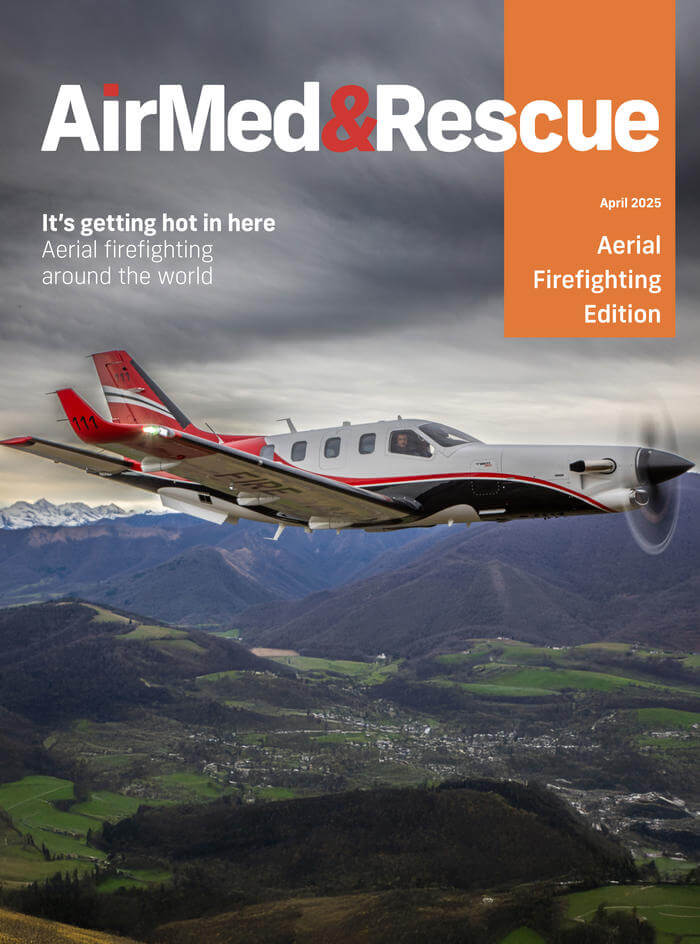
Our April edition has a special focus on aerial firefighting, with features that include rescues during wildfire situations; the coordination process and tools used between aircraft and firefighters; the distinct job of the smokejumper; the different use cases for buckets and tanks, and what needs to be considered for your airframe; the continued appeal of the Firehawk platform; and the importance of proper expertise when treating traumatic brain injuries; plus more of our regular content.
Jennifer Ferrero
Jennifer Ferrero owns Ferrero Agency. She focuses her writing on feature stories for aerospace and manufacturing trade publications. She also provides marketing and public relations services. She has been an entrepreneur and writer for over 25 years. She lives in Spokane, Washington.