
Case Study: TrustAir on the aeromedical transfer of Covid-19 patients

Flying a Covid-positive patient is a huge challenge from both a teamwork and a professional perspective. Dr Peter Turi of TrustAir described how his team manages Covid patients
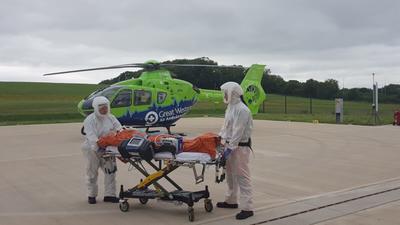
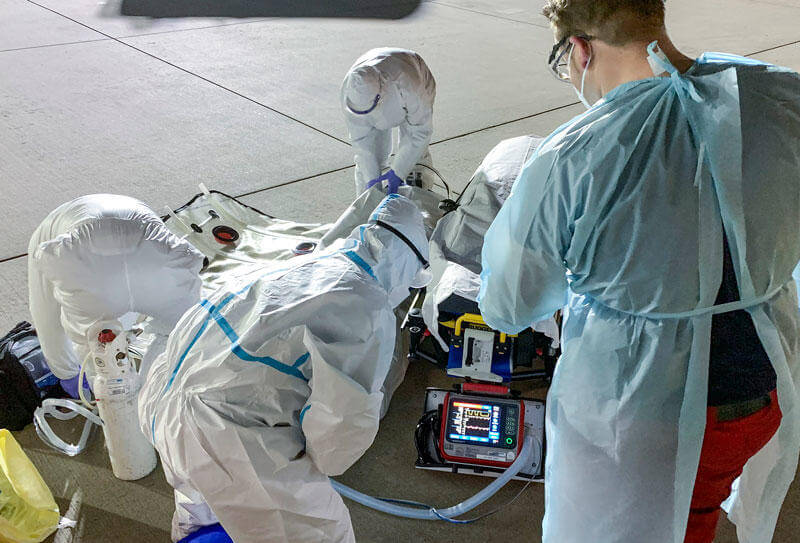
We've already flown dozens of Covid positive missions since the outbreak of the pandemic, and over 60 per cent of our patients needed immediate intervention before departure. It basically means primary ICU care onsite, such as advanced airway management, sedation, cardiac support to stabilize and prepare them for the flight in a closed, negative-pressure patient medical isolation unit (PMIU).
Find the right PMIU for the patient
We have several units, and our experience is that not necessarily the most expensive, fancy one is the best. As patients’ body size varies, we always try to provide the best one for them. Our units give a bit of flexibility; their wall is soft, so they are comfortable even for a conscious patient.
We can provide half-sitting, supine or abdominal (prone) position, which is professionally more favorable for ventilated critical Covid-positive patients. Units are closed during the flights, providing the highest safety level for our crew, however, emergency opening is also possible (this has only happened once, so far). The medical crew wears PPE during patient pick-up and handover, of course. Our crew’s safety is just as important as our patients’ interest, therefore TrustAir doesn’t accept any Covid-positive patient without an isolation unit, even if they are completely well and asymptomatic.
Bedside service
Although we would prefer airport handovers, in the majority of our cases, we meet our critical patients at the treating hospital. This often means three, four or five hours of ground time for the flight crew, mainly depending on the distance from the airport (sometimes 50 to 100kms), and the complexity of the case. Immigration is not a real problem for us; we have always experienced very collegial relations with border control or police forces. This pandemic has brought all officials and teams on duty a bit closer to each other, I think.
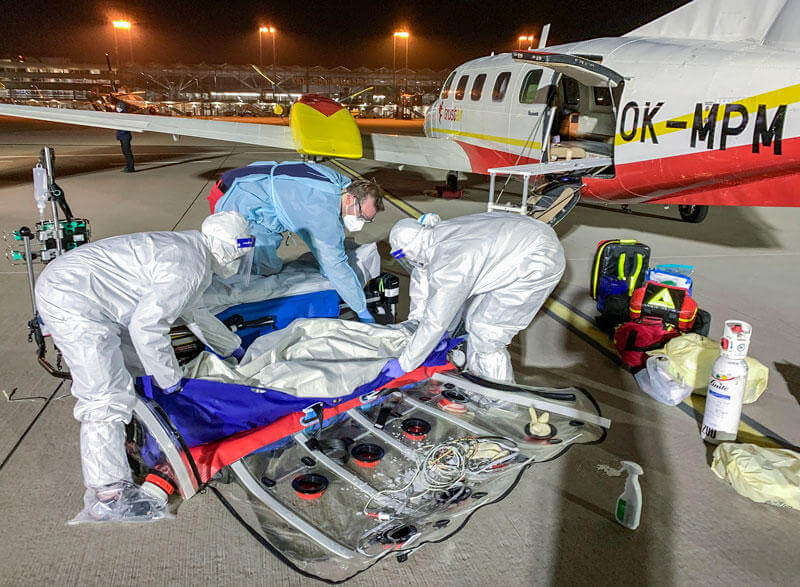
Placing the isolation units into the aircraft is also challenging, but we are lucky, as our aircraft have particularly wide cargo doors (113cm). But, still, positioning is always a key moment and requires focused attention from the whole team.
We always provide an augmented crew for these missions, as Covid-positive patient transfers require more hands than typical and usual air medical flights. We, together with our local ground ambulance providers, can safely manage all movements, and transfer our patients to their destination, wherever they need to be in Europe.


Issue 114 | March 2021
In the March 2021 issue:
Flight Risk Assessment Tools – what are the software options for operators?
Hoist training – the choice of virtual reality, mixed reality, classroom and real-life
FOAMed – the pros and cons of open medical information exchanges
In this issue
March 2021
Issue
In the March 2021 issue:
Flight Risk Assessment Tools – what are the software options for operators?
Hoist training – the choice of virtual reality, mixed reality, classroom and real-life
FOAMed – the pros and cons of open medical information exchanges
Editorial Team
The AirMed&Rescue Editorial Team works on the website to ensure timely and relevant news is online every day. With extensive experience and in-depth knowledge of the air medical and air rescue industries, the team is ready to respond to breaking industry news and investigate topics of interest to our readers.
AirCARE 1 case study: Covid-19 patient transfer
Covid-19 changes EURAMI accreditation audit process