
Change for good

Acquiring new or used aircraft can provide an opportunity to modernize the cabin or the platform itself to take advantage of new technology and equipment. Rob Coppinger talks to operators going through the process of upgrading their fleets
Older platforms are more readily available and often come with shorter lead times than off-the-shelf new aircraft. But many of these will still need modernization and customization to be fit for the special mission roles they are to perform. What can be modified and how does this make for a better special mission aircraft? “We’ve done lots of upgrades with increases to the [Bell] 214ST … We’ve designed and developed a scooping system to enable us to scoop and use salt water for our operations,” said McDermott Aviation Founder and Chief Executive Officer John McDermott.
Across the Pacific and the California Department of Forestry and Fire Protection (CAL FIRE) has this year been completing the replacement of a Bell UH-1H Iroquois ‘Huey’ fleet with Lockheed Martin’s Sikorsky S-70i Firehawks. “We just had the last two bases transition in the last six months [March to September],” said CAL FIRE Aviation Communications Officer Linnea Edmeier. CAL FIRE now has 16 Firehawks with 10 of these platforms across 10 of the organization’s Californian bases. The remaining six are ready to be deployed so the other Firehawks can be rotated through maintenance, which can take a few months.
On the other side of the Atlantic, Germany’s DRF Luftrettung, ‘air rescue’ in English, plans to replace its Airbus Helicopters H135s with the new Airbus Helicopter H140. This was after a “long and deep investigation” into the existing alternatives on the market, the outfit explained. The H140 is about one meter longer, at 13.3m, and has roughly the same maximum takeoff weight as the H135, 3 tonnes. Operating in Austria as well as all around Germany, from its mountainous areas to off its shore, DRF Luftrettung’s missions range from helicopter emergency medical services (HEMS) to mountain rescue and training.
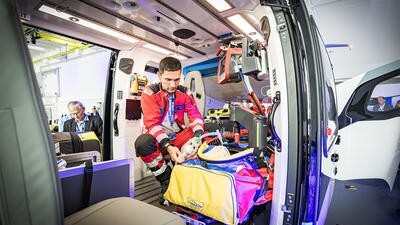
McDermott Aviation has a wide range of missions, including medical evacuation, search and rescue (SAR), charter, winching, firefighting, natural disaster recovery assistance, forestry, aerial survey, and helicopter lifting and construction services. Aerial firefighting is growing in demand, hence the change in the water-scooping system. While originally founded in Australia, McDermott operates worldwide. Its fleet is mainly Bell models, from the Bell 204 and 206 Long Ranger to the Bell 214ST, while it also has two Airbus types, AS355 and AS365 Dauphin.
“We’re doing glass cockpit installations in the 214STs. We’ve designed, obviously, and manufactured, along with Helitak, the firefighting tank system,” McDermott explained. “And then we’re going back into production with the 214ST … So, we’ll actually be building brand new 214STs hopefully in the next couple of years. There’s a massive shortage of medium-heavy helicopters, or we call them heavy-medium, throughout the world – of that type of aircraft that’s robust enough to do the job. So we decided to put them back into production.”
There’s a massive shortage of medium-heavy helicopters throughout the world
McDermott Aviation also operates a number of Transall C-160s.
“We’ve also got Transall C-160 and [we] have an ongoing large airtanker program. So, that’s a large airtanker and that’s a 14,000L capacity, and we’re hoping to flight-test that very soon and get final certification sooner rather than later,” McDermott said. “We’ve just got to get the people who can sign the piece of paper to certify us – we’re talking to the various agencies. The aircraft’s all done – it’s all modified, it’s airworthy, it’s all ready to go; we’re ready to go. It’s just pieces of paper that hold all this up.”
Regulated choices
For DRF Luftrettung, the choice of the H140 was governed a great deal by regulation. “If you want a multi-role helicopter with a takeoff weight not exceeding 5 tonnes, the given choice is very limited, especially through the European HEMS regulations and the safety to operate twin-engine helicopters. On the lower edge there is Bell Textron, then Airbus Helicopters, and on the upper edge is Leonardo.”
The DRF Luftrettung fleet includes Learjets, the Cessna Citation C680 Sovereign+ and different versions of the H145 – a five-blade rotor, a five-blade rotor with winch, just with the winch, and the basic four-blade H145 available before 2020.
As well as building brand new 214STs, McDermott wants more airframes because “we’re all flying older aircraft and some of the bits and pieces are getting harder to find,” he explained. “We own the type certificate for the 214 and the 214ST, so we’re actively engaged in manufacturing parts anyway for the aircraft for continued airworthiness.” The upgraded 214STs are getting glass cockpits as well as firefighting systems. “We’ve joined with Genesys [Aerosystems] to put in glass cockpits for our aircraft. And again, it’s to replace the older, steam-driven analog dials. So that’s phase one; [the next phase is] gross weight increases for external loads onto the 214ST – that’s just to increase its gross weight external load by 1,000lb.”
They still maintain all the same engineering performance and it’s just to enable us to increase our external load capability, which is jettisonable to 1,000lb
To fly with the higher gross weights and externals loads, the aircraft are not being changed fundamentally; it is a process of certification. “They still maintain all the same engineering performance and it’s just to enable us to increase our external load capability, which is jettisonable to 1,000lb. The 214ST was designed originally to be able to carry greater weight than whatever it was ultimately certified for. So we’re going to take advantage of that now. We’ve got adequate performance and reserves with the existing engine and transmission configuration,” said McDermott.
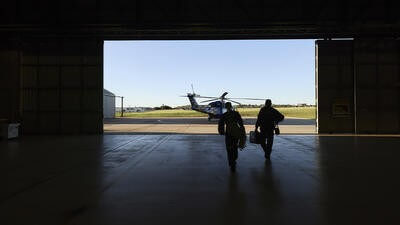
CAL FIRE’s change from Bell UH-1H Iroquois, commonly known as Hueys, is quite the change as the UH-1H is a very old, Vietnam war-era type while the Firehawks are relatively new. The Huey has two blades, was 57ft (17.3m) long, had a gross weight of 9,040lb (4,100kg), a cruise speed of 125mph (201km/h) and range of 315 miles (506km). The Firehawk has four blades, a cruise speed of 183mph and can fly at night. “We were on the UH-1H Huey,” Edmeier explained. “We were on that platform for over four decades and [have] slowly been transitioning the fleet. And so now the entire fleet, all of our bases are now on the Firehawk.”
We knew we needed a more sophisticated machine to be able to fly at night
A dangerous incident led to the decision to replace all the Iroquois, not because of a problem with the aircraft but a recognition that there was a safer option for crews. “We knew we needed a more sophisticated machine to be able to fly at night,” Edmeier said. “We needed those advanced avionics and for the safety of the crew. With the redundancy, the avionics and the dual engines, we get more safety for the crew. And this Hawk has an external fixed hoist. The Huey had a hoist that we would have to configure for rescue.”

Hoists
While the hoist is easier to use, and more capable, on the Firehawk, Edmeier pointed out that the principles of how the crew operate have not changed. “There’s the technology of the aircraft, that changed. But the principles of what we do on the ground didn’t really change. The tools that we use might have developed a little bit, but the complement of tools that we carry with us, it might vary from base to base.”
Fighting fires requires some heavy-duty equipment where trees are involved. “So, for example, one of our bases in northern California, where they’re … more often in timber than some of our other bases. They may carry a complement of two chainsaws and two back pumps and hand tools,” Edmeier explained. This compares to a station that is in an area with oak woodland and grasslands where they would not have two saws. “So, each complement of tools really is unique to each base. There are some fundamentals, there are some that stay the same,” she added.
The well-chosen configuration of our helicopters helps us to easily exchange them between bases
Across its fleet, DRF Luftrettung uses harmonized equipment, so while it is buying new H140s, they will be fitted with the existing mission loadouts. “We’re starting with PSE [personal safety equipment] and medical devices and moving to a similar helicopter platform. Using one original equipment manufacturer (OEM) reduces maintenance costs as you can perfectly fit on the spares, tools and education,” the organization explained. “The well-chosen configuration of our helicopters helps us to easily exchange them between bases. All are equipped with the highest modification standard for our missions and can be used for every scenario. No matter which registration is at a base, the emergency medical service (EMS) equipment is standardized through a dedicated group, which eases the daily handling.”
McDermott is not planning on equipment changes either, “because we’ve already embraced most of the [technology] upgrades on the way through. In fact, we were a significant part of most of the development of new technology in aerial firefighting, so we were well at the front from the start,” he outlined. “Data collection, tank configuration and drop analysis, eye in the sky, cockpit voice recorder (CVR) and flying data recorder (FDR) capability, and health and usage monitoring system (HUMS). That’s sort of generally where we are.”
We were a significant part of most of the development of new technology in aerial firefighting, so we were well at the front from the start
For CAL FIRE, the Firehawk’s capabilities led the crews to start to rethink how they would carry on with the practices they had perfected with the Huey. “When they knew they were going to get the Firehawk, there was a small group that was chosen and they said, ‘Okay, you guys go figure it out.’ We didn’t even have the Hawk yet,” Edmeier said. “So they got together and with the specs of the machine started to try and figure out, how are we going to do this? And in their minds, the Hawk was a little bit bigger, it’s heavier. So, they were trying to take the things that they knew off the Huey and try to do them the same way on the Hawk.”
When the Firehawk arrived, the team decided to “go out and play with it basically, and try these things”, Edmeier recalled. What they discovered was that the crews did not have to continue working the same way: the Firehawk was so different, new approaches could be taken. “We can really crack our thinking and develop new ways of doing things,” Edmeier said.
There are various reasons to acquire aircraft: an aging fleet, obsolescence like with the Iroquois, and better versions of onboard equipment, such as the hoist, can help. But modernizing the platform or the cabin to take advantage of new technology and equipment may not be necessary if the equipment that crews have long been trained on can still do the job and meet regulatory requirements.
December 2025
Issue
Our December edition rounds off the year with articles relating to special missions from around the world. We have features that look into the upgrades that have been integrated into special missions platforms to improve operations; the technology used to alert and support aerial firefighting tactics, helping attack fires quicker and more strategically; the simulators that are making training for special missions better and safer; and the latest updates and announcements of digital and physical technology in the last year.
Rob Coppinger
Rob Coppinger is a veteran aerospace writer whose work has appeared in Flight International, on the BBC, in The Engineer, Live Science, the Aviation Week Network and other publications. He has covered a wide range of subjects from aviation and aerospace technology to space exploration, information technology and engineering. In September 2021, Rob became the editor of SpaceFlight Magazine, a publication by the British Interplanetary Society. He is based in France.