

Saving weight and lives

As the challenge continues to ensure that medical equipment is flight compatible, Rob Coppinger finds out what is suitable and validated to carry on an aircraft
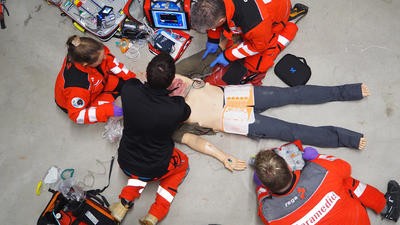
Air ambulances and helicopter emergency medical services need a range of equipment that can accommodate and attend to the needs of all the sorts of patients they transport. Air ambulance operators are choosing carefully the tools and equipment they select to carry on board. From town centers to winding rural roads, the loadout for an air ambulance will always have its essential elements, such as a mechanical cardiopulmonary resuscitation unit, but increasingly that is now being added to with blood warmers and pupil measurement for head trauma diagnosis.
“We’ve recently introduced a pupillometer,” said Laurie Phillipson, Clinical Academic Fellow and Critical Care Paramedic at Essex & Herts Air Ambulance in the UK. “That gives us an objective value of the size and reactivity of a patient’s pupil. So, if you have a big lesion inside your head or a big mass of blood inside your head, that can compress on some of the vital nerves that supply the eye and that can affect its ability to dilate and constrict naturally.” A handheld device, the pupillometer uses reflected light to measure the pupil response.
Another handheld device with a digital screen that is seeing demand is a video laryngoscope. “We may plan to buy video laryngoscopes,” said Air Ambulance Services of Norway’s Biomedical Manager, Anders Aa. A video laryngoscope is a device used to obtain an improved view of the glottis and helps with intubation, inserting a ventilation tube into the trachea. It is a handheld, easily handled device that can be used in the confines of a helicopter cabin. But, as regards other equipment, Aa explained: “It’s very difficult for us to find equipment for our service that we, with hand on heart, can say is suitable for these environments.”
Another device easily held in the hand but with another purpose is the digital syringe pump. These can have WiFi and cybersecurity. “We have trialed and are implementing the B Braun Spaceplus Perfusor,” said LifeFlight Medical Director Jeff Hooper. LifeFlight operates mainly in Queensland, Australia, providing emergency helicopter air ambulance services. The Spaceplus Perfusor has IP44 moisture protection, a color touch display compatible with wet gloves, and can operate as a standalone device with WiFi. Its software can also be updated remotely.
Aside from medical devices, air ambulances are investing in new equipment that can help with remote communication. Air ambulance service provider HeliOtago, located on New Zealand’s South Island at Taieri Airfield, has adopted SpaceX’s Starlink satellite telecommunications. “We have a portable Starlink system that we take with us, if necessary,” said HeliOtago rescue helicopter Clinical Operations Manager Peter Cain. “It’s a very recent addition. When they had the floods, or the cyclone, we took it with us when we sent our helicopters up there and, at that point in time, it was the only communication means whatsoever up there. So it proved very, very useful.” Cyclone Tam, in April this year, brought widespread flooding to New Zealand.
Always online
Starlink has a ‘Mini’ version of its satellite internet product that can fit in an aircraft and, when pointed through a window at the sky, can send and receive data with home broadband-like speed. At HeliOtago, Cain and his colleagues use an MBB/Kawasaki BK117 B2, Airbus H145 D3 and Airbus EC145. In the emergency medical services (EMS) configuration, the H145 D3 carries one patient and up to three crew or passengers with one or two pilots. It has a winch and can carry a medical oxygen supply. The BK117 B2 EMS configuration can carry one or two patients with one or two pilots and up to three crew or passengers. It has a winch, a weather radar, an auxiliary fuel tank, a medical oxygen supply and a 100kg external storage pod. The EC145 in the EMS configuration carries one patient and up to three crew or passengers with one or two pilots and, like the H145 D3, it has a winch and a medical oxygen supply, but it also has a weather radar.
LifeFlight operates a mixed fixed- and rotary-wing fleet. It has four Bombardier Challenger 604 aircraft and three types of helicopter: the Leonardo AW139, the Bell 412, and the BK117. The AW139 can have a winch and accommodate up to five crew and two patients. The Subaru Bell 412EPX claims room for six patients, with two large sliding doors allowing ingress and egress. LifeFlight Chief Operating Officer Lee Schofield said: “LifeFlight is acquiring additional AW139 helicopters. These new helicopters will be used to increase our capability across Queensland and beyond. The initial deliveries will be used to replace the B412s at our Sunshine Coast and Bundaberg bases, along with the BK117 at our Mount Isa base. The additional deliveries will also enhance our capability in Brisbane and Toowoomba, along with our ability to service short-term deployments as needed. Deliveries of the new aircraft are expected to be completed in 2027.”
Norwegian Air Ambulance Foundation has a subsidiary, Norwegian Air Ambulance Helicopter. It is the operator of all 13 of the country’s medical helicopters, including Leonardo AgustaWestland types and the Airbus H145 for testing new equipment and in-flight medical care. Whatever the helicopter type, some air ambulance services must select equipment for potentially far harsher regimes. “It’s very seldom that the manufacturer actually thought of the problem with temperature changes,” explained Aa. “Which is very important as all the equipment can be inside the aircraft at plus 25° Celsius and then brought outside to -25°C and then back in the aircraft. It was that 50° change in temperature that can be a problem.”
Under pressure
Another issue is the cabin pressure, whether in fixed- or rotary-wing aircraft. Aa cited the 9,000ft ambient pressure in the cabin as a challenge for some equipment that may have difficulty with the change from 1 bar at sea level. With helicopters, which suffer from vibration, some equipment is “badly constructed when it comes to vibration and shock”. Aa stated that a crew might have to accept, and cope with, the fact that some equipment measurements will be “wrong”. The pressure issue affects capnography and ventilators, which work with pressure and air flows. Capnography is a non-invasive measurement of the partial pressure of exhaled carbon dioxide (CO2) as a CO2 concentration over a period of time. “So that’s our biggest problem: finding equipment that we can say is good enough,” Aa commented. “That’s why we are working very hard with international and European standards.”
In North America, the challenges are much the same. Boston MedFlight operates helicopters out of facilities at Hanscom Field, Bedford, Plymouth Municipal Airport, Lawrence Municipal Airport and Mansfield Municipal Airport. This emergency medical transport nonprofit organization operates five twin-engine H145 helicopters among a fleet of six helicopters and a fixed-wing twin-jet aircraft. The equipment they use on board includes invasive and non-invasive mechanical ventilators, a critical care monitor with invasive monitoring, and airway management equipment, including video and surgical airway devices. Its paramedics and nurses also use inhaled vasodilators, intra-aortic balloon pumps, multiple medication pumps that are preprogrammed with an infusion library, a transport Isolette, and transvenous pacemakers. The staff are also proficient with equipment hospitals may send, such as extra-corporeal membrane oxygenators, Impella heart pumps and ventricular assist devices.
The list of equipment being taken on board is only growing, as the investments in new technology and aircraft above show. Hooper described what his critical care doctors and flight paramedics use. Their range of medical equipment to support the airlifting of patients from an accident scene or during an interhospital transfer includes a primary bag and interhospital bag with full drug kits and four units of packed cells and fibrinogen concentrate. The helicopters can contain a Hamilton transport ventilator and a Zoll monitor. To hand, the medics will have Braun infusion pumps and Philips Lumify ultrasound.
Cain set out the long list of equipment his HeliOtago colleagues employ, from a corpuls3 monitor defibrillator and CPR device, which work together, to a HAMILTON-T1 transport ventilator. Their loadout set also includes a capnography machine, a Lumify handheld ultrasound, Braun syringe drivers, Mequ blood warmer systems, Ready-Heat II first responder blankets to treat shock and hypothermia, glide scopes for airway management, and traction splints for bone fractures. The HeliOtago teams also use a Stryker M-1 stretcher and rescue vests for winching. “We have a specially made bridge that holds all of our equipment on it [the stretcher],” Cain explained.
Careful buyer
The Essex & Herts Air Ambulance operates the Leonardo AW169, with a crew of a pilot, a co-pilot, a doctor and a paramedic, and sometimes a third clinician as required. Phillipson detailed what the Essex & Herts crews can take with them in addition to the ubiquitous stretcher and mechanical CPR device. Blood warmers are ready in case blood transfusion is needed; there’s a monitor that allows them to take an electrocardiogram of the heart. Another device, an oximeter, is used to measure the oxygen saturation in the blood and the capnograph measures how much CO2 they exhale. Ultrasound is another technology now taken on board, as is a video laryngoscope, along with a ventilator for after intubation. Phillipson gives the video laryngoscope as an example of what is required to select new equipment. “We played with lots of different types before we actually settled on the one that we wanted. And it’s the same with the ultrasound.”
Radios are also now a necessity, as are mobile phones and tablet computers, as they contain patients’ care records. Lights are also taken to ensure nighttime work is not a problem. “Everything on the aircraft, down to the smallest bit of kit, needs to be weighed, so that we know the exact weight of the aircraft, so we know exactly how many crewmembers we can take and how much fuel we can take on board. So, weight is a very important issue,” he explained.
Any variation on what is taken begins with the emergency call that comes in. “When the call comes in, we get a rough idea of what it is. You’ve got to take it with a bit of a pinch of salt because, at the end of the day, you’re relying on the details provided by a stressed-out caller,” Phillipson said. The crews have bags of equipment ready and “generally speaking, the two bags will carry everything, and then we supplement that, depending on the type of call”.

Equipment for the situation
City emergencies differ from rural ones, with urban areas seeing serious multiple-vehicle accidents whose victims require the speed of air transport. These accidents can involve pedestrians too. Rural areas can see mountain falls, horse riding or farm accidents, or traffic accidents where individual vehicles have left the road as a result of bad driving conditions. While challenges remain due to medical equipment being made for the clinical environment and not the airborne cabin, the technology on offer, often handheld and potentially internet linked, is developing, providing new ways to detect and diagnose internal injuries that might otherwise go unnoticed.
September 2025
Issue
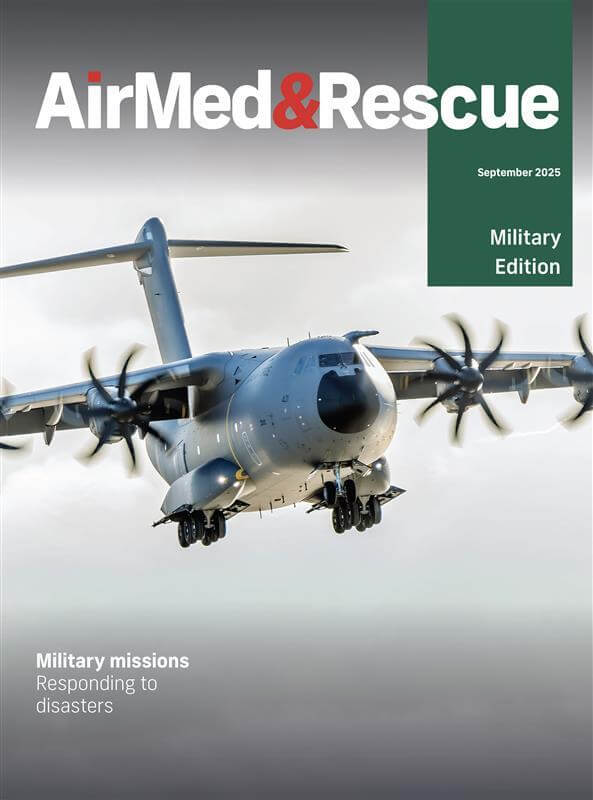
Our September edition is the special military issue, bringing together news, features and other articles that showcase military contributions to special missions. We have themed features on air forces helping with disaster response, the stretchers and baskets that make combat search and rescue possible, and the varied duties of military coast guards, and we have an extra non-themed feature on the medical equipment used in air ambulances.
Rob Coppinger
Rob Coppinger is a veteran aerospace writer whose work has appeared in Flight International, on the BBC, in The Engineer, Live Science, the Aviation Week Network and other publications. He has covered a wide range of subjects from aviation and aerospace technology to space exploration, information technology and engineering. In September 2021, Rob became the editor of SpaceFlight Magazine, a publication by the British Interplanetary Society. He is based in France.