

Event review: Paris Air Show welcomes the world

With exhibitors representing 48 countries, and attendees from numerous more, the International Paris Air Show was truly a global melting pot of ideas, technology, and connections. The AirMed&Rescue team returned with a tan and a review of the event
The 55th edition of the International Paris Air Show (Salon International de l’Aéronautique et de l’Espace) kicked off at Paris-Le Bourget Airport in grand style. Approximately 2,500 exhibitors and 300,000 attendees were present at the show across a blisteringly sunny week in June. The weather was conducive to a spectacular set of flight displays in the afternoons, which showcased the abilities and skills of the pilots and platforms, such as the aerobatic displays from the Extra flown by the French Air and Space Force Aerobatic Team (EVAAE), with an apposite smoke trail heart while in the City of Love; Beta Technologies’ ALIA, coming off its recent Irish milestone as the country’s first crewed electric flight, before heading to an offshore oil and gas and search and rescue (SAR) operator in Norway; the NHIndustries NH90 Caiman, used for a variety of multi-mission operations across many global military forces; the Racer – Airbus’ demonstrator focusing on aerodynamic efficiency and targeted at the special missions and commercial transport sectors; and many more, including the deafening power of the fast jets and surprising maneuverability of some the large passenger jets.
The show wasn’t without controversy and, in light of the continued war in Gaza followed by the recent start of military strikes in Iran, the French government deemed it inappropriate for the Israeli stands to display some of their particular items of warfare. Disputing this last-minute decision, the Israeli exhibitors attempted to negotiate their position; arguments that may have been fair to present are that the businesses exhibiting were not responsible for Israeli government policy, and that as wars are multinational, many of the other exhibitors from other nations were showcasing arms, equipment and services currently being used in those conflicts. However, the arguments did not sway the show organizers, who said that the mandate came from the French government and it was inflexible. As such, the Israeli stands were boarded up with black fabric obscuring all but the top of the exhibits.
As well as the organized events, the Paris-Le Bourget Airport site hosts the Musée de l’Air et de l’Espace. With a history stretching back to the end of the First World War, the museum is home to a series of halls, each dedicated to a different aspect and period of aviation and space travel. The collection started to be housed in Le Bourget from 1975 and has grown ever since. The Helicopter Hall even has a Sud-Aviation SA 319B Alouette III formerly used by the French Gendarmerie, equipped with a winch, and staged as a scene in mid-rescue.
The Paris Air Show also attracts events outside the bounds of the airport. On the Sunday night before the airshow, the Aerospace Media Awards took place at the Aéro-Club de France, in the 16th arrondissement of Paris. A wonderful evening of networking drinks was followed by a dinner and the ceremony itself, with live entertainment, singers, a magician and a portrait artist. The awards this year were bigger than ever, with more categories than previous editions. The recipients were deserving of their awards after publishing photos, articles and contributions that affected the aviation industry in positive and informative ways.
Similarly, Blueberry Aviation put on a chic evening of entertainment for its colleagues, clients and guests, hosting them on the Riviera Fuga, a stylish floating restaurant on the banks of the Seine. Cocktails flowed freely, and an assortment of canapés kept the attendees fueled for the live musicians and dancing. Not to mention the shuttle boats that took guests on a beautiful sightseeing trip up the river to the Eiffel Tower and back.
Some of the highlights of the announcements and presentations from the Air Show follow.
Aviation Sans Frontières and Windracers
Addressing the challenges of poor infrastructure and vast distances, Aviation Sans Frontières and Windracers have partnered to deploy a dual-drone system designed to overcome the logistical challenges of delivering medical supplies to isolated communities.
The project aims to combine Aviation Sans Frontières’ operational expertise in humanitarian aviation with Windracers’ rugged aircraft technology, integrated proprietary autopilot systems, and mission control software. Windracers’ ULTRA MK2 – a heavy-lift, long-distance, self-flying cargo aircraft capable of transporting a useful load of up to 150kg with a range of up to 1,000km – is a dual-use, multi-mission platform and offers an optional three-door drop bay floor to safely and accurately parachute aid and supplies if required.
Beechcraft
The Textron Aviation Beechcraft King Air 360 multi-mission demonstration aircraft made its show and European debut at the Paris Air Show. This aircraft was equipped to showcase the wide range of missions available on the King Air, fitted with extended-range fuel tanks, factory-installed wing hardpoint provisions, and a cargo door that supports air ambulance and freight operations. The craft has PT6A-67A engines with dual oil coolers, which offer improved hot and high airfield performance as well as improvements in climb performance and cruising speeds. It came with a factory-extended utility nose capable of housing a variety of different sensors up to a 20in electro-optical and infrared sensor with a lift kit to retract them. The cockpit is compatible with night vision imaging systems (NVIS), and the interior features include a mission rack with displays and a mission computer, original equipment manufacturer VIP seating, AvFab and LifePort mission seats, and a LifePort medevac stretcher.
Bell
Bell Textron announced a signed purchase agreement for 12 Subaru Bell 412EPXs to the Tunisian Air Force, marking the first order for this Bell 412 variant in the region. The aircraft will be used for multi-role military and security missions.
This sale builds on recent entries of the Bell 412 to the Japan Coast Guard, San Diego Fire-Rescue, Croatia Ministry of the Interior, Sarajevo Canton Ministry of the Interior, and more. The platform enables critical missions with a useful load of 5,385lb.

Cessna
Textron Aviation and Tassili Travail Aérien (TTA) signed a purchase agreement for two new Cessna SkyCourier aircraft, marking the first order of an air-medical-equipped SkyCourier and the first SkyCourier order in Africa. TTA provides passenger transportation, air medical evacuation, and other special mission services to the energy sector across Algeria.
The twin-engine, large utility Cessna SkyCourier turboprop will modernize TTA’s fleet, offering improved efficiency and reliability, and lower operating costs, while supporting transportation and medevac missions. The aircraft will be based in Algiers and Hassi Messaoud, Algeria, and delivery is anticipated in 2026.
Curtiss-Wright
Curtiss-Wright’s Defense Solutions division announced that it had been awarded a US$7.7 million firm-fixed-price indefinite delivery, indefinite quantity (IDIQ) contract by Tyonek Aircraft Overhaul. Under the contract, Curtiss-Wright will provide a MIL-STD-1553 data communications interface variant of its Fortress combined cockpit voice recorder (CVR) and flight data recorder (FDR) for use on the US Coast Guard’s MH-65E Dolphin and MH-60T Jayhawk helicopter fleet. The contract has a one-year base period followed by a four-year option period.
De Havilland Canada
De Havilland Aircraft of Canada showcased the Twin Otter Classic 300-G. This next-generation Twin Otter, on display for the first time at a major international airshow, is fully assembled, ready for delivery, and awaiting final certification before entering service with Zimex Aviation, a long-standing De Havilland Canada customer and global operator of utility aircraft.
The Classic 300-G is equipped with a new Garmin 1000 avionics suite and an all-new cabin interior, which is now included as standard on new Classic 300-G production aircraft. The novel interior of the Twin Otter enhances passenger comfort while significantly reducing the aircraft’s basic empty weight.
The aircraft on display is the first Classic 300-G built to production standard and will join the Zimex Aviation fleet following final certification. Zimex, headquartered in Switzerland, operates worldwide in humanitarian, cargo, and remote logistics missions – making the upgraded Twin Otter an ideal platform for its demanding missions.
De Havilland Canada also announced the sale of a Twin Otter Classic 300-G aircraft to the US Air Force (USAF) for the Guatemala Air Force. The aircraft will play a key role in delivering essential services to remote and underserved regions, improving disaster response, and contributing to regional stability.
Furthermore, De Havilland Canada announced that the province of Manitoba has confirmed its intent to purchase three De Havilland Canadair 515s (DHC-515) – the next generation of the aerial firefighting aircraft.
The DHC-515 builds upon the proven legacy of the CL-215 and CL-415 aircraft, featuring modern avionics, enhanced performance, and increased efficiency. With climate change contributing to longer and more intense wildfire seasons, the DHC-515 is specifically designed to meet the operational challenges faced by today’s aerial firefighters.
This new commitment also represents a major investment in the Canadian economy. De Havilland Canada is designing, building, and assembling the DHC-515 entirely in Canada, reinforcing the country’s aerospace leadership while creating high-quality Canadian jobs across engineering, advanced manufacturing, and skilled trades. The program supports a broad national supply chain, drawing on the strengths of Canadian suppliers and service providers coast to coast.
Embraer
The Ministry of National Defence of Lithuania has announced that the Embraer C-390 Millennium has been chosen as country’s next-generation military transport aircraft.
This decision marks a significant step in enhancing Lithuania’s operational readiness and interoperability within NATO (North Atlantic Treaty Organization) countries and paves the way for the acquisition process according to national legal procedures and legislation.
The C-390 Millennium is capable of performing a wide range of missions, such as transporting and dropping cargo and troops, medical evacuation, SAR, firefighting, and humanitarian missions, operating on temporary or unpaved runways, such as packed earth, soil and gravel. The aircraft may be configured with air-to-air refueling equipment.
Embraer also announced that the Portuguese state had decided to acquire a sixth KC-390 Millennium aircraft. In August 2019, the government of Portugal and Embraer signed a contract for the acquisition of five KC-390 aircraft, and with this potential additional acquisition, the Portuguese Air Force’s transport fleet will include six new-generation KC-390 aircraft, expanding its capacity to fulfill the missions of the Armed Forces and other missions of public interest.
Additionally, Embraer and the Portuguese Air Force intend to include 10 purchase options in the current contract for potential future acquisitions by European nations or NATO members through the Portuguese state, in government-to-government negotiations. This will allow for increased interoperability and cooperation with new operators of the KC-390 aircraft, with benefits in reducing costs associated with training, logistical support, and life cycle, as well as the growing involvement and development of the Portuguese aeronautical cluster.
Embraer will also supply a set of air medical evacuation systems for the Royal Netherlands Air Force’s C-390 Millennium fleet. The contract comprises one firm order and seven purchase orders for the roll-on/roll-off medical modules. The system is designed to be a “self-contained, air-transportable unit that functions as a mini hospital”, Embraer stated. It supports both the treatment and transport of a range of patients, including those with infectious diseases, or who require full life support.
Fargo Jet Center
Fargo Jet Center (FJC) announced the acquisition of two Beechcraft King Air 360 aircraft from Textron Aviation.
FJC provides aviation services and special mission aircraft modifications. Since 1995, it has completed more than 145 special mission aircraft used worldwide for air medical transport, atmospheric research, reconnaissance, and cloud seeding.
This milestone marks FJC’s first time exhibiting at the Paris Air Show, underscoring the company’s expanding global presence in the special missions aviation sector. The acquisition was a result of a collaborative agreement between key representatives from both organizations.
Hynaero
François-Noël Buffet, French Minister attached to the Minister of the Interior, announced the financing of Hynaero to the tune of €7 million for the establishment of an industrial site in Istres.
Based in Bordeaux, Hynaero has designed a 10,000L water-scooping airtanker seaplane, the Fregate-100. At a time when the risk of forest fires is increasing, building a new type of waterbombing aircraft is a major strategic advance.
While the Fregate-100 was primarily designed to address the growing threat of wildfires domestically and abroad, Hynaero advises that variants can be used for other special missions roles, such as SAR and air ambulance tasks, as well as for passenger and cargo transport.

Leonardo, Honeywell and Near Earth Autonomy
Honeywell and Near Earth Autonomy announced that they had successfully completed the first autonomous test flight of a Leonardo AW139 helicopter, marking a major milestone in support of the US Marine Corps (USMC) Aerial Logistics Connector (ALC) program. This flight demonstrates the feasibility of uncrewed, autonomous aircraft capable of operating in contested environments without an onboard pilot or remote operator.
The test flight on Honeywell’s AW139 took place in Phoenix, Arizona, and represented a critical step in efforts to deliver scalable, autonomous logistics support to the USMC. For the first time, key autopilot modes of the AW139 were controlled directly by Near Earth’s onboard autonomy software, without pilot input, showcasing precise flight control and autonomous decision-making.
The ALC program, managed under a Naval Aviation Systems Consortium Other Transaction Agreement (OTA) with Near Earth Autonomy as a prime performer, aims to develop and deploy autonomous aerial logistics systems that reduce risk to personnel and increase the speed and scale of supply operations. Future testing will expand autonomy capabilities, including automated obstacle avoidance, and integration into military logistics workflows, resulting in a safer, uncrewed delivery system to help boost operational readiness and improve responsiveness in theatre.
Lockheed Martin Sikorsky
Lockheed Martin Sikorsky showcased the S-97 RAIDER aircraft on static display for the first time internationally. The X2 technology aircraft represents a foundational next-generation platform designed to meet evolving international requirements, including NATO’s Next Generation Rotorcraft Capability (NGRC) program. X2 technology’s coaxial rotor system and pusher propeller enable speeds exceeding 250kts, dramatically outpacing conventional helicopters, while maintaining exceptional maneuverability and low-speed handling.
Beyond the S-97 RAIDER, X2 offers potential development pathways for larger and/or smaller platforms, including optionally piloted and uncrewed variants, meeting a broad spectrum of mission needs from reconnaissance and light attack to medevac, disaster response and SAR.
Parrot
Parrot unveiled the ANAFI UKR range: a family of compact intelligence, surveillance and reconnaissance (ISR) micro uncrewed aerial vehicles (UAVs) built to meet the critical demands of field operations, from defense theatres to public safety missions.
Initially developed for defense forces operating in high-threat environments, ANAFI UKR brings together embedded artificial intelligence (AI), optical navigation, and full offline autonomy in a sub-1kg format. Building on this foundation, ANAFI UKR GOV adapts the platform’s proven capabilities to the needs of law enforcement, first responders, and government agencies, ensuring the same level of resilience, tactical awareness, hardened cyber-resilience, and total data sovereignty.
ANAFI UKR and ANAFI UKR GOV are both in full production and commercially available. Deliveries are ongoing to defense and institutional clients, and the systems are now open to order for all eligible public safety agencies, law enforcement units, and government users worldwide.

Positive Aviation
Positive Aviation announced the completion of a fundraising of €8 million from French private investors engaged in addressing the issues of civil protection, sovereignty and reindustrialization.
The Toulouse-based company, created in 2024 by former Airbus engineers and program managers, designs and manufactures the FF72, a water-scooping firefighting aircraft derived from the ATR 72-600, which has similar characteristics to the Canadair CL-415. This derivation consists of replacing the ATR 72’s landing gear with two floats, themselves equipped with landing gear and scoops. These give the aircraft the ability to scoop water from water fields (lake, river, sea) to fill 8,000L of water in 12 seconds into tanks installed in the fuselage, which can then be dropped on fires in approximately one second.
The €8 million equity round will continue to finance the development of the FF72 and consolidate the company’s French industrial and capital base. This round of funding brings together the Falcon Investissement fund, supported by Shanghaivest as lead investor, the Toulouse-based company NOGA (Doncieux family), the ARTS France company and numerous private investors.
An additional crowdfunding round of €2 million is underway on the WiSEED platform. Its aim is to bring the FF72 to fruition and unite the citizen enthusiasm that has accompanied this project since its creation.
Smith Myers
Smith Myers joined forces with leading aviation training and simulation provider JD2E to showcase cutting-edge solutions. Attendees experienced the full potential of the Deployable Mission Operator Station (DMOS). The versatile and transportable simulation and training platform is tailored to mission system and sensor software training across diverse environments and demonstrates unparalleled integration and capability.
The DMOS features a fully integrated airborne system incorporating CarteNav’s AIMS-ISR mission software, the Teledyne FLIR Star SAFIRE series airborne sensor and the groundbreaking Smith Myers ARTEMIS system. Visitors witnessed firsthand how this integrated system revolutionizes operations by combining real-time mass cellular handset identification and tracking through ARTEMIS, augmented reality mapping overlays via AIMS-ISR, and automated sensor steering with the Star SAFIRE.
August 2025
Issue
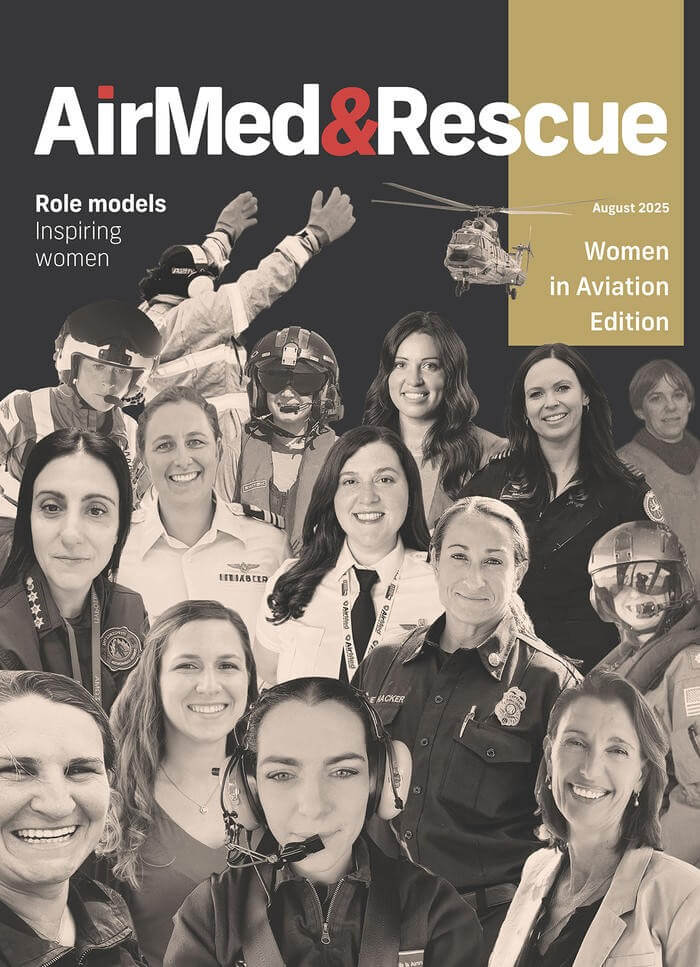
Our August magazine is the inaugural women in aviation edition, highlighting and showcasing female voices from the airborne special missions sector. We have features on blood products used in emergency medical services, challenging hoist rescues, pregnancy while flying, and portable water sources for firefighting. We also have interviews, a gallery, an industry voice, a news analysis piece, and a provider profile, as well as a review of the Paris Air Show.
Editorial Team
The AirMed&Rescue Editorial Team works on the website to ensure timely and relevant news is online every day. With extensive experience and in-depth knowledge of the air medical and air rescue industries, the team is ready to respond to breaking industry news and investigate topics of interest to our readers.