

Fixed wings, flexible interiors

The AirMed&Rescue editorial team asks operators about their use of fixed-wing aircraft, whether equipped full-time for medical evacuations or configured to switch from VIP transport to air ambulance operations
As global demand for rapid, reliable medical transport grows, air ambulance services have become essential in providing advanced care to critically ill or injured patients, regardless of their location. Whether responding to an emergency in a remote rural area or repatriating a patient across continents, the mission profiles of air medical operations are as diverse as the environments they serve. Air ambulance missions rely on highly customized aircraft, cutting-edge medical equipment, and rigorous logistical coordination. This article explores the operational realities, equipment requirements, and design considerations that define the current air ambulance landscape.

Mission profiles
Bob Gibbs, Vice President of Global Special Mission Sales at Textron Aviation, pointed out that fixed-wing air ambulances typically transport stable patients between hospitals. “However, they are equipped to handle emergencies if a patient’s condition deteriorates during the flight. These flights typically last between 30 minutes and three hours, longer than rotary-wing aircraft. Patients may include those with leg fractures, pregnant women, and extracorporeal membrane oxygenation (ECMO) patients requiring advanced care,” he said. “Bariatric patients are becoming increasingly common and require special stretchers, loading devices, and entry ports. Transporting patients with infectious diseases is a specialized operation with specific challenges and training requirements.”
Air ambulance missions vary greatly depending on the region, geography, and aircraft type, according to Maria Emilia Stalder, Marketing Manager at Bucher Leichtbau. “Helicopter missions typically serve local or regional needs, such as emergency response, trauma, and interhospital transfers. Fixed-wing aircraft are used for longer distances, including international repatriations. At Bucher, we see a growing demand for equipment that supports trauma and intensive care, such as ventilators, defibrillators, and infusion systems. Additionally, neonatal and pediatric missions require incubators or baby pods, ECMO support for critically ill patients, bariatric transport with reinforced stretchers, and loading and isolation systems for infectious diseases, particularly post-Covid, using negative pressure systems or isolation pods,” she said. “Patient profiles have evolved with increasing medical complexity and increased expectations for hospital-level care in-flight. Operators now expect modularity, power management, and ergonomic layouts that allow for mission-specific customization.”
Patient profiles have evolved with increasing medical complexity and increased expectations for hospital-level care in-flight
According to a Pilatus spokesperson, there is a diverse customer base that uses customized air medical aircraft for its operations. “We have a long-standing relationship with the world’s largest aeromedical organization, the Royal Flying Doctor Service (RFDS) of Australia, which uses both PC-12s and PC-24s for its operations. These aircraft have been configured and outfitted to literally transform into a flying intensive care unit, capable of providing lifesaving critical care to people working and living in Australia’s most remote areas. The PC-24 has been configured to transport three patients on stretchers and four healthcare workers,” the spokesperson said. “The aircraft and aeromedical teams can be called upon at any time, day or night, 365 days a year, to assist people in distress, including a mother about to give birth, a person seriously injured in a road accident or a cattle farm incident, and someone requiring transport to a capital city because remote healthcare facilities are unable to meet their medical needs.”
With fixed-wing aircraft, CareFlight typically flies the Darwin–Adelaide route, often four or more times a week, covering 1,450NM (2,685km), according to Iain Percival, Head of Flying Operations and Chief Pilot HOTC at CareFlight. “The other ‘routine’ route is Darwin–Melbourne, covering 1,700NM (3,150km). Both routes occasionally have a sea-level cabin requirement, meaning the aircraft must be capable of flying from Darwin to Melbourne at approximately 23,000ft,” he said. “We also operate other transcontinental routes, such as Perth to Sydney, and to Southeast Asia, typically Bali, Fiji, and Vanuatu, but also further afield, such as Bangkok, India, Japan, and China.
“We transport a wide range of patients, including critically ill trauma patients, cardiothoracic and neurosurgical patients, as well as pediatric and neonatal patients. Patients undergoing ECMO are occasionally transported. We also transport low-acuity patients returning home after successful treatment. Our jets can accommodate two high-acuity stretcher patients or two low-acuity stretcher patients and one seated patient.”
Range, performance, and operating costs
Stalder observed that each type of mission requires a different aeronautical profile. “Helicopters offer vertical takeoff and landing, ideal for rapid interventions in remote areas. Turboprops, such as the PC-12, balance performance on short runways with cabin space and fuel efficiency. Light jets are used for long-distance repatriations, but may face limitations on short or high-altitude runways,” she said. “We support operators on both platforms by designing lightweight, mission-optimized medical interiors. Because weight directly impacts range and performance, our products are engineered with high-strength aluminum and composite materials to reduce load without compromising functionality.”
Because weight directly impacts range and performance, our products are engineered with high-strength aluminum and composite materials to reduce load without compromising functionality
Gibbs affirmed that several factors determine the performance requirements of an operation. “Hospital systems or government organizations often use major airports and focus on minimizing patient stays on board. Contract service providers must plan for a broader range of services and smaller, regional, or remote airports,” he said. “Cessna and Beechcraft turboprop and jet aircraft can cover long distances from smaller airports, making them ideal for most medical transports. Some programs require patient pickup from gravel runways or dirt fields. Other operators serve remote areas using seaplanes.”
Key performance statistics for Pilatus aircraft include a maximum altitude of 45,000ft, a top speed of 787km/h, and a range of 3,610km, according to the Pilatus spokesperson. “The cabins are 1.69m wide, 7m long, and 1.55m high. When purchasing an aircraft, the first question to answer is ‘What does a typical mission profile look like? What does the aircraft need to be capable of?’ Everything else, in terms of capabilities, costs, etc., depends on the answer to this very important question,” they said. “The PC-24 possesses an efficient operational envelope suited to the aeromedical sector.”
According to Percival, the aircraft chosen is determined by the most demanding routine operations. “We regularly fly the Darwin–Melbourne route, often with a sea-level cabin, or with a heavy load of specialist equipment and personnel. Furthermore, the aircraft must be capable of completing the longest and most frequent route non-stop, as the risk of failure with a critical patient and a load of specialist equipment in an intermediate location is unacceptable. We operate our own jets to and from major Australian airports and reach remote locations with our own King Air or rotary-wing aircraft,” he said. “This ensures continuity of patient care from the accident site to interstate specialist care. Of course, there are occasional missions, mainly international, where intermediate stops for refueling are unavoidable, but we are committed to minimizing them and using locations that can accommodate the patient’s needs in the event of a breakdown during the stopover.”
Flexible configurations
Gibbs pointed out that aircraft intended for hospital systems or contracted service providers are typically equipped for full-time medical evacuation operations. “Cessna and Beechcraft aircraft can also be configured to quickly transition from a medical evacuation crew to a VIP or corporate shuttle for transporting medical teams or organ transplant teams,” he said. “A modular system with quick-change roll-on/roll-off capability can be easily installed to facilitate mission flexibility.”
Permanent installations offer highly specialized layouts, seamless medical systems integration, faster deployment, and mission readiness, affirmed Stalder. “Modular/convertible configurations offer reconfiguration flexibility for different mission types, such as VIP, cargo, medical evacuation, and improved aircraft utilization. We have observed growing interest in flexible interiors, especially in the government and parapublic sectors, where multi-mission capability is critical,” she said.
We have observed growing interest in flexible interiors, especially in the government and parapublic sectors, where multi-mission capability is critical
For a dedicated aeromedical operation like the RFDS, aircraft are permanently configured for air medical use, the Pilatus spokesperson observed. “They must be able to respond to a medical need at any time, day or night. Some charter operators also offer a medical evacuation service, and, for this type of operation, an aircraft like the PC-24 allows for easy cabin reconfiguration, for example, from standard charter missions to medical evacuation missions,” the spokesperson said. “Thanks to its large cargo door, it also facilitates patient loading onto a stretcher and facilitates patient transfers between ground and air medical transport.”
CareFlight’s aircraft are also permanently configured for medical use, according to Percival. “As a medical organization that uses aircraft to transport patients, our aircraft and equipment are optimized for patient needs. Our aircraft are permanently equipped with customized medical interiors. This means we do not have access to additional revenue streams from activities such as executive charters,” he said. “An air passenger transport operator that occasionally performs medical activities can opt for flexible interiors and accept compromises.”
Essential medical equipment
Bucher systems are designed to integrate several key elements. “Equipment includes stretcher systems, both fixed and modular, with a capacity of up to 250kg, oxygen delivery systems with high-pressure storage, and medical panels equipped with integrated power, suction, compressed air, and medical gas outlets. Dedicated storage is also provided for medical devices such as ECMO units, monitors, and infusion pumps. Optional isolation pods or modular units are available to support infection control. Regarding integration, the supply and oxygen systems are routed via certified interfaces, while all equipment is installed on supports that have passed 16g crash tests,” Stalder said. “Quick-access panels are also included, designed to facilitate intervention by medical and maintenance personnel. All our installations are European Union Aviation Safety Agency (EASA) or Federal Aviation Administration (FAA) supplemental type certificate (STC) certified. We work closely with original equipment manufacturers (OEMs) and operators to ensure turnkey certification support, reducing lead times and ensuring regulatory compliance worldwide.”
Quick-access panels are also included, designed to facilitate intervention by medical and maintenance personnel
A Spectrum stretcher attaches to a Spectrum base on the aircraft CareFlight operates, explained Percival. “The bridge is attached to the foot end of the stretcher. A HAMILTON-T1 ventilator, a Philips Tempus Pro monitor, a suction unit, and four syringe injectors are attached to the bridge. We also have a defibrillator, a C-MAC video laryngoscope, a ventilator, and a backup monitoring system, as well as point-of-care blood testing equipment and an ultrasound machine,” he said. “For infection control, we have antibacterial wipes for cleaning our equipment during the flight, and hand sanitizer. We also have personal protective equipment (PPE) for all crew, including pilots, if needed.”
Thanks to the RFDS, various medical devices can be loaded on board the Pilatus aircraft based on the type of patient, according to the Pilatus spokesperson. “For example, a stretcher can be replaced by a bassinet for a premature baby requiring transport to an intensive care unit in a capital city. The aircraft also features systems that manage various aspects of patient care, such as oxygen, equipment power, and other essentials, to ensure patient wellbeing during transport,” the spokesperson said. “Regarding aircraft certification, the customer purchases the aircraft with an STC for aeromedical use, approved by the Civil Aviation Safety Authority (CASA) in the case of the RFDS or, for European operators, by EASA.”
Shifting healthcare needs
The evolution of air ambulance operations reflects broader shifts in both aviation technology and healthcare delivery. From modular interiors and high-capacity medical equipment to aircraft capable of traversing vast distances with critically ill patients, the sector demands solutions that combine clinical excellence with aviation operational requirements.
October 2025
Issue
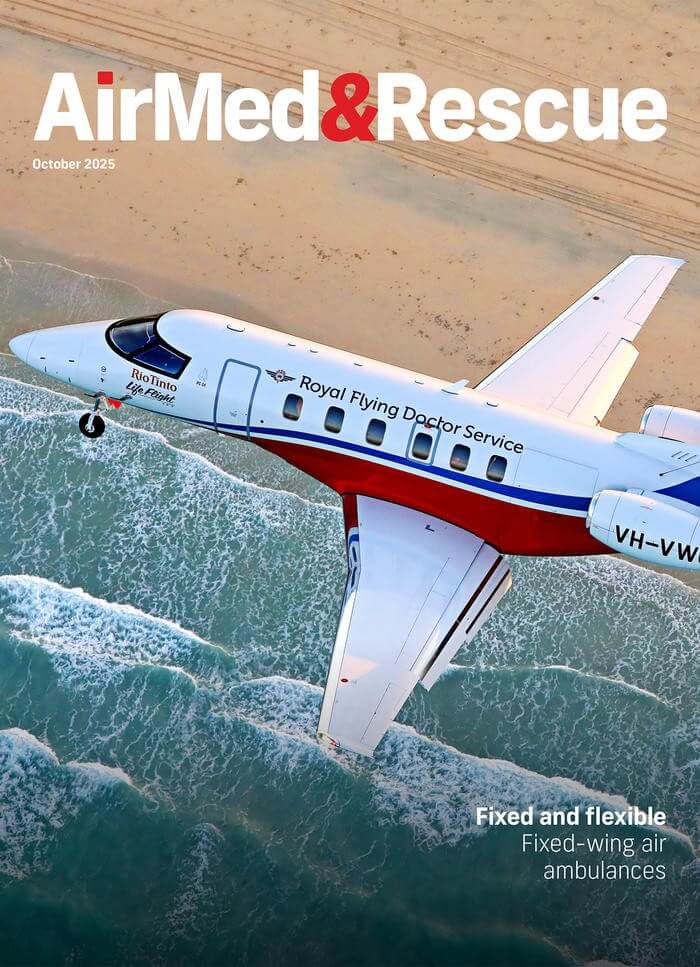
In our October edition, we bring you news, features and more showcasing special missions from around the world. We have features that focus on the fixed-wing air ambulance platforms that are enhancing air medical operations; the care and considerations when transporting children with infectious diseases at risk of deterioration; the law enforcement agencies that use aircraft to find and track persons of interest; and the challenges of treating patients with hyper- and hypothermia.
Editorial Team
The AirMed&Rescue Editorial Team works on the website to ensure timely and relevant news is online every day. With extensive experience and in-depth knowledge of the air medical and air rescue industries, the team is ready to respond to breaking industry news and investigate topics of interest to our readers.