

Fly and avoid

Air ambulance companies are having to plan more roundabout routes and wing-to-wing transfers to avoid no-fly skies in eastern Europe, the Middle East and Africa. The patchwork of risky regions is ever-changing, making their task even more complex. Robin Gauldie reports
Air ambulance operators are increasingly being called on to clock up more air miles as they transfer patients to and from points further from home. Long-distance travel from main tourism source markets has bounced back strongly since the end of the Covid-19 pandemic, according to airlines, tour operators and travel industry organizations. The British travel trade association ABTA, for example, in its Travel Trends for 2025 forecast, noted significant year-on-year growth in 2024 for travel to destinations in Asia, Australasia, the Middle East and Africa. That increase in demand for long-haul travel, though, has not directly triggered any dramatic increase in demand for medevac flights from long-haul vacation destinations, according to air ambulance companies.
Instead, they identify a greater need to skirt around potentially hazardous airspace and to fly in and out of volatile regions as the main driver behind the growth in demand for longer transfers. That growth in turn has led companies such as Turkey’s Redstar Aviation – which serves points as far from its Istanbul base as Australia – Luxembourg’s European Air Ambulance (EAA), and the French air ambulance operator Airlec to add more aircraft with longer legs. Airlec’s pick has been the Dassault Falcon 900EX, while the Bombardier Challenger 605 has been the equipment of choice for both Redstar (which now flies four Challengers alongside five Learjet 45XR aircraft) and EAA, both of which added additional Challenger 605s last year. Meanwhile, Nuremberg-based Aero-Dienst, the main medevac aircraft operator for Allgemeiner Deutscher Automobil-Club (ADAC), Germany’s automobile association and insurance and medical assistance provider, will put a new Challenger 650 aircraft into service as a dedicated air ambulance next year. According to ADAC Versicherung board member Sascha Petzold, the Challenger 650’s long-distance capability was a key factor in the acquisition, enhancing ADAC’s global reach. “Thanks to Challenger 650’s long range, we are able to serve our members worldwide with our own ADAC fleet,” he stated. “The acquisition of this new aircraft is another significant step in our strategy to modernize our fleet.”
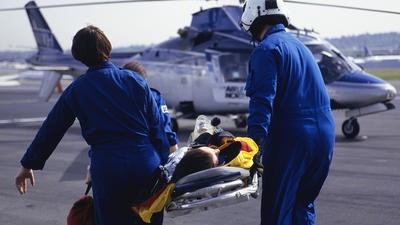
Three years of Covid-related travel restrictions heightened worldwide demand for longer-range air ambulance provision, as operators sought to circumvent multiple lockdowns and tougher landing protocols by diverting around affected countries. Since the peak of the pandemic, demand has dropped back to close to pre-Covid levels, some operators say. Interviewed by AirMed&Rescue in 2022, FAI rent-a-jet Managing Director Volker Lemke foresaw “only limited demand” for long-range operations, adding that existing capacity in the long-range air ambulance sector was adequate for current needs after catching up with some years of “relative undercapacity”.
Three years on, he stands by that opinion. The Nuremberg-based company has not to date seen a major increase in demand for long-haul ambulance flights as a result of growth in vacation travel, he said. Historically, flights of over 5,000NM, including flights from destinations in Asia and the Caribbean to Europe, have accounted for around 20–22% of FAI’s requests, he added.
Growing need for alternative routings
The escalation of conflicts around the world, though, has increasingly forced air ambulance companies to use longer routings, he pointed out. “Geopolitical issues are increasingly necessitating planned detours with additional stops, meaning that flights that would normally be considered medium-haul are becoming almost long-haul,” said Lemke. “This results in a larger number of longer flights over a period of time, though this can fluctuate depending on how the situation develops.
Geopolitical issues are increasingly necessitating planned detours with additional stops, meaning that flights that would normally be considered medium-haul are becoming almost long-haul
“Changes can be short term, as was the case in avoiding overflight of Iranian airspace [in October 2024], which reverted back to normal after just a few weeks, or it can be long term, as is the case with Russian airspace, which remains in place today,” Lemke added.
A look at the Safe Airspace Conflict Zone and Risk Database shows the scale of the challenges air ambulance planners face when devising routings that avoid high-risk airspaces.
Compiled by Opsgroup – an independent organization made up of airlines, corporate flight departments, private operators, charter operators, military, and governments – it uses updates from civil aviation authorities including the US Federal Aviation Administration, the UK’s Civil Aviation Authority, Germany’s BMVI and France’s DGAC.
At the time of writing, it classes seven countries (Syria, Yemen, Lebanon, Libya, Haiti, Sudan and Ukraine) as no-fly zones, while listing more than a dozen – including Russia, Israel, Iran, Iraq, and several countries close to conflict zones in Ukraine and along the Red Sea – as ‘assessed risk’.
“We typically have at least one flight per year to destinations such as Afghanistan, Russia, Israel, Kuwait, Beirut, Iraq, Iran, and Libya,” said Daniela Wilson, Director of Aviation at Bordeaux-based Airlec, which in 2022 operated the first air ambulance flight using the Dassault Falcon 900EX, with its 4,500NM (8,334km) range. Airlec’s fleet of nine aircraft also includes Hawker 1000 and Hawker 900, Merlin and Citation aircraft.
“Additionally, we operate almost weekly flights to Africa, particularly to various volatile regions,” Wilson said. “We receive frequent quote requests, but of course competition plays a role, as assignments ultimately depend on pricing and availability.

“We are forced to follow these alternative routings because flight plans that enter restricted or conflict zones are automatically rejected, leaving us with no other choice. Due to the ongoing conflicts, it has become increasingly difficult to plan direct flights along the shortest great-circle routes. We must avoid all restricted zones, often resulting in zigzagging routes. This poses challenges such as extended duty times for crewmembers, higher costs due to increased flight distances, additional overflight permit fees, and increased fuel consumption due to more frequent refueling stops.
We are forced to follow these alternative routings because flight plans that enter restricted or conflict zones are automatically rejected, leaving us with no other choice
“Today, flight planning requires considering multiple factors to provide clients with tailored solutions. Greater flexibility, such as wing-to-wing with our own aircraft, allows us to optimize flight routes while ensuring crew duty times are adhered to. Additionally, we must strategically pre-position crews to facilitate in-flight crew changes when necessary. The patient’s origin and destination also dictate our approach,” she said.
Transporting a patient from London to Pakistan, for example, could require pre-positioning a crew in London then following a route to Karachi avoiding restricted zones with technical stops for routing purposes in Cairo and Muscat. After patient drop-off and tarmac turnaround (necessitated by security concerns and visa restrictions), the aircraft would return to London (Farnborough) with an overnight in Muscat and a technical stop in Cairo.
“This is the only viable routing for safely transporting the patient to their final destination while complying with flight restrictions,” said Wilson. “A direct route would cross restricted airspace, which is not an option.”

Surge in long-range repatriations
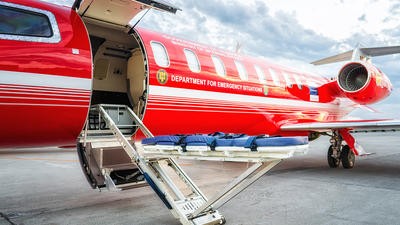
EAA added a second Bombardier Challenger 605 to its fleet last year as part of its long-term strategy of building up its ability to handle long-range missions, said the company’s Business Development Manager, Tom Hienckes. EAA’s first Challenger 605, delivered in 2021, exceeded the operator’s expectations and expanded its reach and its ability to handle global patient repatriation, after client demand confirmed a need for a second aircraft of the type.
Successful operation over the past three years affirmed the decision to add a second Challenger, Tom Hienckes said.
“We received our first long-haul aircraft, the Bombardier Challenger 605, in late 2021,” he explained. “While we conducted thorough business case analyses before investing in long-haul aircraft, the Covid-19 pandemic significantly altered market dynamics, rendering pre-pandemic assumptions less reliable. Once global travel restrictions were lifted, we experienced a noticeable increase in demand for long-range repatriations. This surge in requests ultimately led us to acquire a second Bombardier Challenger 605, which we received in the summer of 2024,” Hienckes said.
While we conducted thorough business case analyses before investing in long-haul aircraft, the Covid-19 pandemic significantly altered market dynamics, rendering pre-pandemic assumptions less reliable
“In general, we have observed a steady increase in demand. However, competition in the long-haul air ambulance market has also intensified, with more operators opting to acquire long-range capable aircraft.
“The geopolitical challenges we are currently facing, along with the resulting longer flight routes and times, are key factors driving the increased demand,” he added. “With the extended range of our Bombardier Challenger 605 fleet, we require fewer fuel stops compared to the Learjet 45XR. Beyond the operational time savings, fewer takeoffs and landings also benefit patients – especially those requiring intensive care – by reducing physical strain and medical risks.
“Another significant advantage is the Challenger 605’s larger cabin size, which allows us to transport up to three lying patients, carry more medical equipment and luggage, accommodate additional accompanying passengers, and even expand our medical crew composition when necessary. On long-haul and ultra-long-haul flights, the more spacious cabin significantly improves working conditions for our medical crew, enabling them to provide optimal care for our patients.”
The global environment may be posing new and complex challenges for air ambulance companies, but operators seem confident that they already have the skills and flexibility – whetted by long experience – to adapt.
“In response to evolving geopolitical challenges, we must remain agile by re-routing flights or, in extreme cases, suspending operations when necessary,” said Hienckes. “Our dedicated risk management team, integrated within our operational control center, continuously monitors global events, enabling us to react swiftly to emerging situations that may impact our air ambulance flights. By staying proactive and adaptable, we ensure operational resilience, even in uncertain environments. Through strategic planning and real-time decision-making, we uphold our commitment to delivering lifesaving services while navigating complex geopolitical landscapes.”
Lemke agreed. “Creativity, flexibility and adaptability have always been crucial for us, whether dealing with natural disasters, conflicts and wars, epidemics or similar, and especially during the pandemic,” he said. “Adjusting fleet structure and personnel requirements, developing new standard routes and constantly reworking established processes remain an essential part of our daily work. In our business, it’s imperative to think outside the box.”
May 2025
Issue
Our May edition is full of articles centered around training, with features covering pilot training, winch and rear-crew training, and air medical training; as well as a feature in the trend towards longer-range air ambulance transfers; plus we have more of our regular content, with lots of articles highlighting different aspects of training, from startle and surprise management to simulation centers and everything in between.
Robin Gauldie
Robin Gauldie is a former editor of Travel Trade Gazette and other travel and tourism industry titles. Now a freelance journalist specialising in travel, aviation and tourism, he writes for a variety of international consumer and business publications including International Travel & Insurance Journal, AirMed and Rescue, and Financial World.