

In safe hands: expert TBI transport protocols

The transport of traumatic brain injury (TBI) patients is high stakes and requires a highly coordinated and skilled approach. Experts share with Lauren Haigh their knowledge on best practice
Traumatic brain injury (TBI) is a leading cause of death worldwide and a growing global health priority. According to statistics from the US Centers for Disease Control and Prevention (CDC), there were over 200,000 TBI-related hospitalizations in 2020 and more than 69,000 TBI-related deaths in 2021.
TBI results from an external force that disrupts normal brain function. AirMed&Rescue asked Dr Michael Murphy, Emergency Medicine Physician and Director of Emergency Medical Services (EMS) and Prehospital Care at Tufts Medical Center, about the key causes. “Falls, especially among older adults and toddlers; vehicle-related accidents (cars, motorcycles, scooters, bicycles and pedestrians); violence, including gunshot wounds, physical interpersonal violence with and without weapons, domestic violence and non-accidental trauma in children; and blast injuries caused by industrial explosions or acts of terrorism,” he stated.
The expert transportation of TBI patients is essential to minimize the risk of secondary brain injuries. Best practices involve initial stabilization and assessment and continuous monitoring during transport, with the goal of avoiding additional damage.
“Primary injuries happen at the moment where there are external forces which injure the brain. This results in shearing of axons, vascular injury, contusions, and sometimes bony injuries,” explained Dr Murphy. “Pre-hospital personnel are essential in identification of these injuries and obtaining a thorough history – loss of consciousness, confusion, and documentation of the Glasgow Coma Scale (eye, verbal, motor) – at the scene and monitoring for any neurological changes that occur en route to the appropriate medical facility. The primary injury has already occurred and is generally irreversible.”
While primary brain injury is caused by direct impact, secondary brain injury can occur due to a complex physiological response following the initial injury, which is why comprehensive management of TBI is crucial.

Precision over speed
Pre-hospital care and transportation can directly impact the outcome of TBI patients but, with this type of injury, speed – while important – may come second to expertise. The golden hour is a well-known phenomenon but this crucial window may not necessarily apply in the case of TBI patients, providing they are suitably stabilized, assessed and monitored.
“The traditional mantra ‘time is brain’ has long driven emergency response protocols for TBI patients. However, recent research challenges this assumption, revealing a more nuanced picture of optimal TBI patient transport and care,” Enrique Murguia, Senior Director of Clinical Education at Air Methods, told AirMed&Rescue. “The implications are significant for air medical transport decisions, suggesting that the benefit to the patient comes more from the clinicians’ abilities than the speed of transport.”
The implications are significant for air medical transport decisions, suggesting that the benefit to the patient comes more from the clinicians’ abilities than the speed of transport
For example, a 2021 study published in the Canadian Journal of Neurological Sciences, which investigated transport time and mortality in critically ill patients with severe TBI, found no association between pre-hospital transportation time and in-hospital mortality. Dr Stephanie Queen, Senior VP of Clinical Services at Air Methods, explained: “The key is making appropriate transport decisions based on patient condition and available resources, not solely on speed. Sometimes a longer transport to a facility with comprehensive neurosurgical capabilities is preferable to a quick flight to a closer but less-equipped facility.”

Packing best practices
Best practices for packing TBI patients for air transport require a specialized approach to keep a patient stable and minimize the risk of further injuries. Securing the airway is an important practice.
“Patients with head injuries commonly present with altered consciousness and this in turn can put an airway at risk,” said Dr Simon J Forrington, Board Member, Auditor and Head of Standards at the European Aero-Medical Institute (EURAMI). “Prior to transportation, TBI patients with altered consciousness should usually have their airway secured by an endotracheal tube prior to transportation (an anesthetic or RSI is required to achieve this). Once the airway has been secured and mechanical ventilation commenced, then other treatments can be given to reduce the risk of secondary brain injury.”
Murguia agreed: “Airway management considerations in TBI transport demand particular attention to detail. Crews must proactively secure airways in declining patients, following strict neuroprotective intubation protocols that minimize secondary injury risks. Continuous end-tidal CO2 monitoring, with maintenance of target ranges between 35 and 40mmHg, helps prevent hyper- and hypoventilation. Patient positioning requires careful attention to optimize cerebral venous drainage, while suctioning techniques must be modified to avoid unnecessary increases in intracranial pressure.”
Airway management considerations in TBI transport demand particular attention to detail. Crews must proactively secure airways in declining patients, following strict neuroprotective intubation protocols that minimize secondary injury risks
Blood pressure must be continuously measured through an arterial line. “This allows beat-to-beat blood pressure to be monitored and ensures the avoidance of hypotension, which can cause a secondary brain injury,” Dr Forrington highlighted. “Adequate monitoring of oxygen saturations with a sats probe +/– blood gas analyzer [is necessary] to avoid hypoxia, which can also cause a secondary injury. Any other associated trauma should be treated – limbs splinted and spinal immobilization should be in place if a cervical spine injury is suspected. Packaging modalities to be considered include head blocks to immobilize the neck, a spinal board (for short distances until the spine can be ‘cleared’ radiologically) and a pelvic binder if pelvic injuries are suspected.”
Dr Murphy agreed that a constant focus on airway, breathing and circulation must be maintained. He added that when transporting a TBI patient via fixed-wing, they should be loaded with their head towards the front of the aircraft. “The stress of G-forces may increase intracranial pressure (ICP) and also diminish cerebral blood flow,” he stated. “Additional consideration should also occur at altitudes above 8,000ft where TBI patients may be at risk of hypobaric hypoxia, which may increase the severity of secondary brain injury.”
Standardization for success
During transport, communication is maintained with the receiving facility, including the provision of detailed information on the patient’s condition. Murguia underlined that this requires a comprehensive, standardized approach: “Crews must provide detailed handoffs using standardized formats such as MIST or I-PASS, ensuring crucial information isn’t lost during care transitions. Regular updates to receiving facilities about patient status changes help prepare teams for immediate interventions upon arrival. Clear documentation of interventions and patient responses provides crucial information for continuing care, while early notification of deterioration or specific needs upon arrival helps optimize resource allocation at the receiving facility.”
Dr Forrington said that patients with TBI generally need to be transported to a neurosurgical center. “This is commonly part of a larger trauma hospital, which is important as TBI often accompanies other trauma to other body systems as might occur in a high-speed road traffic collision, for example,” he commented.
Patients with TBI generally need to be transported to a neurosurgical center
Murguia underlined that the need for specialized neurosurgical intervention must be weighed against transport risks and facility capabilities. “Time to definitive care versus time to the nearest facility represents a crucial decision point, particularly given recent research showing a limited correlation between transport time and outcomes,” he stated.
Dr Murphy provided an insight into a receiving facility. “As a Level I Trauma Center we receive patients directly from the scene via aeromedical as well as ground transport. Additionally, Tufts Medical Center also receives patients via interfacility transfer from other medical institutions,” he told AirMed&Rescue. “[In the USA] there is a shortage of EMS personnel and various parts of the country are facing workforce shortages due to increased demand, funding/reimbursement issues and turnover.”
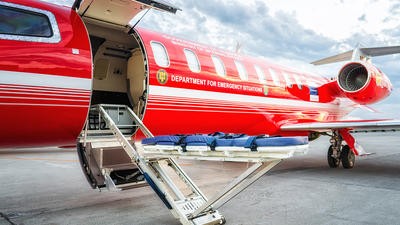
Maintaining cerebral perfusion pressure
Specialized equipment and protocols are required to treat TBI patients during transport. Dr Murphy asserted that although these may vary on a regional and international level, secondary injury prevention is always of paramount importance. “I like to retain a formula in my mind which is helpful for those patients with multiple trauma and traumatic brain injuries. Remember: MAP-ICP=CPP. Mean arterial pressure minus intracranial pressure equals cerebral perfusion pressure,” he noted. “Conceptualize a trauma patient in shock and the effect it would have upon the cerebral perfusion pressure. In the back of a helicopter, fixed-wing, or ground ambulance you may not have the ICP number. However, all goals should be to prevent secondary injury and maintain a cerebral perfusion pressure to prevent cerebral ischemia. [When there is] injured brain tissue without normal autoregulation, the pressure driving cerebral perfusion must increase to overcome the high ICP. Maintain your patient’s blood pressure with elevated ICP. Always remember the Cushing’s response (hypertension, bradycardia and hyperventilation), which occurs due to increased ICP.”
Remember: MAP-ICP=CPP. Mean arterial pressure minus intracranial pressure equals cerebral perfusion pressure

Training and guidelines
Guidelines for the safe transportation of TBI patients help minimize the risk of secondary injuries. By adhering to best practices and developing your own evidence-based guidelines, safety can be ensured during patient transfer. “The National Institute for Health and Care Excellence (NICE) produced guidelines in 2023 on head injury management. There are also guidelines from other organizations, such as the Brain Trauma Foundation, Scottish Intercollegiate Guidelines Network (SIGN) and Headway – the brain injury association,” highlighted Dr Forrington. “These guidelines should be considered, but each retrieval service should develop their own guidelines and train their staff appropriately in them.”
Training equips EMS personnel with the skills and knowledge they need to provide specialized care to TBI patients. “Most experienced doctors, nurses and paramedics will have had training in TBI management as part of their medical training. However, it is important to stay up to date and continuous professional development is key,” Dr Forrington underlined. He pointed out that simulation training is particularly valuable in air medical transportation. “Some providers, such as Gama Aviation (who I am Medical Director for), have high-fidelity simulation suites,” he stated. “We use an old aircraft that has been retired from the fleet. We took off the wings and turned it into a simulator, modified the emergency exit so that it is reusable. We use this for clinical simulation and to simulate aviation emergencies, such as fire in the cabin. We do this for all new starters and have an annual program of simulator training to keep everyone up to date.”
Addressing challenges
Owing to the crucial need to continuously minimize the risk of secondary injuries, transporting TBI patients is fraught with challenges. Dr Murphy said there is more to be done in the area of technology to assist air medical crews: “Aeromedical crews presently have limited diagnostic and therapeutic resources. Future goals should be directed towards improving triage systems, exploring biomarkers and mobile imaging devices, evaluation of neuroprotective agents and their ability to decrease secondary injury. Additionally, the implementation of improved assessment, training and skills maintenance should benefit those who suffer from traumatic brain injury.”
Aeromedical crews presently have limited diagnostic and therapeutic resources. Future goals should be directed towards improving triage systems, exploring biomarkers and mobile imaging devices, evaluation of neuroprotective agents and their ability to decrease secondary injury
In addition to EMS staffing shortages, there are challenges associated with resource limitations. “The landscape of rural TBI care presents multiple interconnected challenges that extend beyond simple geography,” Murguia told AirMed&Rescue. “Rural healthcare facilities face significant resource limitations that directly impact patient care. Critical staffing shortages, particularly in specialty areas like neurosurgery and critical care, create substantial gaps in service availability. Many facilities operate with limited access to advanced imaging capabilities, lacking 24/7 computed tomography (CT) or magnetic resonance imaging (MRI) interpretation services that are crucial for TBI assessment. Studies have shown that rural trauma centers face longer delays in obtaining neurosurgical care compared to urban centers.”
Murguia pointed out that system-level issues further compound these challenges: “Rural healthcare networks often struggle with limited options for interfacility transfer agreements and a scarcity of ground critical care transport teams. Coordinating multiple EMS agencies across vast service areas requires complex logistics and communication systems. Financial constraints affecting equipment and staffing resources create ongoing operational challenges that impact the entire care delivery system. The community impact of these challenges is significant and far-reaching. Rural areas consistently show higher mortality rates for severe TBI compared to urban settings.”
An evolving landscape
Looking to the future, Murguia said that the air medical community must continue evolving its approach to TBI transport as new evidence emerges and technologies advance. “Developing evidence-based transport protocols represents a critical next step, requiring collaborative efforts between transport programs, trauma centers, and researchers to establish best practices based on current data,” he said. “Implementing real-time telemedicine consultation shows promise, offering rural facilities and flight crews immediate access to neurosurgical expertise during critical decision-making moments. Enhanced coordination between rural and urban facilities must extend beyond simple transfer agreements to create integrated care networks that optimize resource utilization and patient outcomes.”
Rural healthcare access continues to make air medical transport an essential component of TBI care delivery
Murguia agreed that progress is contingent on mindful advancements. “While research has demonstrated that transport time alone does not correlate with patient outcomes, the reality of rural healthcare access continues to make air medical transport an essential component of TBI care delivery. Success in this evolving landscape requires a delicate balance between maintaining rapid transport capabilities and focusing on optimal patient care throughout the transport process,” he concluded. “By embracing evidence-based protocols, advancing crew education, strengthening rural healthcare networks, and leveraging emerging technologies, air medical programs can continue to advance their critical role in TBI patient care.
“The future of TBI transport lies not in how quickly we move patients but in how effectively we care for them throughout their journey to definitive care.”
April 2025
Issue
Our April edition has a special focus on aerial firefighting, with features that include rescues during wildfire situations; the coordination process and tools used between aircraft and firefighters; the distinct job of the smokejumper; the different use cases for buckets and tanks, and what needs to be considered for your airframe; the continued appeal of the Firehawk platform; and the importance of proper expertise when treating traumatic brain injuries; plus more of our regular content.
Lauren Haigh
Lauren has worked in the publishing industry for eight years and reads and writes about healthcare, science and travel insurance on a daily basis. Her favourite aircraft is the plane from the title sequence of British educational children’s TV series Come Outside.