
Flying beyond the glass ceiling to improve gender diversity in aviation

Female leaders share with Lauren Haigh what it means to be a woman in a male-dominated industry and how they are helping shape a more inclusive future for aviation
According to the International Civil Aviation Organization (ICAO), women represent roughly 4–6% of pilots globally, making aviation one of the most gender-imbalanced professions in the world. While representation in leadership is improving, a 2021 survey by the International Aerospace Womens Association (formerly the International Aviation Women's Association; IAWA) found that over half (59%) of women in leadership positions in aviation had considered leaving the industry due to barriers to progression and promotion, highlighting ongoing retention challenges. The women occupying leadership positions in aviation today are role models to the next generation, providing tangible proof of what’s possible.
A careful balance
Aviation leadership demands safety responsibility, precise decision-making, and operational coordination, often in dynamic environments. Jennifer Thiel, Aviation Base Manager at STARS (Shock Trauma Air Rescue Service) in Calgary, Canada, describes a role that blends clinical urgency with aviation precision: “We respond to critically ill or injured patients, often during their darkest days, so every mission carries a deep sense of purpose,” she explained. “On the aviation side, I’m responsible for safely operating our aircraft and making real-time decisions in high-pressure situations. Ultimately, my focus is on creating an environment where our team can perform at its best, delivering rapid, reliable care to those who need it most.”
For Christine Allerding, Helicopter Pilot at DRF Luftrettung in Germany, operational complexity defines daily life: “We fly rescue missions as part of a 24-hour operation, both day and night, using the Airbus Helicopters H145. As Captain, I am responsible for the safe and efficient conduct of the flight, the helicopter and the crew.” She also trains new pilots: “As a Type Rating Instructor, I train new colleagues on this aircraft type – both in real-world flight and in the simulator.”
Love at first flight
For Thiel, her love for aviation sparked at 16 on a flight with her uncle. “I’ll never forget lifting off in the helicopter, flying low down a river with the doors off, the wind in my face and the world rushing by below,” she recounted. “We even landed on a rock bar in the middle of the water – so thrilling and surreal that I knew immediately this was for me. That day, I spent hours in my uncle’s flight suit, lying in the infield, watching helicopters take off and land, imagining myself in the pilot’s seat. The thrill, skill, and freedom captivated me instantly. From that moment, I was hooked. I used every opportunity to learn, from reading about aircraft to taking a crash site survival course at 17. What started as a single exhilarating flight became a lifelong passion. Simply put: it was love at first flight!”
We even landed on a rock bar in the middle of the water – so thrilling and surreal that I knew immediately this was for me
It was a similar tale of fulfilling a lifelong dream for Allerding; one that developed from growing up surrounded by model aircraft enthusiasts. “They certainly passed on their fascination with aviation to me. As a primary school pupil, I was particularly fascinated by the SAR 71 rescue helicopter. It was a Bell UH-1D, and the distinctive sound of its rotors made my heart race whenever it came in to land at the nearby swimming pool. I even dreamt about flying at night and found the feeling of being able to move freely in three dimensions simply fantastic,” she said.

A place in the room
Despite progress, many women in aviation still report experiences of bias and exclusion. Heléna Holt, former CEO of Devon Air Ambulance in the UK, said: “There is significant evidence that women are underrepresented in all areas of the sector, except for the activities that actually sustain it, such as retail and fundraising. No surprise, sadly, that these are also the less well-paid roles, reflecting every other industry. This has improved over the years but there is a long way to go, particularly in frontline roles but also in leadership,” she stated. “Talking to other women in leadership roles, we all have stories of being talked over in meetings, of hearing our words and ideas presented by male colleagues as their own, and worse.”
Allerding said that a woman flying a plane was still seen as ‘novel’. “My experiences do, to a certain extent, reflect the fact that much of society is surprised when a woman is piloting a helicopter. I’m more than happy to dispel such prejudices, because an aircraft simply doesn’t care whether it’s being piloted by a woman or a man,” she stated. “However, I can also say that the reactions I’ve received have been overwhelmingly positive, and I’ve often heard people say it’s ‘cool’ to have a female pilot flying. There have also been situations where I’ve sensed that this fact makes some people feel uncomfortable. I don’t let that get to me, though.”
I can also say that the reactions I’ve received have been overwhelmingly positive, and I’ve often heard people say it’s ‘cool’ to have a female pilot flying
Inge Maria Heutinck, Chief Commercial Officer at USMX AirLink, said that in Mexico, aviation is still quite a traditionally male-dominated industry, especially in technical and leadership roles. “At the same time, it is a region with a long and complex history when it comes to the role of women. There has been meaningful progress, but you still see a mix of strong traditions and ongoing change. I also experience this through my own background, having grown up in the Netherlands and now working in Mexico,” she explained. “That contrast gives you a different perspective and makes certain dynamics more visible, not only related to gender, but also to hierarchy, communication styles, and broader social factors. Being an executive woman in Mexico today brings both opportunity and complexity. There is real progress, but it also requires awareness and the ability to navigate different expectations.”

Growth from adversity
The struggle of achieving work-life balance is one that resonates with women in aviation and beyond, particularly in leadership roles. According to a 2025 Women in the Workplace report from McKinsey, around 60% of senior-level women report frequent burnout. “Women often have to balance their work commitments with the lion’s share of running the home, parenting and caring responsibilities, doubly so for me as a single parent,” stated Holt.
Furthermore, research from Hays found that 70% of women had experienced imposter syndrome during their careers.
Thiel reported feeling like she had to meet unspoken expectations. “Early in my career, I often felt like I always had eyes on me; if something should go wrong, it wouldn’t just be a mistake – it could be seen as a reflection on women in aviation as a whole,” she recounted. “I faced moments where I was told I couldn’t or shouldn’t pursue certain paths. I didn’t push forward to prove anything to the naysayers. It was about proving to myself that I could succeed.”
I faced moments where I was told I couldn’t or shouldn’t pursue certain paths. I didn’t push forward to prove anything to the naysayers. It was about proving to myself that I could succeed
Nadine Nieuwkamp, MD, Head of Flight Physicians Jet and Deputy Managing Director, Medical Department, Swiss Air-Ambulance Rega, has faced similar challenges. “Unfortunately, it is still the case that women in these roles often feel they must deliver more to be perceived equally. While progress is happening, it remains an important topic that requires continuous attention. I work closely with my line manager and our Chief Medical Officer to address these issues proactively, not only for my own experience but to help strengthen the path for future generations,” she explained.
A time of change
Indeed, through awareness and action, this path is becoming increasingly well trodden. “Around half of our pilot crew is female, and we have several women in director-level positions, including medical, finance, and operations,” confirmed Heutinck. “For me, that shows that with the right environment and opportunities, there is real potential for women to grow into both technical and leadership roles.”
Allerding also sees positive change happening. “I am convinced that gender plays an increasingly less decisive role, both now and in the future. A great deal has happened in recent years in terms of equal opportunities, and a significant proportion of today’s flight students are female. I therefore expect that more female pilots will soon be taking their places in the helicopter cockpit,” she stated. “We’ve even managed to crew a helicopter with an all-female team – that was lovely and set a good example.”
Role models and advice
A key part of this change is visibility and modelling what’s possible. “Early on, I was focused on learning, improving, and proving to myself that I belonged in this field,” said Thiel. “Over time, I realized how important visibility can be. When women see others succeeding in operational or leadership roles in aviation, it helps make those career paths feel more attainable. Mentorship is something I care deeply about. I’ve had the opportunity to mentor women during flight training – those starting their aviation careers, and others who are interested but feel a little intimidated by the industry. Sometimes all it takes is a conversation, encouragement, or sharing honest experiences to help someone realize it’s possible.”
When it comes to advice for the next generation, key words are learning, resilience, and self-belief. “I didn’t set out with a plan but I was always keen to keep pushing myself, learning and trying something new,” said Holt. “An open mind, learning mindset, and being opportunistic also helped. Add to that network, network, network and find your tribe.”
An open mind, learning mindset, and being opportunistic also helped. Add to that network, network, network and find your tribe
Dr Nieuwkamp agreed: “My belief is that you can achieve anything if you set your mind to it. But having a strong professional network is essential. Seek mentors, build relationships, and don’t hesitate to step into new challenges.”
Heutinck said that one of the most important things was not to underestimate yourself: “You do not need to fit into a certain mold to succeed. Being authentic and consistent in how you work and communicate makes a real difference over time.”
Thiel agreed: “Don’t let doubt – whether it’s your own or someone else’s – define what you believe you’re capable of. Aviation demands resilience and continuous learning, but it’s an incredibly rewarding path if you’re passionate about it.”

Laws of attraction
There is ongoing focus on improving diversity in the industry. A 2025 report found that, across aviation sectors, women in leadership and operational roles increased from 11% in 2016 to around 19% in 2025. While there’s no silver bullet, ongoing efforts and continued representation are slowly turning the dial. “There are no easy answers to attracting and retaining women in the sector as so many of the challenges are societal, but actually recognizing that women face many barriers that male colleagues don’t is the starting point to being able to identify and break down those barriers,” said Holt. “This is an issue that is gaining attention across the sector and I saw real commitment to change amongst colleagues all over the country, which gives hope for greater improvement ahead.”
Allerding underlined the importance of role models, particularly for sparking initial motivation. “It is important to raise the profile of female pilots in the media and in the public eye – in other words, the pioneers of the industry who are paving the way for future generations,” she stated. “In fact, I benefited from this myself as a young girl when the Bundeswehr’s [German Armed Forces’] first female helicopter pilot appeared in the media. This sparked initial interest and provided motivation. True to the motto: here is a woman who has shown that it can be done.”
It is important to raise the profile of female pilots in the media and in the public eye – in other words, the pioneers of the industry who are paving the way for future generations
The future’s doors are open
Over 200 aviation organizations signed the IATA’s 25by2025 initiative to improve gender balance with the goal of at least 25% women in senior and underrepresented roles across aviation, and some of the participants have now reached or exceeded this goal. Momentum is building and with new generations come new opportunities for gender diversity. “I am optimistic about the future, especially with the new generations entering the workforce. When I gave a talk on women in leadership in aviation last year, I noticed that not only young women attended, but also young men, who were genuinely interested in the topic and asked lots of questions,” said Heutinck. “That shows that the next generation is more open and more aware, and that this progress will continue.”
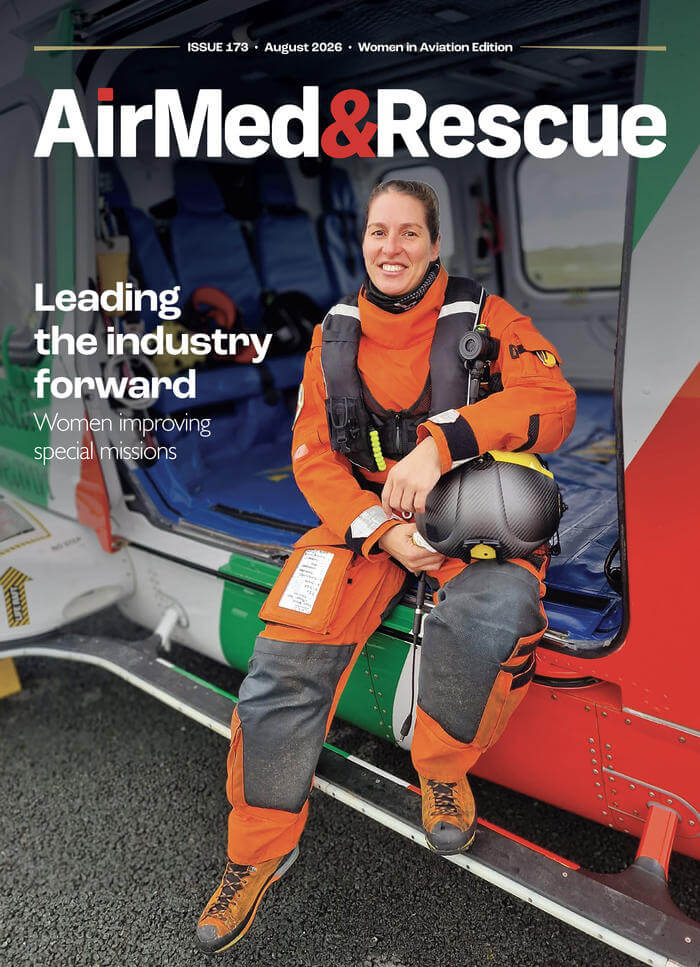
August 2026
Issue
August is a special time of year, and it is my pleasure to present a special Women in Aviation edition of AirMed&Rescue. We have features on the importance of preventing and knowing the early signs of hoist spin; the leadership roles and the value of visibility of women in the industry; the inward-facing and external sensors improving special missions; and the variety and standards that flight suits have to meet.
Lauren Haigh
Lauren has worked in the publishing industry for eight years and reads and writes about healthcare, science and travel insurance on a daily basis. Her favourite aircraft is the plane from the title sequence of British educational children’s TV series Come Outside.