
Industry voice: Advancing new frontiers in patient-centered care

The International Community for Aeromedical Research and Universal Standards (ICARUS) is seeking the buy-in of air medical professionals around the world to share data and collaborate to achieve better outcomes
The International Community for Aeromedical Research and Universal Standards – ICARUS – was formed to place patient care at the center of aeromedical transport. Central to this is the ethical principle of primum non nocere (first do no harm).
Registered as a not-for-profit organization, ICARUS’s work is carried out by a small team of medical professionals assisted by volunteers. Together with other key stakeholders, ICARUS has been focusing in two areas:
- Advocating for air transport medicine to be placed where it belongs: as a medical subspecialty
- Developing a solid evidence base of research and facilitating the creation of regulated standards for patient care.
The four key initiatives to accomplish this are:
- Obtaining formal recognition of air transport medicine as a sub-specialty within the already established disciplines of critical care and anesthesiology
- Formulation of curriculum design for aligning educational content, assessments, and materials necessary for the recognition of the air transport medicine subspecialty
- Collection of evidence-based data, and supporting research, to identify the existing gaps in patient care during air transport. The development of best practices based on this data and research
- Advocacy and publicizing of the best practices developed. To complement the best practices by the development of policies and standards for medical practitioners and air transport providers.

Central to accomplishing the initiatives – and an important goal for ICARUS – is the creation of resources, training courses, and certifications. These would be delivered through a digital platform and in-person workshops.
Recognizing current gaps
Based on her years of real-world industry experience and backed by several studies and advocacy briefs, Dr Ina Schmidt pointed out: “Without adequate knowledge and training policies, without regulations informed by evidence-based research, patients will continue to be unfairly at risk. The industry must be more adequately positioned as a medical discipline that centers on the needs of the patients above all else.”
The unique value of ICARUS
The bold mission of ICARUS is to bring about a transformation in aeromedical transport: in both the clinical medical practices and air transport standards.
As a formal medical subspecialty, based on scientifically sound research and best practice, air transport medicine can best serve those it is meant to – air transport patients
Through engaging in research, specialized training, and the development of evidence-based guidelines and standards, ICARUS intends to shape the field into a patient-centered medical discipline. Dr Schmidt continued: “As a formal medical subspecialty, based on scientifically sound research and best practice, air transport medicine can best serve those it is meant to – air transport patients, particularly the critically ill patients whose lives depend on the highest level of care. This elevated perception and delivery of care will inherently prioritize patient care for other industry participants – such that the ethical standards of healthcare are preserved. ICARUS will support their increased awareness by providing clear procedural instructions in the form of training materials, guidelines, and standards on how to implement the highest forms of patient and practitioner support.”
In this way, ICARUS demonstrates its commitment to the values of:
- Patient centricity – focus on the best possible pathway of care for each patient
- Evidence-based – ensuring decisions and standards are based on scientific research
- Innovation – promoting new technologies and approaches in air medical transport
- Sustainability – integrating responsible and future-oriented practices, in line with aviation and medical advances.

The field currently consists of several stakeholders acting in various areas, in isolation and independently of each other. ICARUS has the unique advantage of taking a comprehensive approach, backed by a network of leading partners within the healthcare and aviation sectors. These include, among others:
- The Air Medical Physician Association (AMPA)
- The Air & Surface Transport Nurses Association (ASTNA)
- The Association of Air Medical Services (AAMS)
- The International College of Advanced Practice Paramedics (ICAPP).
Dr Schmidt continued: “This strategic positioning of ICARUS within the field enables it to wield a strong influence, specifically in global recognition of the importance of formalizing aeromedical transport standards, the development and implementation of policies, and advocating for air transport medicine as a medical subspecialty.”
This strategic positioning of ICARUS within the field enables it to wield a strong influence, specifically in global recognition of the importance of formalizing aeromedical transport standards, the development and implementation of policies, and advocating for air transport medicine as a medical subspecialty
A unique value of ICARUS is that it was founded by a team of medical professionals who have experienced firsthand the risks, gaps, needs, and opportunities for improvement in the field.
The ICARUS team
Each team member carries their own experiences and specialties that collectively make for a formidable combination of scientists, healthcare professionals, researchers, and advocates for change. The core team and founding members include:
- Ina Schmidt, MD – Consultant Anesthesiologist, intensivist, emergency and flight physician; international advocate for patient safety
- Andreas Specht – Flight Nurse, specialist for mechanical ventilation and medical equipment, training, and education
- Prof Terry Martin, MD – more than a decade of experience in air medical education, research, and science
- Ralph Vermeltfoort, MD – extensive knowledge in medevac; innovator in the field of transport medicine and medical logistics
- Douglas Stevens, MD – internationally recognized expert in aviation medicine.
They are backed up by a group of doctors and a team of volunteers. As a not-for-profit, ICARUS is committed to improving our field and welcomes support. If you would like to be part of changing the air medical transport industry or are interested in helping advocate for air transport medicine as a subspecialty, please contact us by visiting the website and using the contact form.
Join ICARUS as a member and be entitled to membership benefits such as:
- Research and science: access cutting-edge research, and journals on air medical transport medicine
- Professional development: enhance your skills and knowledge with online courses, webinars, and other educational resources from leading experts in the field
- Career development: advance your career with mentorship, guidance, and networking opportunities with peers and leaders from around the world
- Advocacy and representation: join a strong and influential voice for the air transport medicine profession and contribute to shaping health policies and standards at the global level
- Networking opportunities: connect with a diverse and vibrant community from across Europe and beyond
- Knowledge: stay updated on the latest developments in air medical transport and air transport medicine, through ICARUS publications and more.
If you would like more information, are an industry stakeholder interested in building a relationship with ICARUS, or would like to share data and collaborate to improve the industry of air medical transport, please contact us at https://icarus-aeromedical.org
Together, we can transform the air medical transport industry through research, evidence-based guidelines, specialized training programs, and advocacy, such that worldwide patient care is prioritized and improved.
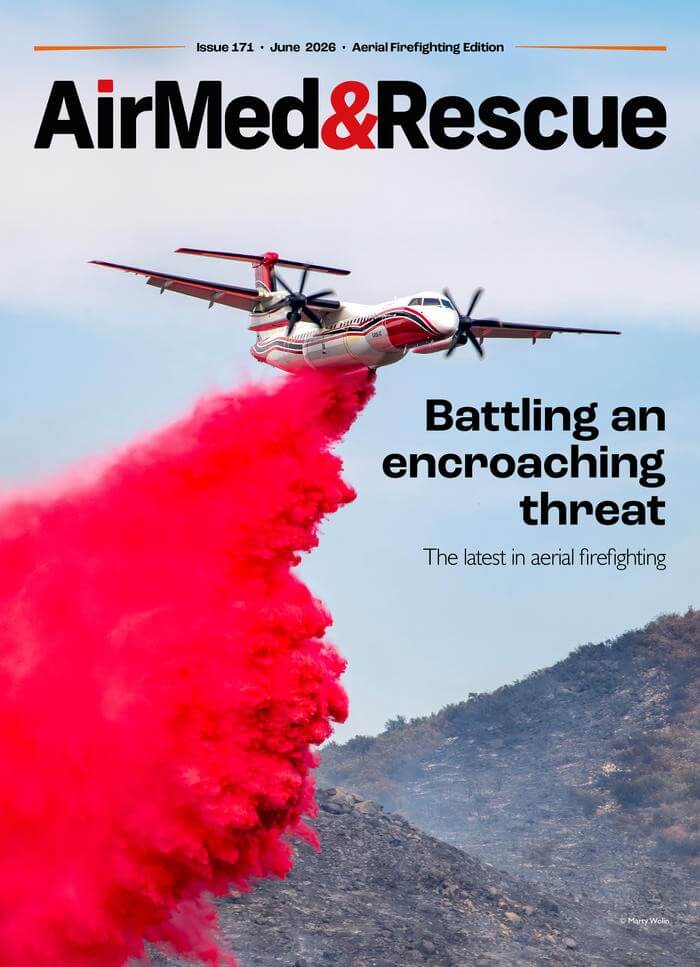
June 2026
Issue
As the northern hemisphere heats up for another hot summer, I’m pleased to bring you the aerial firefighting edition of AirMed&Rescue. We have features on how climate change is accelerating firefighting technology; the improvements in Australian firefighting capacity; and getting ahead of wildfires before they become unmanageable.
Dr Ina Schmidt
Dr Schmidt is a Consultant Anesthesiologist, intensivist, and emergency and flight physician with nearly two decades of experience spanning hospital critical care, pre-hospital emergency medicine, and international fixed-wing air medical operations. She has managed high-acuity patients on long-range missions across continents, often working in austere environments where preparation, teamwork, and clinical precision determine the outcome. Her growing concern about the variability in global air medical standards – and the challenges faced by medical crews caring for critically ill patients in the air – led her to found ICARUS: the International Community for Aeromedical Research and Universal Standards. ICARUS is a clinician-driven, nonprofit association dedicated to strengthening patient safety through research, education, and the development of evidence- based medical guidelines for air medical transport. Dr Schmidt is an active contributor to international air medical and critical care networks and frequently speaks on flight physiology, transport medicine, and the need for unified training pathways. Her work reflects a simple conviction: that patients deserve safe, high-quality medical care no matter where they are – in an ICU, a remote setting, or 36,000ft above the ground.