
Flying cellular towers

AirMed&Rescue examines how the integration of airborne cellular detection systems into SAR operations is helping to save lives
In the critical moments when someone goes missing in remote wilderness, is trapped under earthquake debris, or becomes stranded in disaster-affected areas without cellular coverage, every second counts. Traditional search and rescue (SAR) operations have long relied on visual scanning, thermal imaging, and ground-based communication networks – methods that can be severely limited by terrain, weather conditions, and the vast expanses that must be covered. However, the way in which rescue teams locate people in distress is being transformed by turning aircraft into flying cellular towers that can detect and communicate with mobile phones across distances of up to 35km.
Airborne cellular detection platforms exploit a simple but powerful reality: nearly everyone carries a mobile phone, and these devices are constantly searching for network signals. By deploying specialized equipment aboard SAR aircraft, rescue teams can now detect these signals even in areas completely devoid of cellular infrastructure, establish direct communication with missing persons, and pinpoint their exact locations with speed and accuracy.
This technological advancement addresses one of the most persistent challenges in SAR: the race against time. Whether responding to natural disasters, locating missing hikers, or coordinating emergency evacuations, these systems are proving that the ubiquitous mobile phone – carried by billions worldwide – can serve as a lifeline when traditional communication networks fail or simply do not exist.
Technical process and deployment
Under normal conditions, a mobile phone requires a connection to a network, specifically a base station, to make or receive calls, send text messages, or exchange data, according to Andrew Munro, Managing Director of Smith Myers. “When turned on, the phone passively listens for signals from nearby base stations. Once it detects a signal from the associated mobile network operator, it initiates communication by transmitting a registration request to the network,” he said. “In scenarios where there is no mobile network coverage, such as in remote or disaster-stricken areas, Smith Myers’ ARTEMIS provides functionality by acting as an airborne base station. In effect, it becomes the network the phone is searching for. This means that, unbeknownst to the user, a mobile phone carried by a missing or distressed person is constantly listening for a network, and ARTEMIS allows that phone to connect as soon as a SAR aircraft comes within range.
When turned on, the phone passively listens for signals from nearby base stations. Once it detects a signal from the associated mobile network operator, it initiates communication by transmitting a registration request to the network
“Once connected, ARTEMIS can accurately detect, identify, and locate mobile phones at a range of up to 35km, depending on terrain and environmental conditions. Additionally, the system allows aircraft personnel to communicate directly with one or more devices via voice call or SMS, even in areas without conventional coverage.”
Lifeseeker is an airborne platform developed by Centum that operates as a mobile network base station, giving SAR crews the ability to detect, locate, and communicate with cell phones, including in areas lacking network coverage, explained Olalla Varela, who is responsible for digital marketing at Centum. “The system does not rely on existing cellular infrastructure; instead, it creates its own signal to connect directly with the target device. Once the search begins, the exact position of the phone is obtained and displayed instantly via a secure, web-based interface, enabling real-time coordination between the aircraft and ground teams, as well as direct voice or text communication with the person in distress when needed,” she said.
The Cellular Airborne Sensor for Search and Rescue (CASSAR), implemented by the Canadian Armed Forces (CAF), turns an aircraft into a flying cellular tower, Captain Brian Cormier of the Royal Canadian Air Force (RCAF) said. “The system is most effective when there is no typical cellular network available, as we become the only ‘tower’ around. In the presence of a cellular network, the system ends up competing with the existing network towers. Each make and model of cell phone uses a different proprietary method for searching and connecting to a network,” he explained. “If the aircraft is close enough, it becomes the strongest signal, and the phone will prioritize it over the original network. The challenge lies in the timing of when cell phones search for signals – if the aircraft passes over while the phone is not actively seeking a stronger signal, the missing [person’s] phone may go undetected.”
As part of standard procedures at a Joint Rescue Coordination Centre (JRCC), when someone is reported missing, cell phone information is collected from acquaintances and network providers. This allows search efforts to focus specifically on the missing person’s phone(s), avoiding the need to scan every device in the area, which can slow down operations during time-sensitive phases, said Capt Cormier. “If and when the phone of the missing person is detected, the team has the ability to send a text message or voice call to the device in order to gather information from the distressed party. Typically, they would begin with a text message identifying themselves as SAR and asking if there is any distress, requesting the person to identify themselves so that it can be confirmed that the individual or individuals sought have been located,” he said. “In the case of actual distress or medical issues, they would then attempt a voice call to obtain information more quickly and accurately and to reassure the injured or lost parties. In the event that no distress is reported, they would likely send a text message asking if there is someone the located person would like them to update regarding their status. All of these interactions, of course, are logged and reported back to the JRCC for further action.”
SAR applications and technological capabilities
According to the RCAF, CASSAR offers a major advantage over traditional visual search when the person in need has a mobile phone. “The CASSAR system is already cutting-edge in that it is leveraging existing cellular telephone technology to enable real-time search efforts. The next step for the RCAF is to look for ways to implement this technology in all of our SAR platforms,” Capt Cormier said.
Airborne cellular communication is radically transforming the way SAR operations are conducted, according to Munro. “It has proven highly effective in a wide range of mission types, including locating missing persons, supporting aerial firefighting operations, and responding to natural disasters such as floods, earthquakes, and tsunamis. Operational users consistently report that ARTEMIS enables faster detection and location of people in distress, resulting in faster and more positive outcomes,” he said. “Furthermore, because ARTEMIS can identify and communicate with mobile phones over long ranges, aircraft can cover larger areas with fewer flight hours. This reduces airframe wear and tear, reduces maintenance requirements, extends the platform’s lifespan, and significantly reduces the overall environmental impact of SAR operations. While these are measurable benefits, the most important impact is helping to save more lives, more quickly.”
It has proven highly effective in a wide range of mission types, including locating missing persons, supporting aerial firefighting operations, and responding to natural disasters such as floods, earthquakes, and tsunamis
Recent developments are expanding ARTEMIS’ capabilities, affirmed Munro. “Integration with the Android Team Awareness Kit (ATAK) now allows ARTEMIS location data to be displayed directly on the smartphones of ground responders. This enables real-time situational awareness and direct communication between aircraft and ground personnel. Upcoming enhancements include SARLOC for precise aircraft location, and an emergency warning system (EWS).”
Airborne cellular communication systems demonstrate particular effectiveness in mountainous terrain, maritime, and remote location rescues, together with emergency situations where traditional networks fail, according to Varela. “We have focused on increasing detection range, improving location accuracy, and enhancing the system’s ability to operate in high device-density environments. In addition, we have expanded integration across a wide variety of fixed-wing, rotary-wing, and uncrewed aerial vehicle (UAV) platforms, providing greater operational flexibility for SAR organizations,” she said.

Training requirements and maintenance protocols
Aircraft manufacturers and system integrators apply rigorous qualification standards, particularly for transmission systems, observed Munro. “Consequently, ARTEMIS undergoes rigorous testing to ensure compliance. This not only ensures low-risk integration, both during production and retrofitting, but also contributes to a high mean time between failures (MTBF), improving reliability and mission readiness,” he said. “Operationally, the user interface incorporates design elements familiar from both aircraft systems and mobile telephony standards. This intuitive design significantly reduces training; most operators can achieve full proficiency in just a few days. Training is further supported by the availability of a full-fledged ARTEMIS simulator, which allows for realistic hands-on experience without the need for an operational aircraft.”
CASSAR training was provided by Centum, the project contractor, to a selected group of senior air combat systems officers (ACSOs), who are the primary personnel responsible for the CASSAR system. The RCAF then assumed responsibility for training the remaining SAR squadron personnel. “To remain current and proficient in the use of CASSAR, each quarter ACSOs must either participate in a flying exercise to detect a simulated lost person with a cell phone or must complete the same search scenario using Centum’s computer-based simulator,” Capt Cormier said.
SAR personnel undergo training in mission planning, system usage, and data analysis, explained Varela. “Due to its intuitive interface, Lifeseeker can be operated by any team member, regardless of technical background. The system is intuitive and designed to fit seamlessly into existing SAR workflows, meaning operators can focus on the mission rather than on complex system handling. The system requires minimal maintenance, primarily involving software updates,” she said.
The system is intuitive and designed to fit seamlessly into existing SAR workflows, meaning operators can focus on the mission rather than on complex system handling
For maintenance and field support, ARTEMIS includes extensive integrated test systems that continuously monitor system status, explained Munro. “These diagnostics can be accessed directly through the user interface, enabling quick and easy field checks and maintenance by operating personnel, without the need for specialized tools or in-depth technical knowledge,” he said. “ARTEMIS has been selected by the RCAF as part of their search and rescue fleet upgrade programs. The system is utilized in approximately 80% of SAR missions in Norway.”
It’s a calling
The integration of airborne cellular detection systems into SAR operations represents more than just a technological advancement. As they continue to prove their effectiveness across diverse operational scenarios, from earthquake response to rescue in remote areas, such systems are establishing new standards for emergency response capabilities.
The operational advantages are clear: reduced search times, expanded coverage areas, direct communication capabilities, and effectiveness in conditions where legacy sensors prove limited. Perhaps most significantly, these systems work with the technology people already carry.
The operational advantages are clear: reduced search times, expanded coverage areas, direct communication capabilities, and effectiveness in conditions where legacy sensors prove limited
The philosophy driving this technology is elegantly simple: transform every mobile phone into a potential rescue beacon and every SAR aircraft into a mobile cellular tower. In doing so, these systems are fundamentally expanding who can be rescued and how quickly help can arrive. In the world of SAR, where the difference between life and death often comes down to minutes, cellular technology adoption is proving that sometimes the most sophisticated solution is one that works with the technology already in hand.
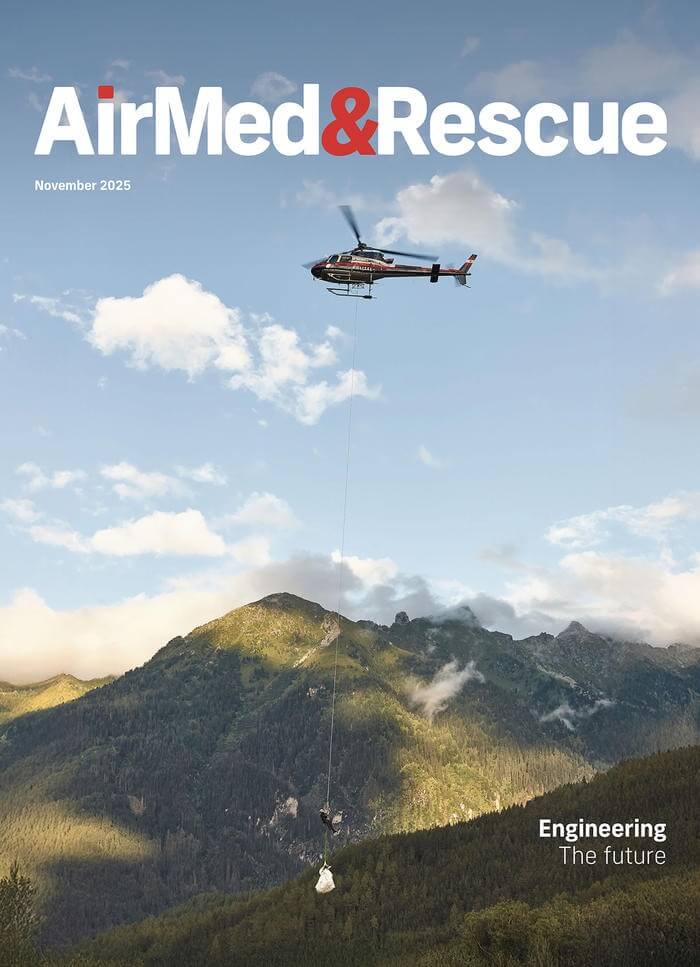
November 2025
Issue
Our November edition is packed with content relating to special missions from around the world. We have features that explore the design and engineering that go into modern rotorcraft; the interactions between ground and air teams on helitack operations; the tools and attire needed for successful water rescues; and the new onboard technology that is revolutionizing special missions by detecting and communicating with cell phones.
Editorial Team
The AirMed&Rescue Editorial Team works on the website to ensure timely and relevant news is online every day. With extensive experience and in-depth knowledge of the air medical and air rescue industries, the team is ready to respond to breaking industry news and investigate topics of interest to our readers.