

Gallery: London charity takes delivery of two brand new Airbus helicopters

Ian Harbison takes a look at one of London’s Air Ambulance Charity’s new H135s equipped for helicopter emergency medical services (HEMS) missions in the UK capital
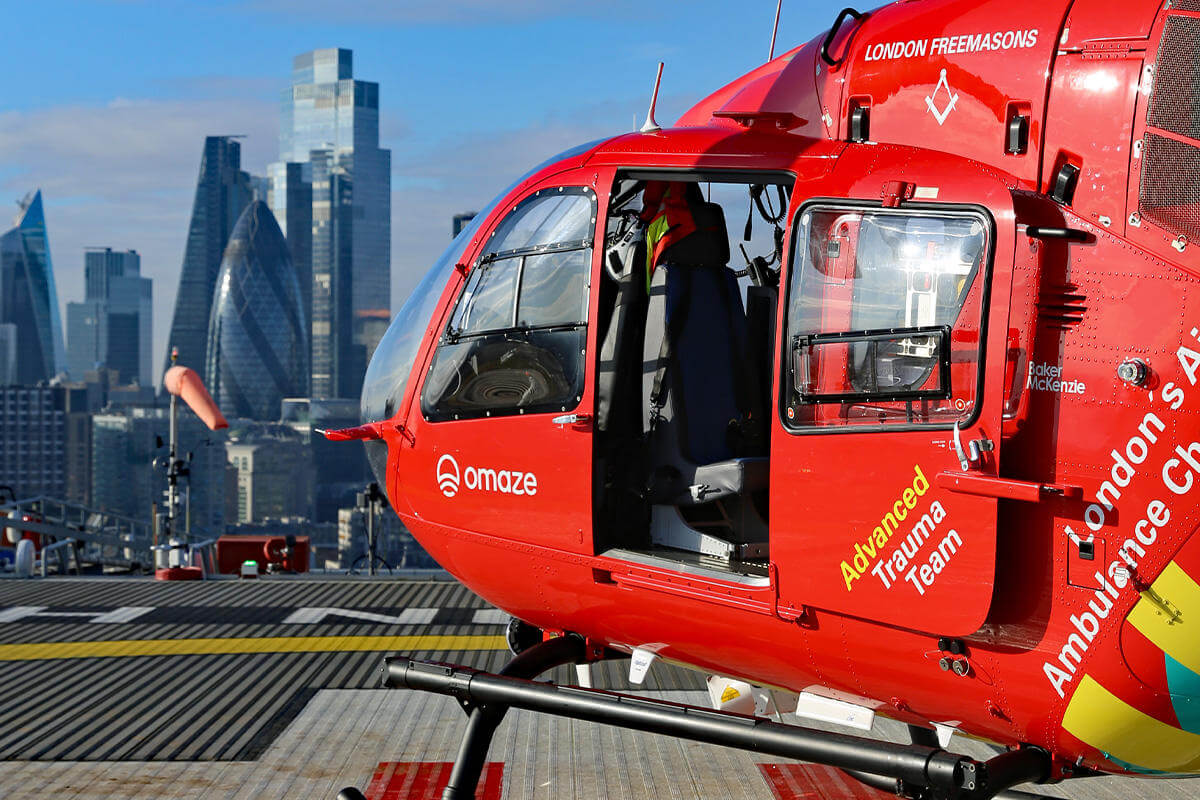
On 1 October 2024, London’s Air Ambulance Charity (LAA) took delivery of two brand new Airbus Helicopters H135s, replacing two MD Helicopters MD 902 Explorers that had been in service since 2000 and 2016. They, in turn, replaced an Aérospatiale AS365N Dauphin that started the service in 1989.
The service has evolved over the years as medical progress and the operating environment have changed. At the start, it was all about the ‘golden hour’, getting patients from the accident scene to a hospital within that time, which had been shown to dramatically improve chances of survival.
Today, the UK capital is served by four trauma centers: the Royal London Hospital (where an LAA helicopter is based during the day), St George’s Hospital, King’s College Hospital and St Mary’s Hospital. The emphasis has switched to using the helicopter to get medical personnel on scene as fast as possible and to stabilize the patient for ground transfer to the nearest trauma center.
That change impacted the interior design of the new helicopter, said Dr Cosmo Scurr, Consultant in Anesthesia and Major Trauma, who was part of a team that made several visits to Bucher Leichtbau in Switzerland to optimize the H135 layout for LAA’s operations, using a full-scale plywood space model.
It is a tight fit. A typical medical crew consists of a consultant, a doctor and a paramedic, while the seriousness of the incidents they attend requires surgical equipment and blood supplies. All of this must be deployed by the crew on arrival.
The kit is contained in specially designed bags manufactured by Pax, which are located in between the two rear-facing seats and on top of the lightweight stretcher. There is additional storage in the rear of the cabin, accessed via the clamshell doors under the tail boom, and organized according to the equipment’s frequency of use.
A lightweight stretcher can be used as only about 5% of flights see a patient loaded on board. In these cases, a simple hook on the cabin wall is used to hold the Zoll X Series monitor. The Zoll Z Vent lightweight ventilator is also carried.
It might be thought to be disturbing for a casualty to be loaded through the rear, but Dr Scurr pointed out that this is never carried out with rotors running and, because of their medical condition, they are likely to be intubated and anesthetized, so unaware of their surroundings.
Pilot Toby Chamberlain said the H135 was a major improvement on the Explorer, particularly given the capabilities of the Airbus Helionix avionics suite with glass cockpit, which includes automatic transition to the hover. The helicopter, which overnights at its maintenance base at RAF Northolt, close to Heathrow Airport, is cleared for two-pilot daylight visual/instrument flight rules (VFR/IFR) operations. LAA selected optional steerable lights under the nose, which allows takeoff in the dark if the helicopter is detained on scene after official sunset. The cockpit is compatible with night vision systems and there is a searchlight mounting on the front of the port skid, so night flights could be a possibility in the future.
Other role equipment includes a loudspeaker, for siren or voice, and a Flightcell satcom system that provides text or voice backup if the VHF radios fail.
The helicopter is augmented by nine Volvo XC90 rapid-response vehicles to ensure 24/7 HEMS service. If the helicopter medical team have to go with the casualty to hospital, they can be replaced by one of the car teams if there is another call.
Chamberlain explained that, while there are two helicopters, only one is deployed during the day. They are swapped at regular intervals, but it is important to maintain a difference in flying time, 30 hours being optimal, as this avoids regular checks coinciding and grounding both for maintenance simultaneously.


May 2025
Issue
Our May edition is full of articles centered around training, with features covering pilot training, winch and rear-crew training, and air medical training; as well as a feature in the trend towards longer-range air ambulance transfers; plus we have more of our regular content, with lots of articles highlighting different aspects of training, from startle and surprise management to simulation centers and everything in between.
Ian Harbison
Ian has had a long career in the defense and aerospace industry, including journalism, PR and market intelligence.
Between 1990–2000, he was at Shephard Press as Editor of Commuter World, later Regional Airline World, and launch Editor of Air Ambulance and Inflight magazines.
From 2004–2020, he was at Air Transport Publications, as Editor of MRO Management, as well as launch Editor of Low Cost & Regional Airline Business, GreenSky - Aviation and the Environment and Aircraft Cabin Management and MRO News Focus newsletter.
From 2000–2004, he variously handled PR for Bombardier Regional Aircraft, was Editor of Offshore Patrol magazine and Airline News Weekly, and freelanced. He is currently freelancing for several publications in the UK and the USA.