
Gallery: The unsung heroes of wildland aerial firefighting

Barry Smith throws the spotlight on smokejumpers as they go about their work parachuting into remote areas affected by wildfire to stop it spreading. Smokejumpers from the US Forest Service (USFS) and the Bureau of Land Management (BLM) are pictured, along with parattack crews from the British Columbia Wildfire Service (BCWS) in Canada
As aviation technology has advanced over the past 100 years, aerial firefighting has used every new innovation. One technology that most people would think of as an anachronism is still in use and going strong. It is the parachute. Known as smokejumpers in the USA and parattack in Canada, these wildland firefighters use parachutes to deploy on small fires in very remote areas. You don’t hear much about them because they are used to contain small fires, like lightning strikes, before they become major fires.
Wearing heavily padded Kevlar suits and helmets, these men and women jump carrying almost 100lb of gear including their main and reserve parachutes and a small backpack. They also carry rope to rappel to the ground if they land in a tree. Several different aircraft are used as jump ships, including De Havilland Twin Otters and Dash 8s, Short C-23 Sherpas, and other types. Good low-speed handling and maneuverability are traits shared by all jump aircraft.
Due to the remote nature of their work, smokejumpers must be in tremendous physical condition and be able to think and act independently. They must be experienced in wildland firefighting, with many serving on hotshot teams, the most skilled wildland teams, for several years before being hired as a smokejumper.
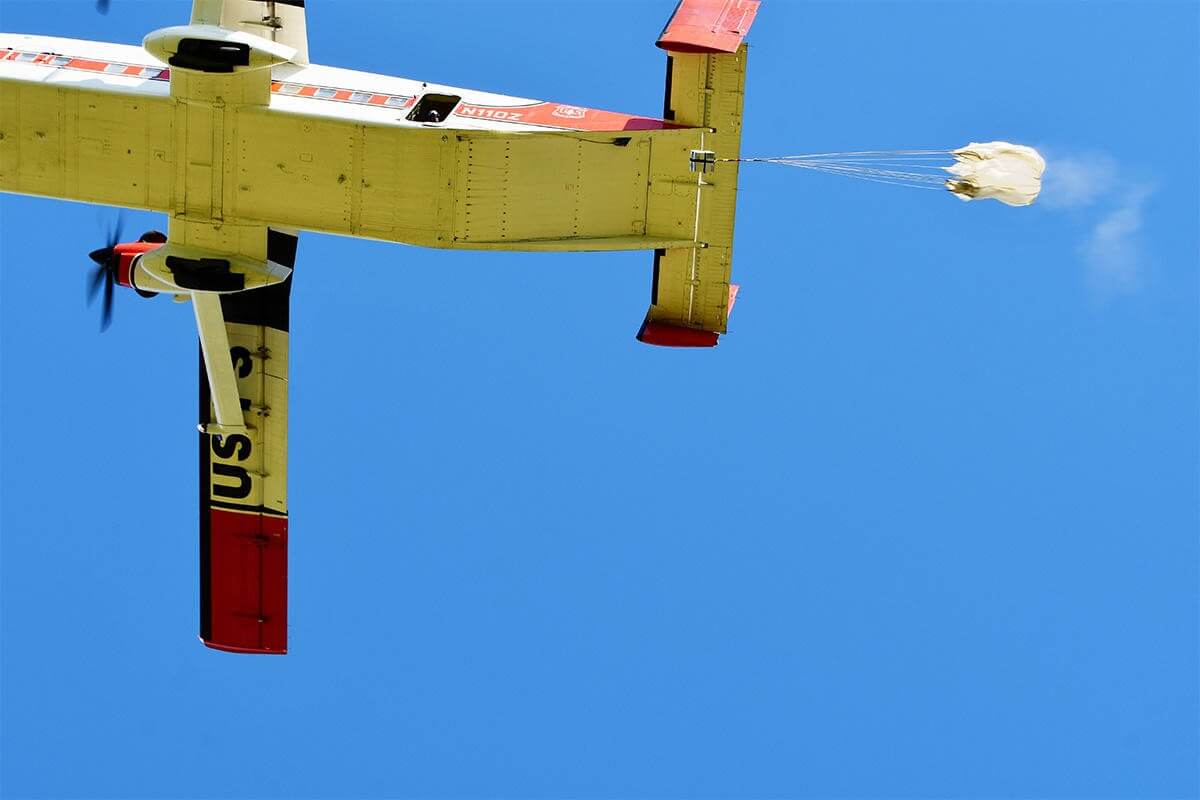
Typically, two to three jumpers are deployed on small fires, but up to 20 or more may be used if needed. Immediately after jumping, cargo will be parachuted to the team. Items such as hand tools, chain saws with fuel, water pumps with hose as well as food, water, tents, and sleeping bags are included. They will have enough supplies to last them two to three days. If they will be out longer, more supply drops will be made. They carry radios and satellite communication equipment so they are never out of contact.
Once the fire is controlled and extinguished, the smokejumpers have to hike out with all of their equipment. They may be able to cut a helipad for a helicopter pickup, but often have to hike to the nearest road. In very remote areas, such as Alaska, floatplanes or hired boats may pick them up.
As severe weather during the summer months spark more and more fires in remote areas, the demand for smokejumpers is only increasing. They are an important instrument in the wildland firefighting toolbox.



June 2025
Issue
Our June edition covers a range of articles with a wealth of experiential information in the features, such as search and rescue as a career route, the latest night vision technology, the increasing popularity of drones for firefighting, the importance of helmets in special missions, why diversity matters in aviation, and why switching to special missions as a job is more fulfilling; plus we have more of our regular content.
Barry D Smith
Barry Smith has been an aviation and emergency services writer/photographer for over thirty years. He has published over 250 magazine articles and six books. He has also worked in emergency services as a paramedic, volunteer firefighter, and member of search and rescue teams for over 40 years.