

HUMS keeping watch

Health and usage monitoring systems can identify technical irregularities in helicopters before they affect operations. Ian Harbison reports on developments in the technology, how it is transforming operations, and what’s driving its increased uptake
Public service helicopters are expected to be always available. A problem preventing takeoff is inconvenient but not a drama. A problem in-flight requiring a diversion or emergency landing is more critical. The worst-case scenario is a problem preventing takeoff from a remote site – a casualty may be put at risk by having to be transferred to a ground ambulance for a longer transfer to hospital, while the physical security of the helicopter could be compromised.
Given that helicopters suffer more vibration than fixed-wing aircraft, health and usage monitoring systems (HUMS) began to be introduced. Initially, the focus was on vibration monitoring of rotor track and balance and then moved on to dynamic components but, as more and more onboard systems gained the capability to record their operational state, coverage increased. With the advent of big data, this information could be analyzed to detect changes in performance that might indicate that a component or system was about to fail. Generally considered as predictive maintenance, it takes on extra significance in this branch of aviation where availability is all.
The most recent development has been the ability to transmit the data in real time from the helicopter for immediate analysis, keeping it in flight if it is safe to do so and avoiding a precautionary landing and delays.

An all-in-one system
Ronnie Ries, Vice President of Marketing at GPMS International, said HUMS started out as a vibration monitoring system, covering most of the helicopter drive train components by itself. From there, it has become more of an ‘all-in-one’ system, covering, in addition to component monitoring, flight data, engine and exceedance monitoring, including integrated rotor track and balance solutions.
HUMS ... has become more of an ‘all-in-one’ system, covering, in addition to component monitoring, flight data, engine and exceedance monitoring, including integrated rotor track and balance solutions
The company’s Foresight MX allows the pilot to complete a flight without any interaction with the system, which, when it detects a landing, automatically starts to upload recorded data to the cloud via a cellular connection or Wi-Fi. By the time the pilot gets back to the hangar, Ries said, maintenance already has the data and what exceedances or negative trends are happening on the aircraft. Using the flight data information available, the system can also advise on how to restore rotor track and balance if a deviation is detected.
While original equipment manufacturers (OEMs) are fitting HUMS as standard on the production line, Ries pointed out that these are usually medium, heavy and super-heavy helicopters, due to the weight and cost of these legacy systems. Lightweight and lower-cost systems like Foresight MX are relatively new in the light helicopter space. Launched in 2018, Foresight MX gained its first Federal Aviation Administration (FAA) supplemental type certificate (STC) on the Bell 407. Since then, STCs have been obtained for the Airbus Helicopters AS350/H125 series, EC135/H135 and EC145/H145, Bell 429 and MD Helicopters MD 530F in this category.
FAA STCs for heavier types include the Airbus Helicopters AS332 Super Puma, Bell 212/412, Mil Mi-8/17/171 and Sikorsky UH-60 Black Hawk. The AS332 and EC135 STCs were obtained in 2024, with the CH-47D and H145 to follow in early 2025 and the Boeing CH-47 Chinook/Columbia Model 234 later in the year.
Ries said the company’s target market is primarily retrofit as most aircraft were originally delivered without a realistic HUMS option. The larger types operated by military/government and offshore operators are now being disposed of into the commercial market, particularly for utility and firefighting work. They either do not have HUMS or have an outdated system.

Safety and reliability
In Australia, the NSW Rural Fire Service (NSW RFS) is the world’s largest volunteer fire service, providing fire and emergency services to approximately 95% of New South Wales. This includes bush and grass fires, house and structure fires, storm damage, search and rescue, motor vehicle accidents, bush fire mitigation and community education.
It has a fleet of 11 aircraft, including a 737 large airtanker, two Cessna Citations, six Bell 412 helicopters, a Boeing CH-47 Chinook helicopter and a Beechcraft Super King Air, all managed by Coulson Aviation Australia under a 10-year contract signed in July this year.
In addition, there are two ex-Royal Australian Air Force Sikorsky UH-60 Black Hawks, which were originally proposed for transfer to the RFS in 2018, but were officially received in 2023, being gifted by the Department of Defence. They arrived without HUMS and the RFS decided to install the Foresight MX system as part of the type certificate process by the Civil Aviation Safety Authority (CASA) to enhance maintenance and monitoring capabilities. The contract was signed in August 2024. The first Black Hawk was due to be fitted with HUMS by January, with another system already acquired for the second helicopter. When the type certificate process is completed, they will be transferred to operational management by Coulson Aviation.
We expect that the HUMS system will enable proactive, efficient maintenance by identifying potential issues early, which aligns with our long-term goals for fleet safety and operational reliability
An RFS spokesperson said: “Selection of HUMS was driven by the unique demands that firefighting operations impose on aircraft compared to typical military use. We expect that the HUMS system will enable proactive, efficient maintenance by identifying potential issues early, which aligns with our long-term goals for fleet safety and operational reliability. We are also monitoring the CH-47 helicopter’s STC for potential future installations, due to the safety focus on addressing unique stress factors in different helicopter models. The RFS intends to apply this monitoring technology more broadly for enhanced safety and performance across the fleet.”

Regulatory requirements
Another trend has been requirements imposed on operators by contracting authorities. In 2022, the US Forest Service made changes to its multiple award task order contract (MATOC) firefighting contracts. These called for real-time communications, automatic flight following, and additional telemetry unit (ATU) bucket drop data, together with cockpit audio recording and flight data monitoring (FDM) data. One such operator is Helicopter Express, based in Tate, Georgia, which was awarded Type 2 and Type 3 ‘modern helicopter’ task orders and equipped its Bell 412EPX and Bell 429 fleets with Foresight MX.
Another example is the International Association of Oil & Gas Producers (IOGP), which published standards for safe aircraft operation. This led Blackcomb Helicopters, in February last year, to equip its four Eurocopter EC135s and four Bell 212HPs with Foresight MX.
Blackcomb Helicopters is headquartered in Vancouver, British Columbia, with other bases in the province at Brackendale, Lillooet, Pemberton and Whistler, and at Calgary, Alberta. Activities include mining and exploration aerial support, powerline services, filming, charters, tourism and training, as well as wildfire firefighting services, medevac operations, and search and rescue missions. It has operated a fleet of Bell 212s and 205s since around 2005 and EC135s since 2014 with no HUMS fitted until last year.
While driven by IOGP, the HUMS installations will have benefits across all operations, and not just related to safety.
When you have unscheduled maintenance, it doesn’t just affect the downtime of the aircraft. When you’re having to source parts AOG, your costs go up
Aaron Trimble, Director of Maintenance at Blackcomb Helicopters, said: “When you have unscheduled maintenance, it doesn’t just affect the downtime of the aircraft. When you’re having to source parts AOG, your costs go up. You’re having to fly the parts in. But if you’re able to plan ahead, you’re not having to go AOG and your customers, engineers, and, of course, your management are all happier. Being able to be more proactive than reactive, while benefiting from the added safety, is what we’re really looking forward to.”
The company worked closely with GPMS to achieve FAA STC approval on the EC135, which was gained in June. While fairly new to the operating system, Blackcomb decided to add the 212HPs in a conversion program lasting about 18 months.
Ries adds that demand for HUMS to be fitted is also extending into law enforcement and emergency medical services.

User case study: Yorkshire Air Ambulance
Yorkshire Air Ambulance (YAA) operates two Airbus H145 D3s. They are based at Nostell Air Support Unit near Wakefield in West Yorkshire and RAF Topcliffe near Thirsk in North Yorkshire, both in the north of England. One helicopter flies with a crew consisting of a pilot, a technical crewmember (TCM) who has the additional role of emergency care assistant (ECA), a consultant doctor with experience in trauma and/or a specialism in anesthesiology too, and one specialist critical care paramedic. The other flies with a pilot, a qualified TCM and two specialist critical care paramedics. Both helicopters are fitted with a bespoke helicopter emergency medical services (HEMS) interior from Bucher Leichtbau.
Owen McTeggart, Chief Pilot, explained that, since operations began in 2000, previous helicopters have included the MBB Bo 105, MD Helicopters MD 902 Explorer and Airbus H145. All were fitted with HUMS but any alerts could only be downloaded and analyzed on the ground. In extreme cases, this left the helicopter stranded on scene until an engineer could be dispatched, identify the problem and clear it to fly.
Both H145 D3s were delivered from the factory last year with HUMS that transmits data to the Airbus data cloud, which can be accessed by engine manufacturer Safran. This is achieved by Wi-Fi at base, or the mobile phone network while on task, with the ability to use satellite communications if in a poor signal area.
YAA’s operating area includes several large cities but it also covers some remote areas such as the Pennines and the North York Moors, and this is where the new cloud-based HUMS comes into its own. The terrain provides a number of challenges that can generate out-of-limit situations – for example, wind shear, when a 20kts wind suddenly disappears in the lee of a mountain, resulting in a sudden altitude drop that the pilot compensates for by applying power and over-torquing the transmission. Sloping ground means the helicopter may slide, putting stress on the rigid rotor head and producing a mast moment indication (MMI). With the data available immediately and remotely, a swift go/no-go decision can be made, with important implications for the treatment of the patient as well as the safety of all on board.
Safran’s access to data is important as it brings in predictive maintenance for the first time, enabling forward planning for when an engine change might be required, reducing costs and downtime.
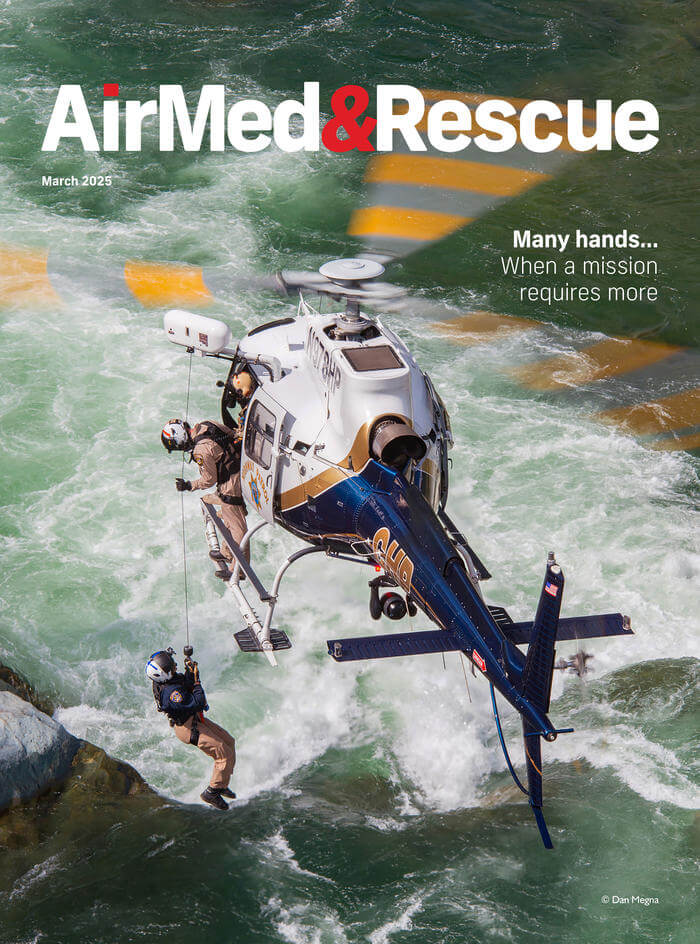
March 2025
Issue
Our March edition has features that let you discover the level of training provided by simulators; learn the ins and outs of medical interiors in aircraft; find out about how health and usage monitoring systems are changing special missions; and see how aerial firefighters communicate and coordinate their missions across multiple agencies and stakeholders; plus more of our regular content.
Ian Harbison
Ian has had a long career in the defense and aerospace industry, including journalism, PR and market intelligence.
Between 1990–2000, he was at Shephard Press as Editor of Commuter World, later Regional Airline World, and launch Editor of Air Ambulance and Inflight magazines.
From 2004–2020, he was at Air Transport Publications, as Editor of MRO Management, as well as launch Editor of Low Cost & Regional Airline Business, GreenSky - Aviation and the Environment and Aircraft Cabin Management and MRO News Focus newsletter.
From 2000–2004, he variously handled PR for Bombardier Regional Aircraft, was Editor of Offshore Patrol magazine and Airline News Weekly, and freelanced. He is currently freelancing for several publications in the UK and the USA.