
Industry voice: Training for fixed-wing air ambulance missions – why it takes a unique set of skills

Clinicians transitioning to retrieval and transfer medicine from hospital-based care must be prepared for the unique challenges posed by the subspecialty. Gareth Evans, Aeromedical Services Director at 247 Aviation, expounds on the skill set required, the surprises along the way, and what he considers to be the most critical element of training
Fixed-wing air ambulance work occupies a distinctive space within modern critical care. It sits at the crossroads of intensive care medicine, aviation, international logistics, and human factors engineering. For clinicians transitioning from hospital-based critical care, anesthesia or pre-hospital emergency medicine, it is often not the medicine itself that proves most challenging, but everything that surrounds the mission profile.
For this reason, training for fixed-wing air ambulance missions cannot simply be an extension of traditional critical care education. It requires a deliberately designed and highly specialized skill set that blends clinical excellence with operational awareness, adaptability, and psychological resilience. Retrieval and transfer medicine is now a recognized subspecialty, and it demands training that reflects both its complexity and responsibility.

The things no-one quite prepares you for
Most clinicians entering the fixed-wing retrieval and transfer environment expect complexity. What often surprises them is where that complexity originates.
One of the earliest challenges encountered is time. Fixed-wing missions are rarely short. Crews may spend many hours with a patient, often across multiple sectors, borders, and time zones. This fundamentally alters clinical decision-making. Sedation strategies, ventilation plans, fluid balance, nutrition, and pressure-area care must all be considered over prolonged periods, rather than during the short transports many clinicians are accustomed to. Fatigue management becomes both a clinical and personal safety issue and must be actively managed by the clinical team and wider operational support.
Another surprise is the environmental constraint imposed by flight. Aircraft cabins are not flying intensive care units. Space is significantly limited, lighting may be poor, noise is constant, vibration is unavoidable and access to the patient becomes restricted once airborne. Tasks that are routine in hospital, such as auscultation, arterial sampling or airway repositioning, take longer and require forethought. This is why training must emphasize anticipation rather than reaction and why clinicians must become comfortable practicing within this environment.
Training must emphasize anticipation rather than reaction and why clinicians must become comfortable practicing within this environment
There is also the degree of increased autonomy. In hospital settings, escalation pathways are readily available. In the air, crews are often delivering the highest level of care available for several hours, usually as a team of two, without the ability to optimize conditions as would be possible in a hospital setting. Decision-making authority sits squarely with the onboard team. This autonomy can be empowering, but it is also daunting, and it demands confidence that is grounded in structured training, clear governance, and appropriate patient selection.
Why some clinicians excel in fixed-wing transfer medicine
Not every excellent clinician thrives in fixed-wing air medical transport, and that is not a criticism. Success in retrieval and transfer medicine is less about raw clinical ability and more about adaptability, situational awareness, and systems thinking.
Success in retrieval and transfer medicine is less about raw clinical ability and more about adaptability, situational awareness, and systems thinking
Clinicians who perform well can assess rapidly, standardize care where possible, and accept what cannot be changed. They understand the longevity of the care they will deliver across the duration of a mission and can interpret both the patient’s current condition and prior clinical trends. This enables anticipation of worst-case scenarios that may develop in-flight and supports informed, calculated decision-making that balances risk, safety, and the patient’s best interests, often without the immediate support structures available in hospital environments.
Pragmatism is essential. Clinicians are frequently faced with pressure from patients and families to return to their home country. This may be compounded by concerns that the patient is receiving suboptimal care or lacks access to specialist services, alongside time pressures imposed by flight-duty limitations, airport restrictions, and operational constraints. In this context, clinicians who can make clear, unambiguous decisions are often better suited to fixed-wing air ambulance work. Importantly, this is not solely an innate trait; it is a skill that can be developed through structured training, experience, and repeated exposure to complex missions.
How simulation and technology have changed training
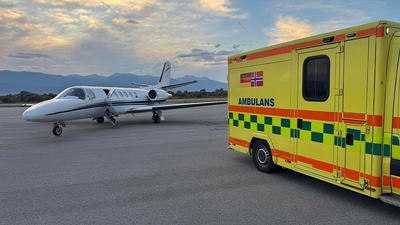
I have always been a strong advocate of training, grounded in the simple principle that if you train hard, delivery becomes easier. Historically, much air medical learning occurred ‘on the job’, an approach that carried inherent risk. As retrieval and transfer medicine has evolved into a mature subspecialty, driven by specialist transfer teams worldwide, the discipline has undergone a significant shift.
We are moving away from the outdated concept of placing a patient on an aircraft with a doctor and nurse, toward a professionalized system that recognizes transfer medicine as a specialist skill set. This ensures clinicians undertaking these missions are not only clinically competent but trained to a level of excellence as experts in the safe transfer of critically ill patients. Central to this progress is high-quality simulation training and structured exposure to risks that, if unrecognized or poorly managed, can rapidly escalate.
A key development has been the integration of flight crew into medical simulation training. This ensures pilots are not encountering clinical realities for the first time during live missions, including patients who are intubated, ventilated, malnourished or affected by prolonged illness. Allowing flight crew to observe medical simulations and ask questions about in-flight interventions promotes shared situational awareness and mutual understanding.
A key development has been the integration of flight crew into medical simulation training
This integrated approach benefits both disciplines. Flight crew gain insight into clinical pressures and time-critical decision-making, while medical crews benefit from improved communication, understanding aviation constraints, and human-factors awareness. Shared training strengthens trust, teamwork, and crew resource management, all of which are critical to air medical and patient safety.
High-fidelity training also plays a central role. Teams train together through regular simulation days, supported by access to simulation manikins and specialist equipment at our bases. Having dedicated training leads within the service allows coordinated and structured continuing professional development to ensure rare but high-risk events remain familiar. Access to ventilator and patient-monitoring simulators further enhances realism, allowing crews to practice managing complex physiological changes in a controlled environment. Protected training time embedded within our full-time staff rosters reinforces that simulation is fundamental and key to safe practice.

The single most critical element of training
If one element of training stands above all others, it is decision-making under constraint. Fixed-wing air ambulance clinicians must be able to make sound, defensible decisions with often, incomplete information, limited resources, and delayed access to external support.
This includes knowing when not to proceed. Training must empower crews to delay, divert or abort missions when patient stability, weather, risk or operational factors make continuation unsafe. Achieving this requires organizational backing and a culture that prioritizes safety over completion metrics. Most importantly, it depends on a just culture, a flattened hierarchy, and consistent support from medical and logistical teams trained to the same standards as the deployed crew, allowing cognitive load to be shared.
Training must empower crews to delay, divert or abort missions when patient stability, weather, risk or operational factors make continuation unsafe
A particularly effective training method is structured case-based discussion within regular review meetings. Crews present real or representative cases as short briefings and tabletop the mission together. Each member declares a fly or no-fly decision and, where appropriate, outlines a plan to optimize the patient. Repeated exposure builds confidence, consistency, and maturity in decision-making before challenges are encountered on the ground or in flight.
Psychological preparedness and support
While clinicians are trained to manage trauma, death, and ethical complexity, transfer medicine introduces additional psychological stressors. These include prolonged exposure to critically ill patients, isolation from their usual support networks, and the emotional burden of international repatriations involving families in crisis.
Psychological preparedness must be valued as highly as clinical competence
Psychological preparedness must be valued as highly as clinical competence. This begins during recruitment and onboarding, with honest discussion of worst-case scenarios, normalization of emotional responses, and reinforcement that vulnerability is not weakness. Support mechanisms should include peer support, access to psychological services, post-mission debriefs and the option to step back after distressing events. These systems must be proactive; waiting for burnout or moral injury is too late.
Conclusion
Training for fixed-wing air ambulance missions is not simply about transferring hospital skills into an aircraft. It is about reshaping how clinicians think, plan, communicate, and cope under prolonged, constrained, and autonomous conditions. Those who succeed are not just excellent clinicians, but adaptable problem-solvers, calm leaders, and resilient team members. By investing in structured training, professionalizing retrieval and transfer medicine through simulation, and providing meaningful psychological support, services can ensure crews are not only technically competent but genuinely prepared for the unique demands of this extraordinary and rewarding role.
May 2026
Issue
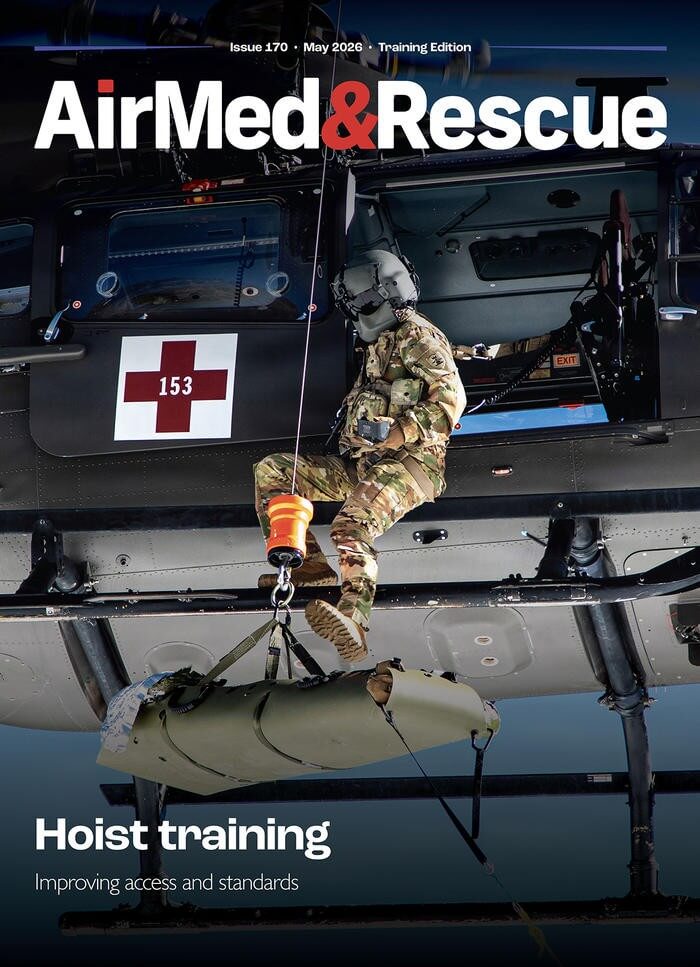
Training for special missions is on another level, so it’s a great pleasure to bring you the training edition of AirMed&Rescue for May. We have features on night flights for police aviators; the simulators for military special missions training; the systems and scenarios for hoist operations; and engineering training for airframe and powerplant mechanics.
Gareth Evans
Gareth is the Aeromedical Services Director at 247 Aviation. A registered paramedic since graduating from Swansea University in 2015, he has extensive experience working in frontline ambulance services, retrieval and transfer medicine, and fixed- and rotary-wing air ambulance operations. Gareth has held senior leadership roles managing training, compliance, and clinical governance, while his clinical background includes intensive care and pre-hospital emergency medicine. His role as Aeromedical Services Director sees him directing multi-disciplinary teams, ensuring the service maintains clinical standards, operational readiness, and workforce development across all of the air ambulance contracts in 247 Aviation’s Learjet 45XR and Pilatus PC-12 fleet.