

Industry voice: Hardware solutions to the dangerous effects of hoist cable swing

Meiyu Zheng, Rui Peng, Luyi Tang, Zhilin Huang, and Mary Lanzerotti at Virginia Tech in the USA, and Harrish Joseph and Prof Walter Lacarbonara at Sapienza University of Rome, Italy, are developing and testing a second-generation swing stabilization system to reduce and remove the hazard of unwanted hoist swing by implementing rapid control collection of gyroscopic data to subsequently wirelessly transmit commands to the hoist system. Prof Jacob Capps at the United States Military Academy in West Point, New York, and Prof Lacarbona initiated the research
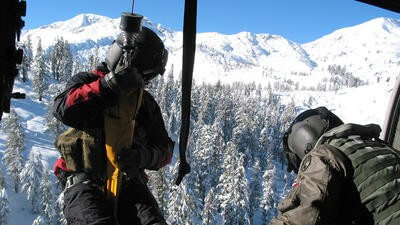
As we discussed in our previous article in the September 2023 edition of AirMed&Rescue1, stabilizing helicopter payloads during medical evacuation (medevac) rescues can be a challenging task due to the swinging of the patient and rescuer. Dangerous effects of hoist cable swing include loss of payload, the cable hitting the airframe of the helicopter, and expediency of medevac rescues. We aim to reduce the large swing angles to the point that the swing angle is small enough that the hoist operator (crew chief) can reel in the patient safely from the hoisting location and into the helicopter, so that the helicopter can transport the patient quickly to a medical facility.
Review of current solutions
As discussed in our September 2023 article, helicopter hoist and winch training for search and rescue (SAR) and medevac is offered by many US organizations using traditional methods and techniques. Some firms manufacture and supply equipment for safe hoisting and hoist training. These firms include Breeze-Eastern, which offers in-house hoist maintenance training at its facility in Whippany, New Jersey. Others specialize in operational training, like Air Rescue Systems, Priority 1 Air Rescue, and SR3 Rescue Concepts. Most of the medevac training occurs at Fort Rucker in Alabama for pilots, hoist operators, and hoist riders (paramedics), with paramedics also receiving specialized training at Fort Sam Houston in Texas. Some companies offer fully integrated haptic virtual training, like Bluedrop Training & Simulation. Some companies provide unique solutions to cable swing and spin, such as Vita Inclinata, whose Vita Rescue System Litter Attachment is affixed to the payload with cinch straps and quick clips, and uses two propulsion systems and a thrust vector system to directly control the movement of a litter.
Review of a novel approach
Our previous article described a 2023 study that demonstrated that it was possible to achieve two-dimensional stabilization and even explore a three-dimensional solution by assuming a steady hover over the patient. This method involves precisely varying the length of the payload line according to the line’s angular motion and specific constraints, drawing on principles of pendulum nonlinear dynamics. The practical application involves accurately measuring the angle and swing of the payload and then directly controlling the length of the line.
The physics behind the payload control is shortening the line when the payload is slowest near its highest angular point in the swing. The line can also be extended when the payload is near the bottom of the swing. With the help of a low size, weight (less than 0.5kg), and power automated stabilization system on the payload that can be enabled and disabled with the flick of a switch at the hoist, this approach holds promise for medevac rescues.
Current progress
Since our previous article in September 2023, the team has new results after developing and testing a second-generation swing stabilization system. The system and test results were presented at the Fifth International Nonlinear Dynamics Conference (NODYCON 2025) on 24 June 2025, and the team’s paper will be published in the 2025 conference proceedings.
In this second-generation system, the variable-length control algorithm is implemented through a payload system that measures the payload angle and rate of change of swing angle, decides whether to reel in the cable based on whether or not the payload swing angle and rate of change of swing angle exceed critical thresholds, and wirelessly transmits commands to the hoist system that is connected to the pivot point of the hoist.
The variable-length control algorithm is implemented through a payload system that measures the payload angle and rate of change of swing angle, decides whether to reel in the cable based on whether or not the payload swing angle and rate of change of swing angle exceed critical thresholds, and wirelessly transmits commands to the hoist system that is connected to the pivot point of the hoist
In the second-generation swing stabilization system, the hoist system is comprised of a DC brushed motor that is driven using pulse-width modulation (PWM), motor driver, battery, voltage regulator, buck converter, Arduino, and wireless communication module. The payload system is composed of an Arduino, SD card adapter, battery, gyroscope, and wireless communication module with MPU6050 sensor that outputs real-time attitude angle measurement with real-time gyroscopic data comprised of 3-axis (pitch, yaw, roll axes) angular velocity data and 3-axis angle data.
The system compensates in real time for the payload’s rotation around the cable based on the real-time gyroscopic data. Continuous monitoring of the payload’s attitude and swing stage provides information that the control system uses to decide when to trigger lift actions, thereby precisely controlling the payload position and mitigating the swinging motion.
The system compensates in real time for the payload’s rotation around the cable based on the real-time gyroscopic data.
Tests conducted with a 6m cable show that the system reduces the swinging from 18.8° to 9.6° in approximately 55 seconds, compared with a free-swinging cable with swing angle, which reduces it from 18.9° to 9.4° in approximately 76 seconds (16 oscillations).
The future for the design
The next stage for this novel design will be to continue developing the swing stabilization system with a smaller payload system and to conduct indoor and outdoor tests with longer lines. Rozzy Finn, Licensing Officer at Virginia Tech Innovation and Partnerships, stated: “Virginia Tech Intellectual Properties (VTIP), a 501(c)(3) affiliated corporation of the Virginia Tech Foundation, has filed US Patent 19/005,445 to protect this innovation, and we look forward to seeing the idea get commercialized and implemented in the world, where it can make a real impact.”
References
1. Reineke D, Nguyen K, Tang L, Lanzerotti M, Lacarbonara W. Solutions to the dangerous effects of hoist cable swing. AirMed&Rescue 2023;141:62–65.
Notes
The views expressed in this work are those of the authors and do not necessarily reflect the official policy or position of the US Military Academy, Department of the Army, Department of War (formerly Department of Defense), or US government. M Lanzerotti wishes to acknowledge Louise Foxcroft for her feedback on a draft of the article.

November 2025
Issue
Our November edition is packed with content relating to special missions from around the world. We have features that explore the design and engineering that go into modern rotorcraft; the interactions between ground and air teams on helitack operations; the tools and attire needed for successful water rescues; and the new onboard technology that is revolutionizing special missions by detecting and communicating with cell phones.
Prof Walter Lacarbonara
Walter Lacarbonara is a Professor of Nonlinear Dynamics at Sapienza University and the Director of the Sapienza Center for Dynamics. During his graduate education he was awarded a MS in Structural Engineering (Sapienza University) and a MS in Engineering Mechanics (Virginia Tech, USA), and a PhD in Structural Engineering. His research interests cover nonlinear dynamics; vibration control; metamaterials; nanocomposites; asymptotic techniques; experimental dynamics. He is the Editor-in-Chief of Nonlinear Dynamics. He served as Chair of the ASME TC MSND, Co-Chair of the ASME 2013 (Portland) and 2015 (Boston) IDETC Conferences, and Chair of NODYCON in 2019, 2021, 2023 (www.nodycon.org).
Dr Mary Lanzerotti
Mary Lanzerotti is a Collegiate Assistant Professor in the Bradley Department of Electrical and Computer Engineering at Virginia Tech (Blacksburg, Virginia). She received an AB summa cum laude from Harvard College (Cambridge, MA), MPhil from University of Cambridge (UK), and MS and PhD from Cornell University (Ithaca, NY).
Harrish Joseph
Harrish Joseph is a graduate student in space and astronautics engineering at Sapienza University of Rome in Italy. He received a bachelor’s degree from Karunya Institute of Technology and Sciences in India.
Meiyu Zheng
Meiyu Zheng is an MEng student in computer engineering at Virginia Polytechnic Institute and State University (Virginia Tech) in Alexandria, Virginia. She received a bachelor’s degree in computer engineering from Virginia Tech in 2024.
Rui Peng
Rui Peng is an electrical and embedded engineer at Sentek Instrument in Blacksburg, Virginia. He received a bachelor’s degree in electrical and electronics engineering from Virginia Tech in 2024.
Prof Jacob Capps
Jacob Capps is an Academy Professor at the US Military Academy at West Point. He received a BS magna cum laude degree from Tuskegee University, an MBA from Northcentral University, an MS from the Naval Postgraduate School, and a PhD from Oregon State University.
Luyi Tang
Luyi Tang graduated from Virginia Tech in December 2022 with a Bachelor’s degree in Controls, Robotics and Autonomy from the Bradley Department of Electrical and Computer Engineering.
Zhilin Huang
Zhilin Huang is a graduate student in biomedical engineering at Duke University. He received a bachelor’s degree in industrial system engineering from Virginia Tech in 2024.