
Industry voice: The human factors we don’t talk about in HEMS operations

Dr Kodey Bogart, AvD, CEO of KB Aviation Solutions (KBAS), highlights the human factors that are less discussed on helicopter emergency medical services and why there should be a greater spotlight on this topic
The radio sounds in the middle of the night. A helicopter emergency medical services (HEMS) crew prepares to launch for another scene call. The weather is legal. The aircraft is airworthy. The crew is qualified. The patient needs help.
From the outside, the operation appears routine.
Yet within that environment, a series of invisible human factors are already influencing operational decision-making long before the aircraft ever leaves the ground. Human factors is the study of the capabilities and limitations of human performance and how those factors influence safety, efficiency, and decision-making in aviation operations.
In HEMS, accidents rarely stem from a single inaccurate decision. More often, they emerge from an accumulation of subtle pressures, degraded cognitive performance, communication breakdowns, fatigue, and operational normalization that slowly shape how risk is perceived and managed.
These are the human factors we do not always openly discuss.

Fatigue does not always look like exhaustion
When people think of fatigue, they often picture someone physically struggling to stay awake because they have been awake for an extended period of time. In aviation operations, fatigue is frequently far less obvious.
Fatigue can appear as slowed processing, reduced situational awareness, narrowed attention, diminished communication, or delayed decision-making. A pilot may feel “fine” while cognitive performance is already degraded. Medical crews and maintainers are no different.
HEMS operations present unique fatigue challenges because the environment itself is unpredictable. Crews may spend hours in low workload conditions before rapidly transitioning into a high-consequence operational scenario requiring immediate cognitive performance. Add nighttime operations, circadian rhythm disruption, weather considerations, and emotionally charged patient care situations, and the cumulative effects become significant.
Experience does not eliminate fatigue exposure. In many cases, experienced operators become more comfortable functioning while fatigued because they have done so repeatedly throughout their careers. Unfortunately, familiarity with fatigue does not reduce its physiological effects.
The danger is not simply being tired. The danger is believing performance remains unaffected.
Mission acceptance pressure
One of the least discussed realities in HEMS operations is mission acceptance pressure.
One of the least discussed realities in HEMS operations is mission acceptance pressure
Unlike many aviation sectors, HEMS crews operate within an environment where patient outcomes are directly connected to operational decisions. That reality creates a unique emotional weight. Even when organizations emphasize that safety comes first, crews may still experience internal pressure to launch.
Sometimes the pressure is external. More often, it is self-imposed.
Pilots do not want to disappoint medical crews. Medical crews do not want to feel they failed a patient. Communication centers are balancing urgency and operational demands. Everyone involved wants the mission to succeed.
This is where human factors become operationally significant.
In HEMS, saying “no” can sometimes feel harder than launching.
Mission acceptance pressure does not always result in unsafe decisions. However, it can subtly influence risk tolerance, decision-making, and how hazards are assessed in real time. Marginal conditions that may have prompted concern earlier in a shift can begin to feel more acceptable after repeated exposure or increasing operational momentum.
This is why organizational culture matters so deeply. Crews must know that declining a mission for safety reasons will be supported without hesitation or second-guessing.

Cognitive overload in dynamic environments
HEMS operations are information-dense environments. Pilots are processing weather, terrain, obstacles, fuel status, aircraft performance, radio traffic, dispatch updates, navigation, landing zone information, and crew communication simultaneously. Medical crews are managing patient care considerations, scene coordination, and operational readiness, often while operating in confined or unfamiliar environments.
Under these conditions, cognitive overload can occur rapidly.
Importantly, overload does not necessarily look chaotic. Often, it appears subtle. Attention narrows. Certain cues receive greater focus while others are unintentionally deprioritized. Communication may become shorter or incomplete. Situational awareness can begin to degrade incrementally rather than suddenly.
Overload does not necessarily look chaotic. Often, it appears subtle. Attention narrows. Certain cues receive greater focus while others are unintentionally deprioritized. Communication may become shorter or incomplete. Situational awareness can begin to degrade incrementally rather than suddenly
This becomes especially dangerous during night operations, deteriorating weather, or high-workload approaches where small lapses in information processing can have significant consequences.
Human beings have cognitive limits. Aviation experience may improve prioritization and task management, but it does not remove those limits.
Situational awareness and crew communication
Situational awareness is frequently discussed in aviation, yet it is often misunderstood.
Situational awareness is not simply ‘seeing’ hazards. It is the ability to accurately perceive operational conditions, understand their meaning, and anticipate future states. That awareness depends heavily on communication.
Breakdowns in crew communication are rarely dramatic. More often, they involve assumptions, incomplete mental models, or information that was never verbalized because everyone believed someone else already understood it.
One crewmember may recognize deteriorating conditions but hesitate to speak up. Another may assume silence means agreement. Over time, communication barriers can quietly erode operational safety margins.
Strong crew resource management (CRM) cultures reduce this risk by creating environments where questioning, cross-checking, and speaking up are expected rather than uncomfortable.
Psychological safety matters in aviation operations. Crews must feel empowered to voice concerns regardless of rank, role, or experience level.
The normalization of deviance
Perhaps one of the most dangerous human factors in HEMS operations is the normalization of deviance.
This occurs when elevated-risk behaviors or conditions gradually become accepted because previous exposure did not result in negative outcomes.
A crew launches in marginal conditions and the mission succeeds. Then it happens again. Eventually, what once felt uncomfortable begins to feel routine.
The operation slowly redefines ‘normal’.
This process is rarely intentional. In fact, it often develops within highly skilled and highly experienced teams. Repeated success can unintentionally reinforce the belief that the risk is manageable because “nothing bad happened last time”.
However, successful outcomes do not always validate safe decisions.
Successful outcomes do not always validate safe decisions
Normalization of deviance is dangerous precisely because it develops gradually and often invisibly. Small operational compromises accumulate over time until the overall risk profile begins to shift without crews fully recognizing it.
The most dangerous practices in aviation are often not the obviously reckless ones. They are the behaviors that slowly become acceptable.
Final thoughts
Human factors are not signs of weakness within HEMS operations. They are realities of human performance within complex, high-consequence environments.
Fatigue, operational pressure, cognitive overload, communication breakdowns, and normalization of deviance are not isolated problems affecting only inexperienced crews. They exist across all levels of aviation and require continuous awareness, honest discussion, and organizational support to manage effectively.
The safest organizations are not those that pretend human factors do not exist. They are the organizations willing to openly acknowledge them, educate crews about them, and build cultures where operational concerns can be communicated without fear or hesitation.
In HEMS operations, safety is rarely defined by a single decision. More often, it is shaped by hundreds of small human interactions, judgments, and conversations occurring every day – many of which happen long before the aircraft ever leaves the ground.
As aviation professionals, we must continually evaluate not only the risks around us, but also the human factors within us. Take time this week to have an honest conversation with your team about fatigue, operational pressure, communication, and decision-making – because the discussions we have on the ground are often what keep us safe in the air.
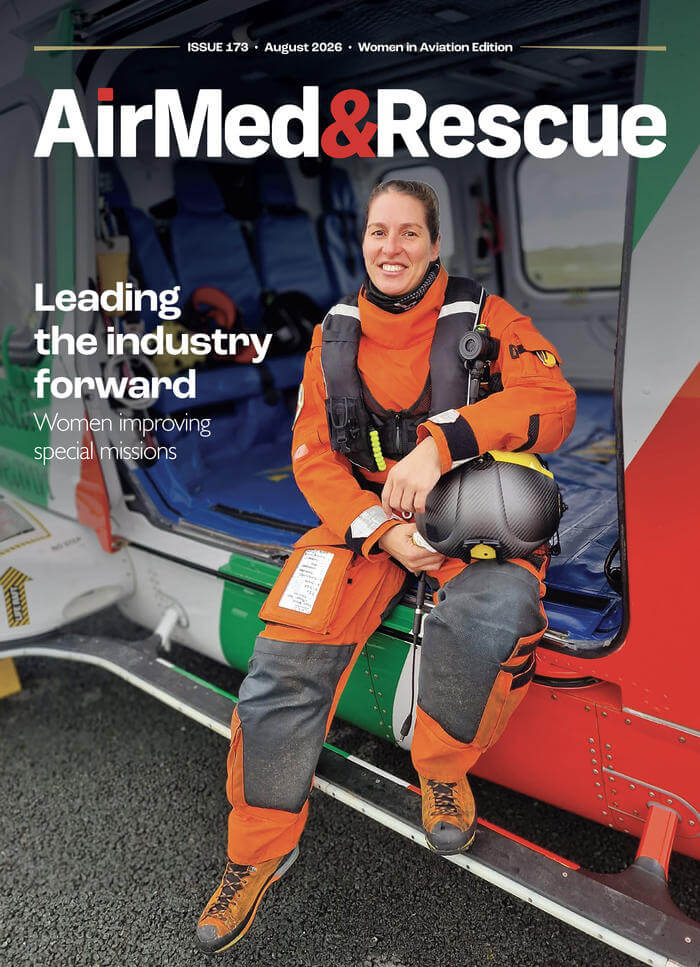
August 2026
Issue
August is a special time of year, and it is my pleasure to present a special Women in Aviation edition of AirMed&Rescue. We have features on the importance of preventing and knowing the early signs of hoist spin; the leadership roles and the value of visibility of women in the industry; the inward-facing and external sensors improving special missions; and the variety and standards that flight suits have to meet.
Dr Kodey Bogart
Dr Bogart is a helicopter pilot, aviation safety leader, and expert in safety management systems (SMS) with experience spanning both military and civilian aviation. A former US Army Warrant Officer and Black Hawk aviator, she flew medical evacuation missions during Operation Iraqi Freedom and is a decorated combat veteran, having received two Air Medals and the Sikorsky Rescue Award.
She holds an Aviation Doctorate from the Florida Institute of Technology, a Master of Science in Aviation Safety with a specialization in SMS, and a Bachelor of Science in Aeronautics with a minor in Helicopter Safety from Embry-Riddle Aeronautical University.