
The evolution of pre-hospital trauma care

Air medical crews share with Lauren Haigh a global perspective on how modern technology and blood products are helping patient outcomes following physical trauma
Traumatic injury is a leading cause of death and disability worldwide. According to the World Health Organization (WHO), each year road traffic accidents are responsible for around 1.2 million deaths and 20–50 million injuries worldwide. WHO statistics also show that for people aged five to 29, road traffic injury is the leading cause of mortality. Helicopter emergency medical services (HEMS) and search and rescue (SAR) crews are often the first advanced medical providers on scene, and modern technology and blood products are improving patient outcomes before hospital arrival.
The evolution of trauma cases
A 2022 European study¹ looked at major trauma across 13 years and found that cases continued to increase significantly over time, rising by an average of eight extra patients per year. Similarly, a US study² compared trauma cases from 2018 to 2021 and found that cases increased each year over the four-year period. In Australia, LifeFlight transports around 8,500 people per year across Queensland. According to Dr Jeff Hooper, Medical Director, trauma accounts for 25% of all missions. “Most typically we see motor vehicle and motorbike accidents, falls from height, and rural accidents involving animals or farm machinery,” he explained. “Trauma as a percentage of retrievals has remained relatively constant despite improvements in road safety and vehicle safety.”
In the UK, as Air Ambulance Charity Kent Surrey Sussex’s (KSS’s) service capability has expanded to 24/7 operations, volume has increased and case mix changed. Jo Griggs, HEMS Paramedic and Head of Research and Innovation at KSS, said that demand had steadily increased over the past decade: “We’re now responding to over 3,000 jobs annually. The case mix has evolved and we attend complex polytrauma and time-critical medical emergencies. Moving to a 24/7 operation enables us to attend time-critical injury and illness around the clock.”
AirMed&Rescue also spoke with Shane Daw, General Manager at Westpac Life Saver Rescue Helicopter Service, to obtain a SAR perspective. He said that there had been a 45% increase in SAR incidents over four years and a 78% rise in mission taskings since 2018. “These range from coastal rescues and land searches to aviation crashes, floods, and disaster events,” he stated. Growing incidence and complexity of cases necessitates advanced clinical interventions, capabilities and equipment, as well as operational preparedness.
A representative for Weinmann Emergency Medical Technology explained how many factors, such as combat medicine, had affected the advances seen in trauma care, but big steps forward were now slowing down: “The conflict in Afghanistan occurred during a time when UK HEMS charities were really pushing hard to develop the doctor/paramedic trauma team operating model, allowing emergency anesthesia, emergency surgical techniques, and later blood product transfusion. Many of the battlefield learning was brought into civilian HEMS by the doctors and paramedics that also served in the military. This really accelerated learning in trauma care, to the point that now several published studies have demonstrated that advanced HEMS teams capable of these interventions have a meaningful impact on trauma outcomes."
Many of the battlefield learning was brought into civilian HEMS by the doctors and paramedics that also served in the military. This really accelerated learning in trauma care
Thomas Brydensholt, Director Distribution Sales at °MEQU, agreed that combat medicine had had an influence on modern civilian air medical practice: “User-driven innovation is the building block on which °MEQU stands. The °M Warmer was developed in close collaboration with the military and special forces, ensuring that it would meet users’ needs in everything from performance to design. A lot of focus went into finding the place where simplicity meets high performance. That means color-coded Luer locks, minimal parts to assemble, no buttons, a small priming volume, and blood warming in under 10 seconds. This limits mistakes and saves a lot of time in critical trauma care where there is not a second to spare.”
The Weinmann representative continued: “So, for trauma specifically, we seem to have reached a bit of a plateau of major development, and teams are focusing on marginal gains, like improving arterial access capabilities, and studies of whole blood instead of component parts.
“There is, however, a growing interest in medical cardiac arrest now, with new novel therapies showing some promise, so an increasing body of research now is looking at how to improve outcomes in medical arrest, which have been stagnant for many years. This has certainly been driven by innovations in medical equipment, including different approaches to delivering chest compressions and novel ventilation strategies.
“From an equipment point of view, no matter what the airframe being used, space is a premium, and so equipment that is small and light is always an advantage.
“As care develops and teams are capable of more complex interventions, the equipment they use must support ease of use, and portability to allow it to be carried to scene and also used in the multiple vehicles that may be used during an incident. HEMS teams often arrive by air but will travel in the back of ambulance service vehicles.”
Blood products and outcomes
A crucial factor is availability of blood products on HEMS and SAR aircraft to enable crews to stabilize patients and improve survival before hospital arrival. In the UK, KSS carries packed red blood cells, freeze-dried plasma, and fresh frozen plasma, supported by local transfusion laboratories and a volunteer blood delivery service called SERV Kent. “When we identify patients with life-threatening hemorrhage, our Code Red protocol allows us to begin transfusion at the scene,” Griggs reported. “Data from our service and others shows improved physiology and survival in this cohort.” KSS has also been a recruiting site for the SWiFT trial, investigating the role of whole blood in frontline trauma care. The study will explore the clinical and cost-effectiveness of pre-hospital whole-blood administration versus standard care for traumatic hemorrhage. “We await the results of this study to inform our future practice,” Griggs stated.
Blood and fluid warmers are needed regularly, depending on the region an air medical service covers. In large metropolitan areas, they’re used daily since trauma cases occur more frequently. In rural areas, they’re equally vital because long transport times make rapid blood transfusions essential for many trauma patients
The rise in need for fluids to be administered to trauma cases is something that °MEQU has seen: “Blood and fluid warmers are needed regularly, depending on the region an air medical service covers. In large metropolitan areas, they’re used daily since trauma cases occur more frequently. In rural areas, they’re equally vital because long transport times make rapid blood transfusions essential for many trauma patients,” said Brydensholt.
LifeFlight has carried blood products since 2002. Today, its aircraft carry four units of packed red blood cells and fibrinogen concentrate, stored in temperature-controlled transport systems. “Provision of blood is a game-changer for our trauma patients, who are often in remote locations or in rural hospitals without blood supply. In the past 12 months alone, we administered blood to 240 patients, using more than 500 units,” stated Dr Hooper. LifeFlight is also participating in the ROUGE (Early Fibrinogen Concentrate for Major Traumatic Haemorrhage) study, which is a pre-hospital trial of fibrinogen concentrate for bleeding patients. The goal of the study is to evaluate the real-world impact of carrying and administering fibrinogen, thereby filling a knowledge gap concerning the early use of fibrinogen in the air medical pre-hospital environment.
AirMed&Rescue also spoke with Dr Mike Peddle, Associate Medical Officer of Canada-based Ornge. He said that the service carried two units of O-negative, Kell-negative blood and was currently evaluating whole blood use through a trial at one base. By participating in these blood trials, air medical services are actively influencing the next generation of trauma care protocols, helping inform decisions around the carrying, transfusion, and logistics of blood products.
Carrying blood constraints
Despite the crucial role of pre-hospital blood products in modern trauma care, logistical and operational complexities around carrying blood products present challenges, including regulatory requirements, aviation certification, and cold chain management. Griggs explained that cold-chain integrity was the primary challenge. “It’s the biggest logistical challenge as blood products need to be stored at specific temperatures and have limited shelf life,” she confirmed. “We rely on close coordination with transfusion laboratories, SERV, and our aviation supplier to ensure compliance and safety.”
Cold chain management is also a challenge and priority for LifeFlight, along with Queensland and Australia-specific logistics and regulations that must be navigated. “The logistics of blood carriage in Queensland include that helicopter bases are remote from blood banks, requiring establishing and maintaining a system of blood fridges that need constant monitoring,” said Dr Hooper. “Transport of blood and products has regulations covered under Australian aviation standards. Blood is a precious resource and maintaining a cold chain of blood packaged in specialized cool transport LifeBoxes is a priority for LifeFlight.”
The logistics of blood carriage in Queensland include that helicopter bases are remote from blood banks, requiring establishing and maintaining a system of blood fridges that need constant monitoring
At Ornge in Canada, aircraft performance considerations are central, as Dr Peddle explained: “Weight and balance, particularly in fixed-wing operations, is a major factor. Additionally, we need to maintain compliance with blood storage, reporting, and regulatory requirements across multiple bases and a provincial operation.” Indeed, the safe carriage of blood requires balancing clinical priorities with regulatory standards and logistical feasibility.
The importance of not wasting the vital fluids and the time to administer it is huge, so getting it up to temperature from the cold storage is an impotant factor, explained Brydensholt: “The °M Warmer’s battery can deliver up to 2L of body-temperature whole blood on a single charge. If more is needed, simply swap the battery to continue the transfusion. While the volume of blood is no doubt crucial, other factors matter just as much. In cases of hemorrhage, you need a blood warmer that warms instantly and has a very fast setup. Reliability and speed are some of the things that the °M Warmer can gift you along with large warming capacity.”

Key tech and equipment
There are core capabilities required for managing major trauma in the field, necessitating specialized equipment and technology to safely and efficiently stabilize patients. Dr Hooper explained that LifeFlight operated with a standardized primary trauma pack across its fleet. This includes advanced airway tools such as video laryngoscopy; high-performance suction and surgical airway kits; vascular access options including intraosseous access; hemorrhage control tools such as hemostatic dressings, tourniquets, pelvic binders, and femoral splints; maxillofacial stabilization equipment; and blood delivery systems with warming capability.
At KSS, additional emphasis is placed on diagnostic and ventilation technologies. “Pre-hospital ultrasound, advances in airway management such as video laryngoscopy, and transport ventilators following pre-hospital emergency anesthesia have all helped us manage serious trauma,” highlighted Griggs. KSS has also explored live video transmission from scene to support clinical decision-making and innovation in partnership with academic institutions.
Daw noted that, for SAR teams, equipment selection was influenced by versatility and speed: “Over the years, the development of our equipment has enabled more timely interventions. For example, we can apply a defibrillator, provide oxygen, and deliver pain relief quickly – all of which improve treatment and increase the chance of survival. At the same time, training and techniques have evolved to ensure crews are skilled to provide emergency life support in challenging conditions,” he commented. “When we go down to a patient, we take everything we need in one go – emergency medical pack, oxygen, defibrillator, and pain relief. Going back to the aircraft isn’t always an option.”
When we go down to a patient, we take everything we need in one go – emergency medical pack, oxygen, defibrillator, and pain relief. Going back to the aircraft isn’t always an option
Technology on board is a vital area that Weinmann is interested in, and the ability to improve conditions via accessibility is an important consideration, explained the company’s representative: “Size and simplicity are becoming key attributes for HEMS teams, along with access to data and connectivity. Improvements in patient databases enable researchers to work more effectively. HEMS teams and equipment manufacturers need access to operational data to see how the equipment is being used. This allows them to identify ways to further improve its application.”
Efficiency and accessibility is also a factor in air medical treatments closely considered by °MEQU. “When a rescue team reaches the point of injury, they have many critical tasks to manage quickly. If the patient is bleeding, transfusing blood and IV fluids is a top priority,” said Brydensholt. “The °M Warmer gives them the ability to deliver emergency room-level transfusions in the field to help prevent hypothermia. Its minimalistic design lets first responders focus on the patient rather than the equipment. With minimal setup and an adhesive patch that attaches near the infusion site, the °M Warmer stays out of the way and can easily remain with the patient from the field all the way to definitive care. Additionally the simple design ensures minimal training and re-training is required to implement the warmer in existing transfusion protocols.”
Regulatory influences and compatibility are also having an impact on the technology for providing better trauma care, added the Weinmann representative: “Beside the size and weight of medical equipment, logistics like intelligent power and oxygen supply are becoming more important. On the manufacturing side, we see a big impact due to changing regulations like the MDR [the European Union’s Medical Device Regulation] and other norms. We also see a high demand for cooperation between emergency medical technology companies and helicopter/aircraft cabin manufacturers in order to advance issues such as mechanical connectivity, user-friendliness, emissions such as EMC [electromagnetic], and mechanical integration.”
Training, now and forever
Training has evolved alongside growing equipment complexity and operational demands. Through simulations, structured education and continuous skills development, HEMS and SAR teams ensure that they are able to effectively use equipment and safely manage critically injured patients in challenging environments. At LifeFlight, orientation for new doctors focuses heavily on pre-hospital trauma. “Training involves a series of trauma simulations that gradually increase in complexity,” said Dr Hooper. “Most are deliberately low-tech. The emphasis is on teamwork, decision-making, and performance under pressure.”
We continue to evolve our prevention and education efforts to provide structured education led by senior and experienced colleagues within pre-hospital care
For the KSS team, training is embedded within a structured governance framework. “We continue to evolve our prevention and education efforts to provide structured education led by senior and experienced colleagues within pre-hospital care,” outlined Griggs. “Simulations cover low-frequency and high-acuity scenarios, and we have the privilege of using a dedicated replica aircraft training platform at our base. Technology assists through careful video review of personal cases as a one part of the debriefing process, alongside formal clinical governance.”
Dr Peddle said that Ornge placed emphasis on continuous learning. “We continually monitor trauma cases and clinical delivery,” he stated. “We combine high- and low-fidelity simulation to maintain skill competency and give frontline staff regular opportunities to practice.”
The Weinmann representative explained that training was important, but so was ease of use to ensure simplicity and accuracy when using tools to help a patient suffering trauma, especially in a time-critical, challenging, and workload-saturated situation: “Ease of use is one aspect, but the rapidly changing environmental conditions in HEMS, such as ambient pressure, temperatures, etc., are also taken into account in the requirements for our ventilators. We also put a lot of effort into developing mounting solutions that are as flexible as possible and can be used from the user’s seat or from other angles, depending on the situation during the mission.
“Education and training are essential for the correct use and safety facing the limited resources on board. That’s why we focus a lot on the usability of our devices and the alarms, as we are aware that our devices are not the only ones used in the aircraft and they work on complex cooperation with a lot of other applications.”
Tomorrow’s innovations
Clinical evidence and operational innovation continue to drive forward pre-hospital trauma care, and blood carriage and transfusion strategies are a key focus. In Australia, LifeFlight is exploring the storage and use of whole blood in the air medical environment, as well as the potential role of vasopressors in trauma management. “Innovations in pre-hospital trauma include defining the best transfusion strategy, particularly the potential for storage and use of whole blood in the Australian setting, exploring the utility of vasopressors in trauma, improved trauma training, and utilization of technology such as VR,” commented Dr Hooper.
Supporting access to the latest technology for simple and fast delivery of blood products and IV fluids is a priority for °MEQU, explained Brydensholt: “Keeping healthcare professionals equipped with reliable, high-performance tools, as pre-hospital care continues to evolve, is at the heart of °MEQU. Right now, our focus is on advancing blood and IV fluid warming technology. This includes expanding into new markets while continuing to support our existing customers. We place strong emphasis on service, ensuring that every user gets full value from our solutions. Fast delivery and a smooth implementation process are also key priorities so first responders can integrate the technology quickly and effectively.”
In the UK, advances in data linkage and targeted dispatch have huge potential to improve operational efficiency and patient outcomes. Griggs highlighted that structured pre-hospital data would allow teams to understand patient needs regionally and nationally, enabling earlier delivery of the right interventions. “Pre-hospital data linkage will help support UK pre-hospital teams to further understand the needs of our patients, both within the region and nationally,” she highlighted. “Innovations that improve targeted dispatch allow us to reach or deliver appropriate interventions earlier, and focused research on appropriate interventions in both trauma and non-trauma patients will all help us to improve patient outcomes.”
Pre-hospital data linkage will help support UK pre-hospital teams to further understand the needs of our patients, both within the region and nationally
The Weinmann representative said that there were a few ways that future trauma care could be enhanced, especially with regard to ventilation: “Successful pre-clinical trauma care and, consequently, better outcomes for patients depend, among other things, on correct and rapid oxygenation. In combination with blood transfusions at the scene, the use of a ventilator is an important measure for implementing this therapeutic step in a controlled and efficient manner. This ensures that the patient receives an optimal supply of oxygen. Once the ventilator is connected, it relieves the burden on staff and frees up capacity for further measures.
“Securing the airway can also be made considerably easier through the use of innovative video laryngoscopes, as these facilitate endotracheal intubation even under extremely difficult conditions. Our ventilators are quick and easy to use. Nevertheless, as with other measures, their use should be practiced. Train it, trust it, and use it on the scene!”
From a SAR perspective, Daw said that one focus was on enhancing communications to coordinate care more effectively across stakeholders. “This is a critical area,” he explained. “Further developments with aircraft-to-ground crew and interagency communications will assist in providing the best care possible.”
These ongoing advancements, combined with existing protocols and technologies, will ensure that air medical teams can continue meeting the growing need for trauma care in the sky.
References
Hardy BM, King KL, Enninghorst N, Balogh ZJ. Trends in polytrauma incidence among major trauma admissions. Eur J Trauma Emerg Surg 2024;50:623–626
Garcia A, Walter D, Chan HK, et al. Changes in adult trauma at a level 1 trauma center before and during the COVID-19 pandemic. JEM Rep 2023;2:100024
April 2026
Issue
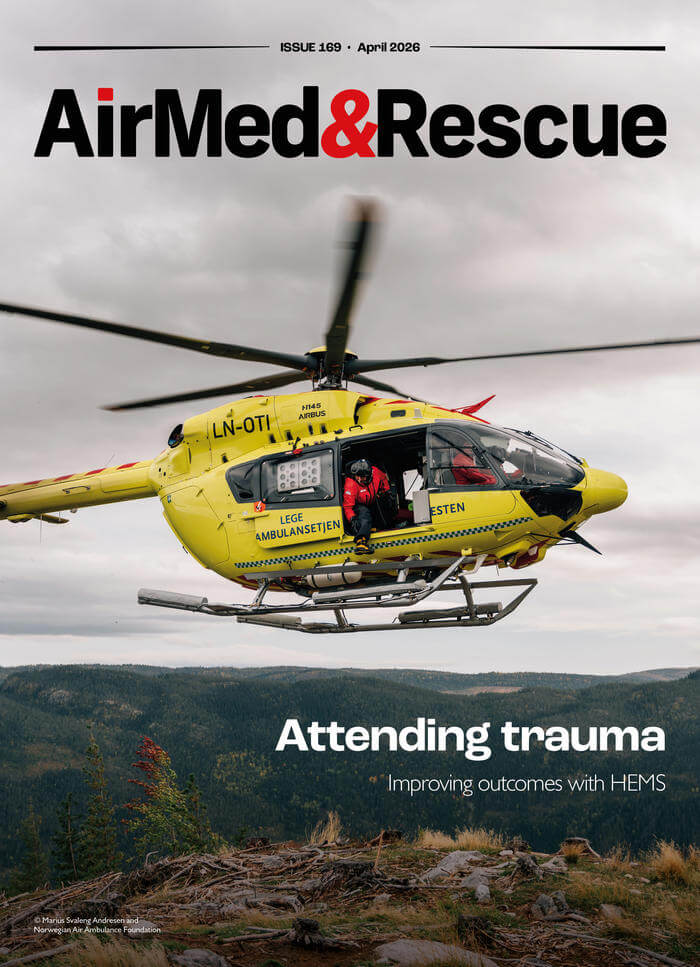
Launching into spring, we have another great edition covering the world of airborne special missions. We have features on the European approach to aerial firefighting; how maintenance, repair, and overhaul companies are still managing the complex supply chain environment; neonatal transfers in regions that are not conducive to easy ground transport; and how helicopter emergency medical services deal with attending to traumatic accidents and injuries.
Lauren Haigh
Lauren has worked in the publishing industry for eight years and reads and writes about healthcare, science and travel insurance on a daily basis. Her favourite aircraft is the plane from the title sequence of British educational children’s TV series Come Outside.